Bizet: Clovis and Clotilde
Let me start with Bizet's Te Deum, the secondary work on this program. If you enjoy the confident striding of Verdi's Anvil Chorus, this sacred setting for chorus and orchestra will be for you.
Each of the four movements have their own
Only the last movement, put into a more serious minor key with fugal and imitative treatments, avoids the operatic label. However, Bizet can't help but add some glitz and spectacle at the very conclusion, so buckle in. Really this reminds me of something akin to Poulenc's Gloria or Gounod's St. Cecilia Mass, two works which hang upon high and quirky spirits. The vocal treatment is similar to any of Rossini's sacred works for chorus and orchestra as well, with no hidden attempts to hide musical secularisms. A bit banal, yet with scads of fun!
The great news in this recording regards the Choeur Regional Nord – Pas-De-Calais, a choral ensemble I was hitherto unfamiliar with. They are solidly confident across all parts, but listen to those altos; they almost outshine their soprano counterparts, a rather unheard-of choral relationship.
There are actually a couple of recordings of Bizet's Te Deum in the books already. One on Profil with German performers, and another from Jesús López-Cobos at the podium leading the Suisse Romande. Both of these other recordings pair Bizet's Te Deum with the Gounod or Poulenc works mentioned earlier, natural recording partners, I think. I can heartily recommend this one on Naxos with French performers, though. Color me impressed by the chorus in particular.
The vocal cantata Clovis and Clotilde is a solo vocal cantata written as a submission for the Prix de Rome, and is one French conductor Jean-Claude Casadesus has previously recorded leading this same orchestra from Lille, with the insurmountable soprano Montserrat Caballé on hand.
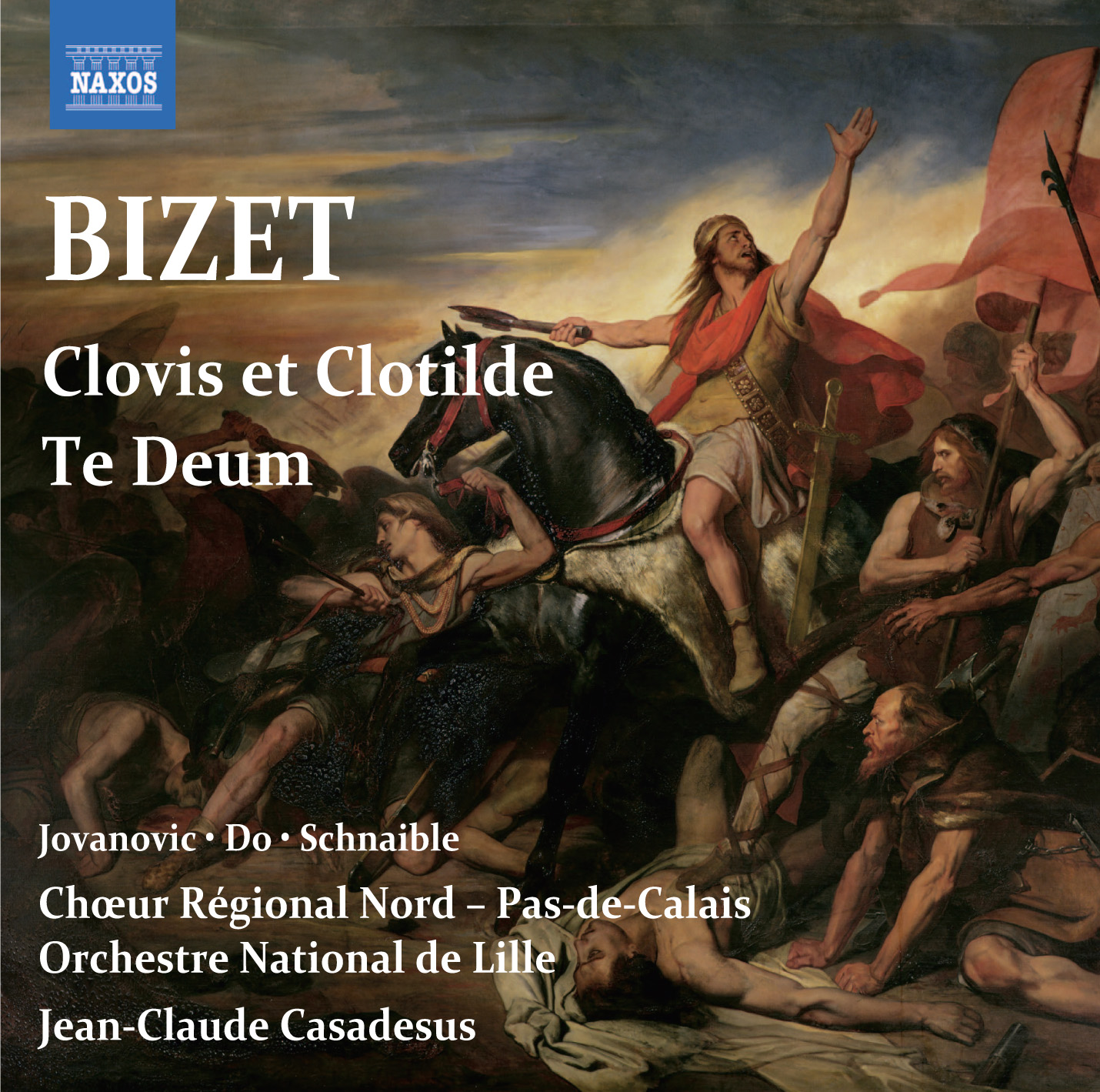
Clovis is a French king from the 400s AD, considered the first ruler to bring together Gaul. Clovis and Clotilde is an opera scena dealing with Clovis' victory at the Battle of Tobliac, which he attributed to the Christian God in a time of widespread heathen Gods, the former his wife's religious influence.
Bizet's music is again peppy and upbeat, even before Clovis returns from the war. A priest joins in on the singing as the two await the King's return, thus this 30-minute scene is for a solo vocal trio without chorus. Aside from a lovely aria aside harp, I don't know that anything is especially memorable here, however like the Te Deum, there is nothing but smiles in this music and for the listener.
Enjoyment will mainly lie upon personal preferences for the singing voices, and I remain undecided. The soprano Jovanovic has a large voice which becomes pinched in its upper reaches, but I don't find it necessarily off-putting either. So too the bass Schnaible, whose vibrato is at times too wide, but again, not distractingly so. I think I enjoy tenor Philippe Do more, although he can be inconsistent too.
I can't comment on Casadesus' earlier recording of Clovis and Clotilde, but the orchestra is excellent here on Naxos, the same one from the 90s Erato recording, but 20 years later. What I can comment on is the wonderfully fizzy performance of the work on Bru Zane, although it is locked within a 4CD portrait of rare Bizet music (BLOG). I consistently find that label's musical explorations to be of the very highest quality, and remains so in Clovis and Clotilde.
On this Naxos recording under review, the song texts are not found in the physical media liner notes, but rather on the Naxos website. A minor inconvenience. Otherwise, this is a perfectly fine way to hear little recorded music from Bizet.
Works
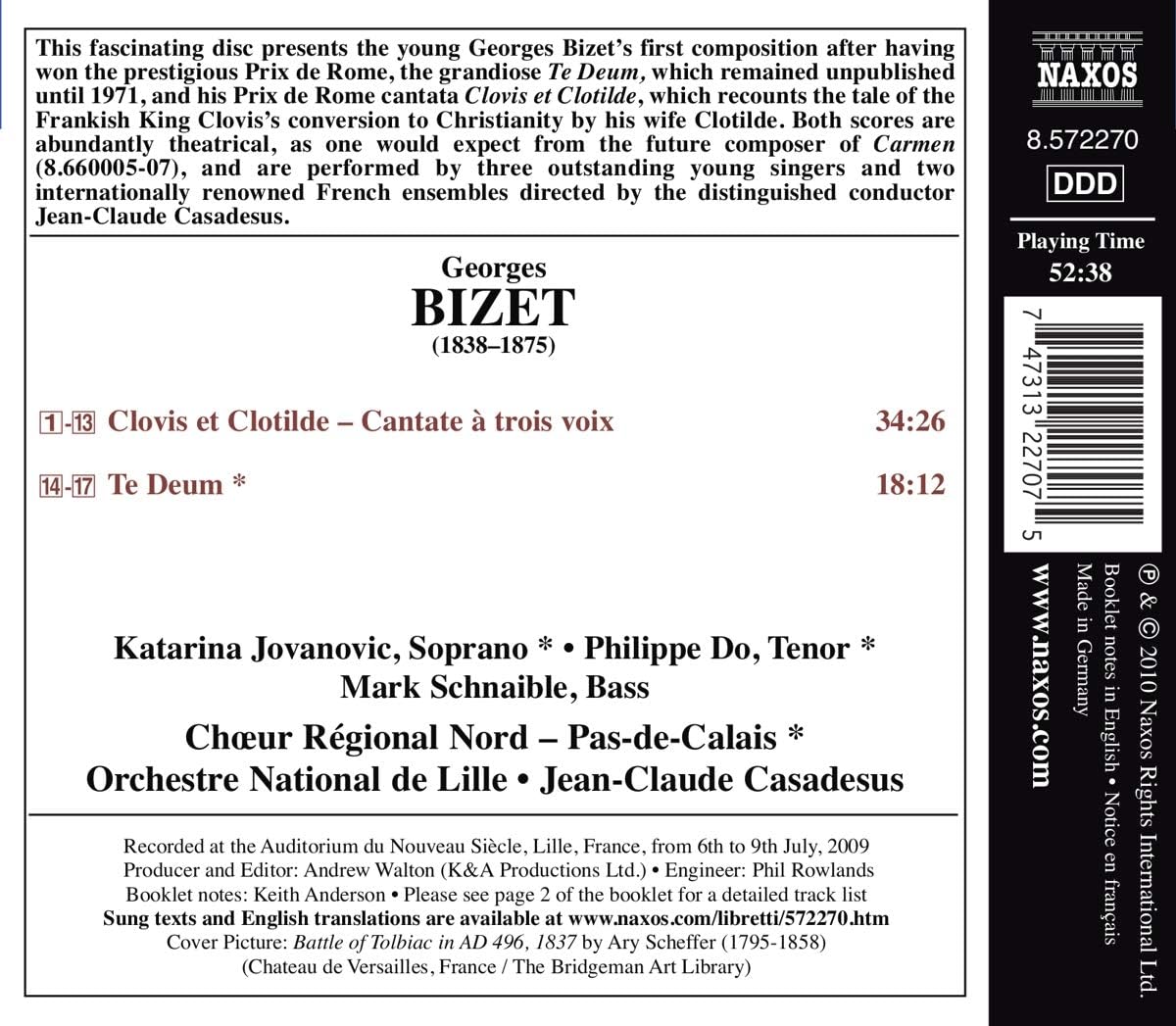
Clovis et Clotilde (34.26)
Te Deum (18.12)
Ensembles
Chœur Régional Nord – Pas-de-Calais
Orchestra National de Lille
Jean-Claude Casadesus, conductor
Label: Naxos
Year: 2010
Total Timing: 52.38
It is great to get to know these little known works from Bizet, but particularly the Pas-de-Calais Chorus and the Te Deum.
Clovis and Clotilde will please nor not depending on individual listener's tastes in vocal soloists. These are fine, if not the most spectacular trio.

Comments
Post a Comment