Liszt: Cantatas
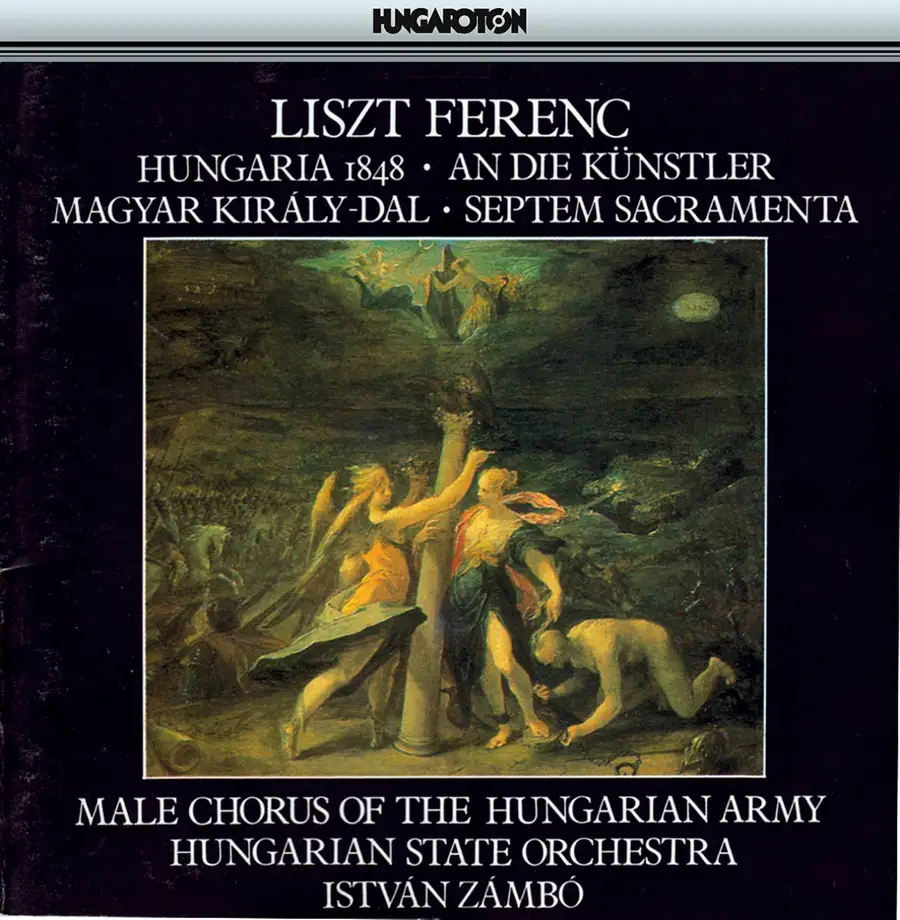
Failure for publication seems to be the theme of this recording, in what I would call a program of secular and sacred cantatas, at least for lack of a better term. If the liner notes are to be trusted, and why not, it seems each work was rejected for one reason or another, thus a sort of Liszt-ian historical throughline runs across each piece.
The first three one-movement works are composed for chorus with orchestra, while the last seven-part work comes with pipe organ accompaniment only.
The Hungaria Cantata of 1848 is filled with patriotic fervor and political zeal, an aspect which is shared with the much shorter Hungarian Royal Hymn (Magyar király-dal). A militaristic texture comes across in the cantata, if nothing else than for the snare drum, bass drum, triangle, and male chorus combination. A burly, nearly operatic baritone solo only adds to such feelings as a listener, later taken over by solo tenor and soprano. The short hymn adds female choral singers, giving the music a more worldly touch amongst the full orchestration.
I would imagine the political commentary of independent Hungary had something to do with these two pieces not being published. However, I can't imagine political pressure being the cause of dismissing Liszt's ode to Friedrich Schiller in An die Künstler. Perhaps it wasn't...
Here, the men's chorus sounds like it comes from a typical male partsong society, bestowing felicities upon a renowned poet through song. A quartet of male soloists echo and bandy with the male choir throughout, an effect which becomes a little tiresome after a while, although Liszt keeps things lively through unusual harmonic motion and orchestrations.
The thematic material is very tight in these secular cantatas, making listening and following along with Liszt's music quite easy.
Septem Sacramenta is a different kettle of fish altogether. Seven choral responsorials, to be sung during the administration of the Seven Sacraments, are functional pieces for church use. Akin to the Szekszárd Mass I recently heard from Liszt, the pipe organ plays a minimal supportive role with a few moments to itself here and there, but often absent for long portions, occasionally only ringing out with a single chord to keep the singers in key.
This choral music is more stark sounding, reminding me of Zoltán Kodály Missa Brevis in addition to the earlier Liszt Mass mentioned earlier. The singing is beautiful though, where the robust martial singing of the male chorus in the above secular cantatas is heard rather sensitively here.
Twists of harmony place Liszt's music firmly in the Romantic Era, however it is plain to my ears that the composer is looking to the musical past in this work (sometimes using older church modes), with strains of what sounds like plainchant existing across the music, harmonized by Liszt or no. The music is otherwise plain and sparse, with Liszt continually stopping and starting with many pauses, leaving this listener somewhat restive. Of course, I don't believe any of these seven choral pieces were meant to be heard as a set for concert, so it might make a difference to get to know each movement individually.
Liszt does employ the occasional vocal solo, plus a return of female sections to the choir in some areas. While the soloists could veer towards Eastern-European qualities in the secular cantatas above, most sound out as intimately chaste here, and affably so. It is good to hear a wide range of abilities coming from all of these singers.
Surprisingly, this program isn't a compilation of earlier performances ported over from Hungaroton's 60s/70s Liszt Choral Works LP series. Rather, this recording was issued in 1991, although no mention is made of a performance date. Either way, the Hungaroton sonics are excellent.
The music itself should appeal to those who need to listen to every corner of Liszt's oeuvre, although its pleasure beyond those confines will depend on the individual. What I can say is the singing is superb, ably captured by the engineering team.
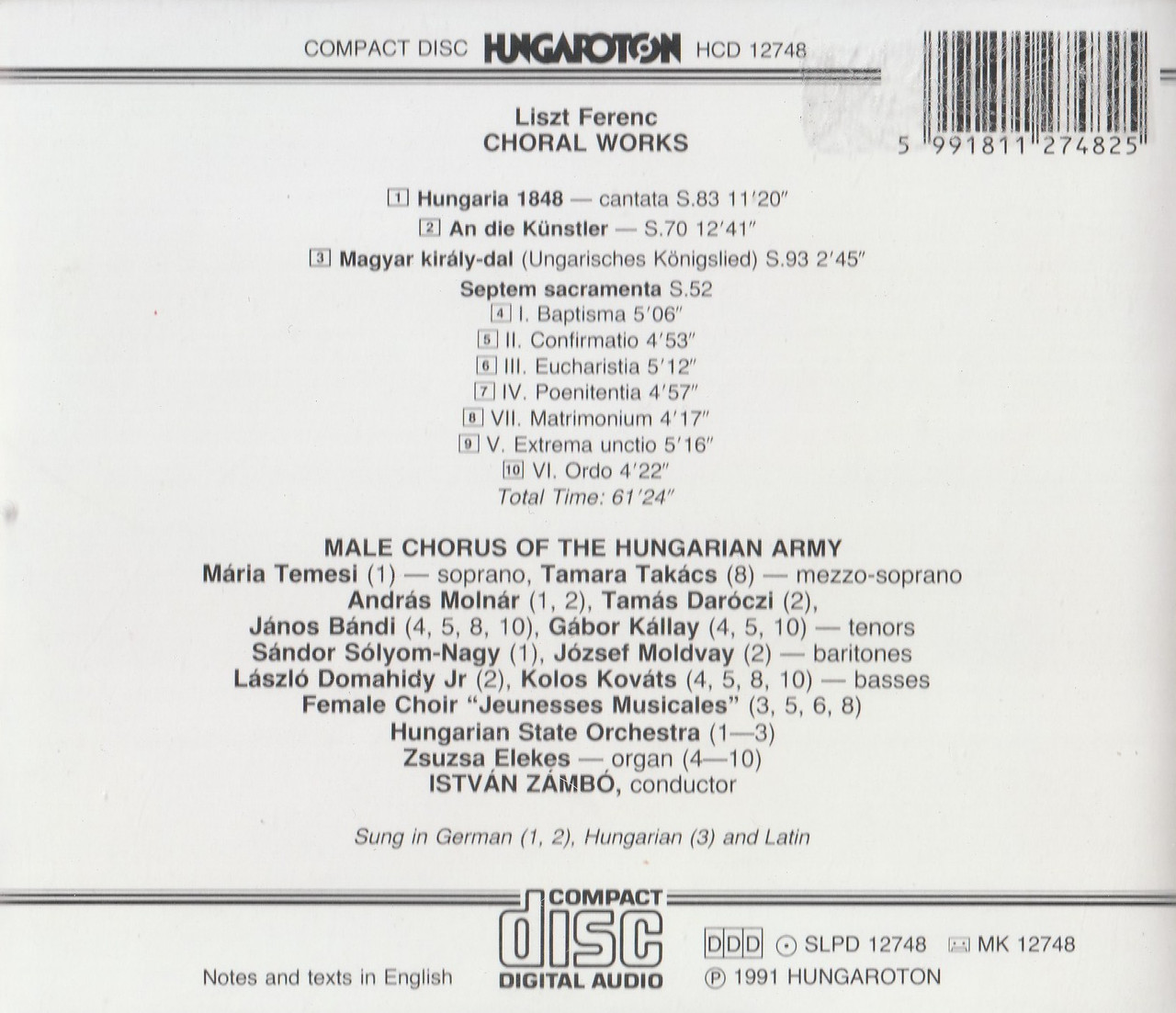
Works
Hungaria Cantata 1848, S. 83 (11.20)
An Die Künstler, S. 70 (12.41)
Hungarian Royal Hymn, S. 93 (2.45)
Septem Sacramenta, S. 52 (34.03)
Soloists
Hungaria 1948
Mária Temesi, soprano
András Molnár, tenor
Sándor Sólyom-Nagy, baritone
An Die Künstler
András Molnár, tenor
Tamás Daróczi, tenor
József Moldvay, baritone
László Domahidy Jr., bass
Hungarian Royal Hymn
Az Ifjú Zenebarátok Női Kar, female choir
Septem Sacramenta
Tamara Takács, mezzo-soprano
János Bándi, tenor
Gábor Kállay, tenor
Kolos Kováts, bass
Az Ifjú Zenebarátok Női Kar, female choir
Ensembles
Cantatas & Hymn
Hungarian Army Male Chorus
Hungarian State Orchestra
István Zámbó, conductor
Septem Sacramentum
Hungarian Army Male Chorus
Zsuzsa Elekes, organ
István Zámbó, conductor
Label: Hungaroton
Year: 1991
Total Timing: 61.24
Another Hungaroton recording seeking out little recorded choral music from a major Hungarian composer.
The orchestrated cantatas work better as whole pieces of music, while the sacred cantata is completely different, setting seven choral responsorials for the church.
Hungaroton's sound, on the other hand, is outstanding!
Find more Liszt recordings HERE!
Comments
Post a Comment