Stanford: Symphony 5
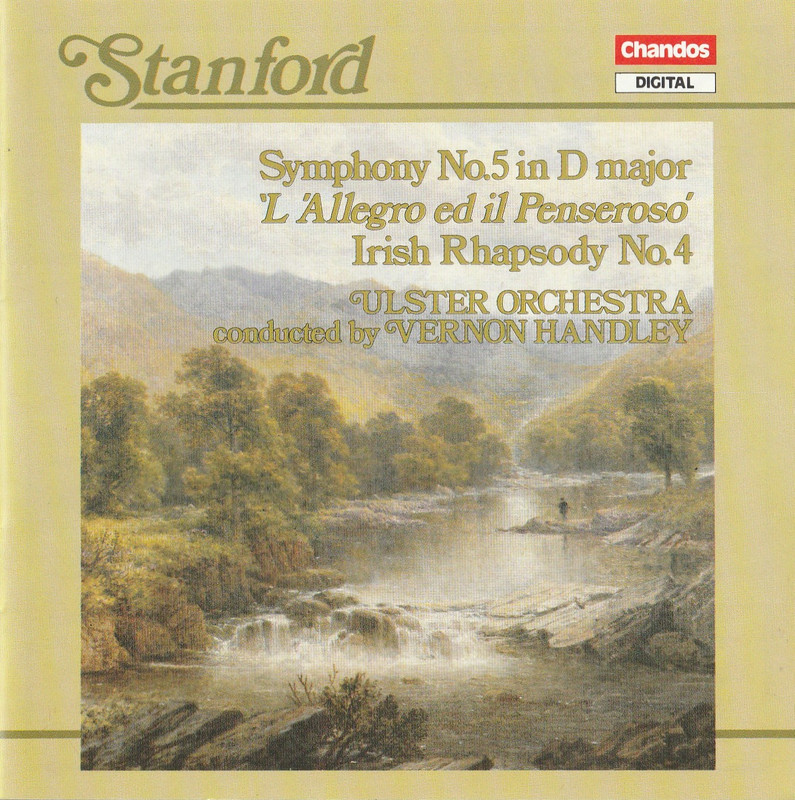
Charles Villiers Stanford's Symphony no. 5 in D Major is a work which simply gets better as the movements go on, at least in my opinion.
The first movement begins in musical strife, with Stanford taking a late-Romantic view to open his Fifth Symphony. When he finally arrives at the first theme of the movement, it is heroic ala Richard Strauss, while later this initial idea is contrasted with more pastoral musings. These three musical ideas are certainly well characterized, and later developed, while the movement itself isn't too lengthy either.
A gentle Pastorale follows in the second movement, complete with hunting horns and bass-line drones. If this section has a rural dance quality, the next Trio area drives ahead more furiously than the country dance allows. So too, a contrapuntal texture breaks up dance feeling, although Stanford continues the merriment despite the changes, only to return to the original musings.
The third-movement Andante begins with a noble string chorale, one which will be turned into a grand march much later on in the work. Stanford builds to a number of grand climaxes, each a little more grandiose than the preceding, making for a well-built movement. A contrasting area of bird trills in the winds gives the listener a brief time away from serious musical matters before Stanford returns back to business. If there was ever a time I felt the symphony was too expansive, however, it was this lengthier third movement, beautiful though it is throughout.
About midway through the fourth and final movement, a notable role for pipe organ enters into Stanford's Fifth Symphony. This will later boil into a big climactic moment, yet Stanford doesn't seem to want to create spectacle here, as Saint-Saëns would in his famous Third Symphony. Instead he utilizes the texture of the organ to supply color and a foundation to the orchestra, sometimes subtly, and at other times with force.
As to most of the fourth movement, it begins with the same sort-of strife the entire symphony opened upon, even if the musical material is different here. After this brief introduction, Stanford turns his matters to a minor melody which is rather effective. At louder decibels, the music sounds slightly swashbuckling to my ears; at faster speeds, I could imagine it becoming menacing and hectoring to some degree. A brass chorale introduces music which is more solemn and ceremonial, bringing to mind a more 'British' sound from Stanford, rather than the pervading German influence thus far.
Despite the heroic conclusion the listener expects, Stanford chooses to end his Symphony no. 5 in relative quietude, and not an unsatisfying choice at that. While the composer's Irish Rhapsody no. 4 in A minor may start plaintively in winds, this one is filled with adventure and surprises, perhaps related to the moniker 'The Fisherman of Loch Neagh and What he Saw'. There is a tale to be told here somewhere, and even if I don't know it, Stanford conveys the fishing tall tale with plenty of yarn-spinning magic.
Vernon Handley cycle of Stanford symphonies spanned the late 80s and early 90s. As this is an earlier recording, Chandos captures the Ulster Orchestra in a rather tubby acoustic. Surprisingly, this doesn't shear any of the orchestral color or detail; this is simply a noticeable recording choice. David Lloyd-Jones comes in a little quicker on Naxos, where Handley prefers a grand take on Stanford. I imagine the sonics are a little cleaner and the orchestra a little leaner than what we have on Chandos as well.

Works
Symphony 5 in D Major, op. 56 (42.55)
Irish Rhapsody 4 in A minor, op. 141 (18.28)
Performers
Ulster Orchestra
Vernon Handley, conductor
Label: Chandos
Year: 1988
Total Timing: 61.33
Symphony 5 in D Major, op. 56 (42.55)
Irish Rhapsody 4 in A minor, op. 141 (18.28)
Performers
Ulster Orchestra
Vernon Handley, conductor
Label: Chandos
Year: 1988
Total Timing: 61.33
Aside the fabulous Third Symphony from Stanford, this Fifth Symphony is probably my next favorite from the composer.
Yes, this is an expansive work, yet I think it builds upon itself rather marvelously, having led the listener on a satisfying symphonic journey from beginning to end.

Find more Stanford recordings HERE!
Comments
Post a Comment