Stanford: Symphony 3
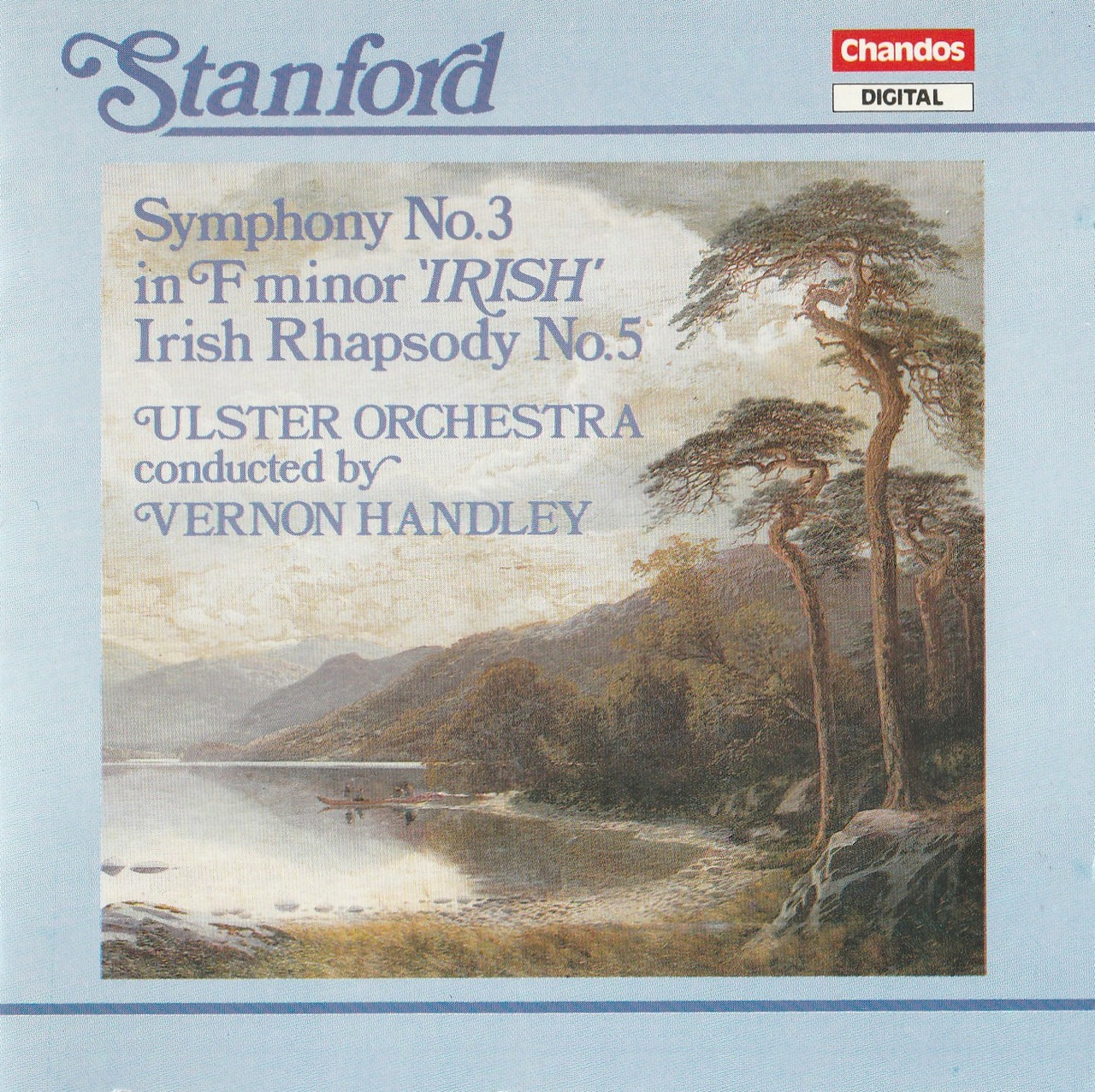
While there are musical elements present from his previous symphonies, pastoralisms and German Romanticism, my focus on Charles Villiers Stanford's Symphony no. 3 in F minor never veered towards styles or influences. Instead, Stanford presents the idea of pure absolute music in its best light, reserved for his first symphony to bear an Opus number.
I also detect less of the early German symphonists in Stanford's Third Symphony. Rather, this is fully Romantic music, probably best compared to Brahms in its studied structures. Once the brass show up as a concerted section in the first movement, the listener has their first glimpse into a 'British' sounding symphony, without a heavy feeling of Nationalism or folksiness usually associated with such notions.
Stanford places a Scherzo as the second movement, a form the composer is really making a name for himself in my mind. Furthermore, Stanford doesn't wholly rely on the titled minor key to make the Scherzo successful, instead utilizing a major tonality aside modalisms as the main thrust of this section. The Trio portion features a bit of metrical trickery, where the previous scurrying 9/8 melds into a broader 3/2 while still retaining the underlying Scherzo subdivision.
Again, the Scherzo bears some brass pomp, securing that aforementioned 'British' sound I mentioned above, while the Trio contains a remarkably uplifting melodic theme, one of the composer's finest I have heard thus far.
The first inkling I recognize regarding Stanford's subtitle 'Irish' comes in the third movement with the prevalence of harp and flute. It seems the first utterance of a melody even bears some Irish rhythmic qualities, even if the tune itself isn't borrowed, but instead wholly original.
If the third movement passes by without recognition of its possible Irish attributes, the fourth movement cannot escape such allusions. I do believe Stanford borrows actual Irish folksong here, two in fact, and gives the work a fun rhythmic profile for its finale amongst some modal harmonic qualities. My mind did wander to Vaughan Williams and Holst occasionally in this movement, and the effect is stirring for this listener.
This time, it is not the brass which bring to my mind a 'British' sound in the last movement, but rather a hardy string chorale playing over a plucked bass line. I only continue to mention these moments, for Stanford's compositional colleague Sir Hubert Parry had so few British-isms in his symphonies, I pounce upon any opportunities I can to identify a burgeoning 'British' sound from the composer.
Released in 1987 and recorded a year earlier, I believe this was the first volume of Stanford symphonies which Chandos released. Indeed, the acoustic sounds a little watery for my liking, perhaps Chandos' first effort attempting to rein in Ulster Hall for this series. Despite the hall resonance, the sound is nicely detailed, where I can identify smaller, subtler sections of the orchestra with relative ease.
While Vernon Handley and the Ulster Orchestra here on Chandos times closely in Stanford's Irish Symphony with David Lloyd-Jones leading Bournemouth on Naxos from the late 2000s once again, an early 1980s performance from Norman Del Mar on EMI moves at a much broader pace for those looking for a diverse approach.
Handley provides Stanford's Irish Rhapsody no. 5 in G minor for a substantial extra to the recording. This 14-minute work builds upon the final movement from the Third Symphony nicely, for there is a further martial, dare I say militaristic, quality to the music. Opposite this, there are chamber-music moments with solo strings and winds offering some textural variety. This is in addition to the native Irish qualities present, be they melodic, rhythmic, or harmonic. A stirring conclusion to the program, for sure.

Works
Symphony 3 in F minor 'Irish', op. 28 (41.29)
Irish Rhapsody 5 in G minor, op. 147 (14.25)
Performers
Ulster Orchestra
Vernon Handley, conductor
Label: Chandos
Year: 1987
Total Timing: 56.02
Symphony 3 in F minor 'Irish', op. 28 (41.29)
Irish Rhapsody 5 in G minor, op. 147 (14.25)
Performers
Ulster Orchestra
Vernon Handley, conductor
Label: Chandos
Year: 1987
Total Timing: 56.02
This is the first of Chandos' Stanford series which I found to be an unequivocal musical success from the composer. Stanford lures me in, not with musical style or early influences, but based on his pure absolute music alone.
Of course, those looking for a little more can find Stanford's love of Ireland in both of the works on offer.

Find more Stanford recordings HERE!
Comments
Post a Comment