Stanford: Symphony 2 & Clarinet Concerto
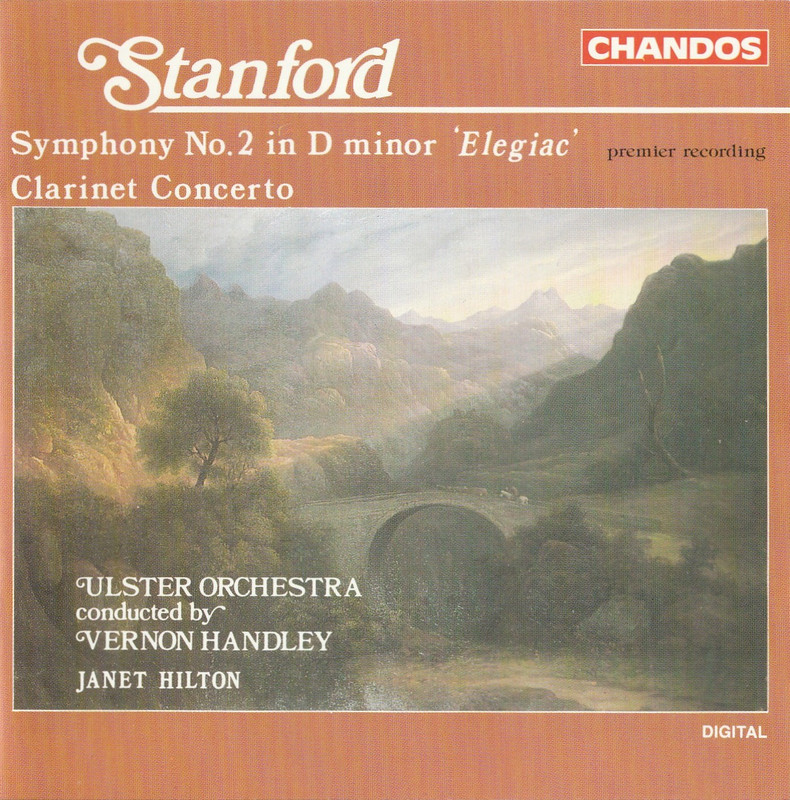
Charles Villiers Stanford did not allot an Opus number to either his First or Second Symphonies. This leads me to believe he didn't have much faith in his earliest symphonic works, although I have found both to be remarkably assured.
Once again, I am reminded of the early Romantics Mendelssohn and Schumann in the first movement of Stanford's Symphony no. 2 in D minor, and even moreso, across the entire work. The occasionally stormy outbursts of orchestra and timpani bring to mind Beethoven even stronger than the others I mentioned, not a bad influence to have in an early symphony. Having been written in 1880, however, makes the music lie on the conservative side though, even if such qualifications do not necessarily lessen the impact of the symphony for this listener.
The broad Lento of the second movement is rather lovely, with oodles of appoggiatura and retardation sigh motives. These non-harmonic tones keep the music graceful, with a few moments of nobility from the brass. Otherwise, it is the strings and winds who are the feature players here.
I was not overly enthusiastic regarding Stanford's Ländler in his First Symphony, but the composer nails the third-movement Scherzo this time around. It is skitterish and rhythmic in all the right ways, well contrasted with the hymn-like Trio section, and altogether aided by the minor key of the symphony. The concluding brass chorale is an excellent surprise for the listener, making for one of Stanford's most characterful symphonic movements thus far. Then again, I am always a sucker for a good Scherzo.
The last movement retains the seriousness of the opening, with a mix of dark clouds and moments with shafts of light trying to burst through. Stanford is obviously trying to set up a symphonic struggle of some sort; I am not sure it completely works, but I appreciate the effort for something more complex.
While most of the individual Chandos Stanford symphony releases are paired with one of the composer's six Irish Rhapsodies, the Second Symphony is here paired with his Clarinet Concerto in A minor, a nice inclusion on the part of the performers.
The jury is still out on how I exactly I feel regarding the concerto, though. The first movement is less melodic than it is a brief musical statement which moves ever forward, with the clarinet rarely ever receiving a break. The middle and final movements improve upon the opening, although I still find little to hook onto overall.
I do enjoy the orchestral portions of the Clarinet Concerto quite a bit however, which seem more intensely Romantic than Symphony no. 2 ever attained, opposite the clarinet trying to find a pastoral middle ground whenever it enters. Curiously, Standford brings back the opening storms of the first movement into the start of the third movement, only to leap off into something a little more playful and virtuosic for the clarinet.
British clarinetist Janet Hilton recorded quite a bit for Chandos, with a few other performances of hers found across EMI, ASV, and Naxos as well. Her tone is full and strong, with plenty of smooth clarinet liquidity to her sound. Hilton is ideally balances with the orchestra.
Recorded around Stanford's First Symphony, Vernon Handley and the Ulster Orchestra are equally beautiful, capping off their series of Stanford symphonies with his first symphonic utterances. Again, Handley and David Lloyd-Jones are quite similar in movement timings, although Handley and Hilton make the middle movement of their Clarinet Concerto flow jollily forward in comparison to the competing Naxos recording.

Works
Symphony 2 in D minor (35.32)
Clarinet Concerto in A minor, op. 80 (19.16)
Performers
Ulster Orchestra
Vernon Handley, conductor
Label: Chandos
Year: 1991
Total Timing: 54.58
Symphony 2 in D minor (35.32)
Clarinet Concerto in A minor, op. 80 (19.16)
Performers
Ulster Orchestra
Vernon Handley, conductor
Label: Chandos
Year: 1991
Total Timing: 54.58
While I am not enamored with Stanford's Clarinet Concerto as a whole, his Second Symphony is a solid effort, often conjuring up the influences of Beethoven, Mendelssohn, and Schumann.
The performers and the Chandos sound are exquisite.

Find more Stanford recordings HERE!
Comments
Post a Comment