Liszt: Hungarian Coronation Mass
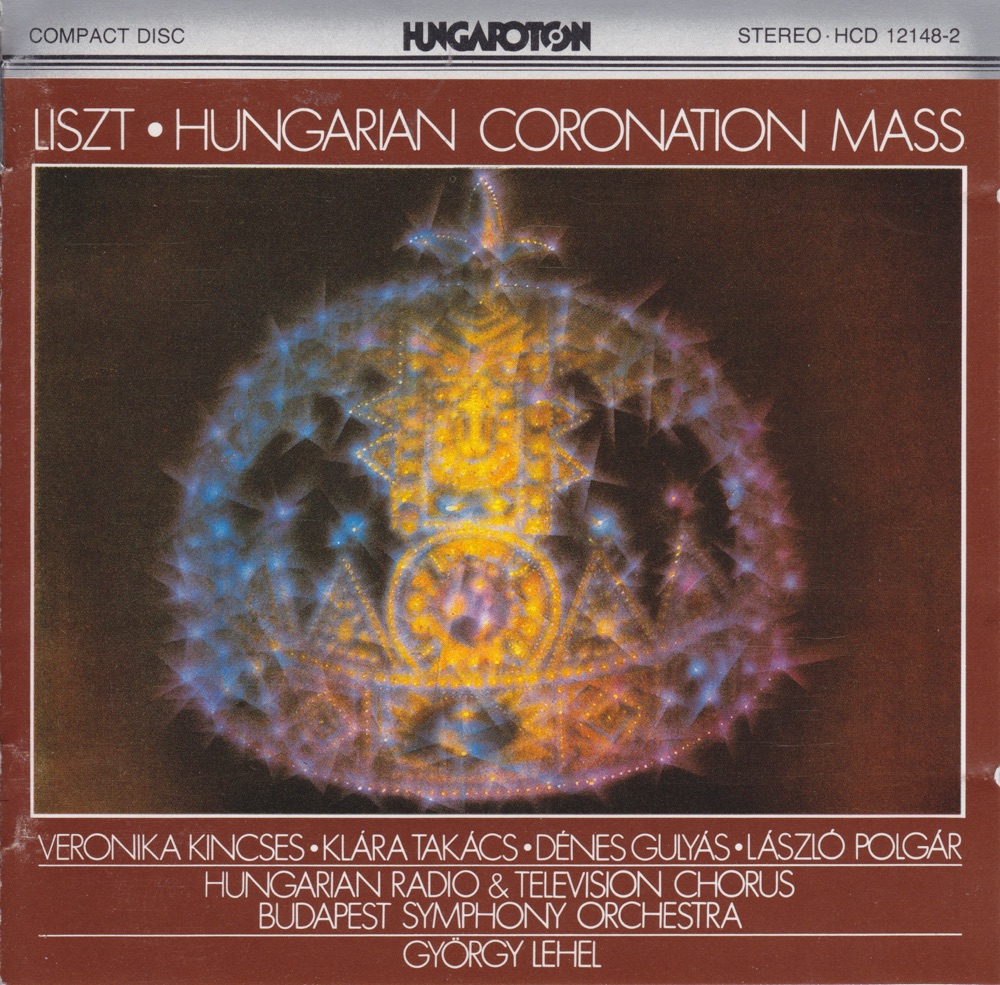
The liner notes imply Franz Liszt had to make some concessions in the way of orchestration and harmonic motion, as well as performance difficulty in his Hungarian Coronation Mass of 1867, I assume at the behest of the church or royalty. Such a statement makes me think this would be an austere work, much in the vein of other sacred choral works by Liszt, but such choices end up more complicated upon hearing.
The Kyrie is surprisingly forthright for a text which translates as more or less of a humble plea - 'Lord, have mercy'. The central 'Christ, have mercy' for vocal soloists rights the religious musical atmosphere some, but it is actually the return of the Kyrie text where the music finally finds the supplicative nature of the words, almost as if the composer has suddenly remembered what this portion of The Mass really means. Perhaps this could also be the musical bandying of a coronation occasion with that of a Holy Rite.
More appropriately, the Gloria brings out the brass and timpani, reveling in the high spirits possible with the text for a coronation. It is here I notice Liszt setting the chorus in unisons, perhaps a nod to holding back on the level of difficulty for the singers, as mentioned above. Any harmonies across the parts of the chorus are rather simple in nature, although effective enough I think. If Liszt had to watch out for choosing instruments that would be appropriate for a Mass setting, the brass and timpani do not hold back here, often with a freight train level of subtlety, especially in the trombones.
While the liner notes mention Liszt was worried about the harmonic development for such a work, I don't here it in these early portions of The Mass. Indeed, there are some strange harmonic motions, pivoting to odd keys and modes, keeping the music colorful and interesting. Perhaps the composer wished to go even further than what is here.
As with many choral Masses with soloists, chorus, and orchestra, the Gloria is a mix of vocal solos and choral features, breaking up the sections of texts amongst the various groups of performers. This is usually the case for the following Credo as well, but Liszt sets his Credo in unison with pipe organ only, and is sung in plainchant fashion. It reminds me of Liszt's other rather austere choral pieces, although Liszt does allow for gentle harmonies from the organ and choir at times. Suffice to say, here on out, Liszt never reaches the revelry of the Kyrie and Gloria again.
While the Sanctus is more forthright and exultant, the conjoined Hosanna is unusually contemplative and lyrical in comparison. The result is actually quite lovely on this recording, making for a Salt-of-the-Earth invocation of sorts. The Benedictus adds solo violin to the proceedings, beginning with a lengthy instrumental introduction which floats down from on high as if a feather with all the time of the world on its hands to descend. When The Holy Spirit solo violin finally reaches the tabernacle, the soloists and chorus sing warmly, although the harmonic motion is rather static for one and all. The connected Hosanna, on the other hand, is more epic than the previous, with an intimate tag for women's voices and solo violin to bring this area to a beautiful close.
The final Agnus Dei is initially calm and peaceful, however the return of the Kyrie tempo inserts itself halfway through the movement for the Dona Nobis Pacem. This isn't the coronation opening though, but rather the supplicative finale which returns, making the work as a whole a tad cozy overall, especially considering the title.
In addition to the regular set of Mass movements, Liszt includes a Gradual based on Psalm 116, placed between the Gloria and the Credo, while the orchestral-only Offertorium is found between the Credo and Sanctus. The Gradual is a solid choral/orchestral feature, one which generously continues the felicities of the Gloria. The Offertorium instead is hushed and devotional with no vocals attached.
There are two recordings of Liszt's Hungarian Coronation Mass, one from the early 1960s with János Ferencsik leading Hungarian performers on Deutsche Grammophon, eventually ported over to Hungaroton. I slightly prefer this 1980 Hungaroton recording with György Lehel leading a similar Hungarian cast. I find the performers are more put together and cohesive in this later recording comparatively, where the vocal soloists have less of that intrusive Slavic vibrato, while the chorus is less wobbly as well. Veronika Kincses' soprano is dreamy and exciting, as is Dénes Gulyás' dramatic tenor, although Liszt has given the solo bass little to do but round out the quartet.
I do think Ferencsik excels in the Credo and Sanctus movements, moving the music along and generally finding more weight and purpose to the music than does Lehel. Ferencsik's recording captures more of the strings textures, while Lehel seems more brass ready. Lehel's recording is found in a large unnamed acoustic, blunting some of the thrust and detail Ferencsik finds, although the Hungarian Radio & Television chorus can really bring out an impressively substantial sound within themselves when needed, and a wonderfully balanced sound at that.

Works
Hungarian Coronation Mass, S. 11
Soloists
Veronika Kincses, soprano
Klára Takács, contralto
Dénes Gulyás, tenor
László Polgár, bass
Péter Hidy, violin (track 5 & 7)
Gábor Lehotka, organ
Ensembles
Hungarian Radio and Television Chorus
Budapest Symphony Orchestra
György Lehel, conductor
Label: Hungaroton
Year: 1980
Total Timing: 48.17
No, I am not agog with Liszt's choral music thus far, but I think his Hungarian Coronation Mass does better than many others. I do think the work could grow on me over time too, although I recognize the Mass is unbalanced musically.
I generally find this later Hungaroton recording more put together vocally and orchestrally compared to the earlier one with Ferencsik conducting on DGG. That 1960s performance, though, has its attributes too.

Find more Liszt recordings HERE!

Comments
Post a Comment