Stanford: Symphony 4
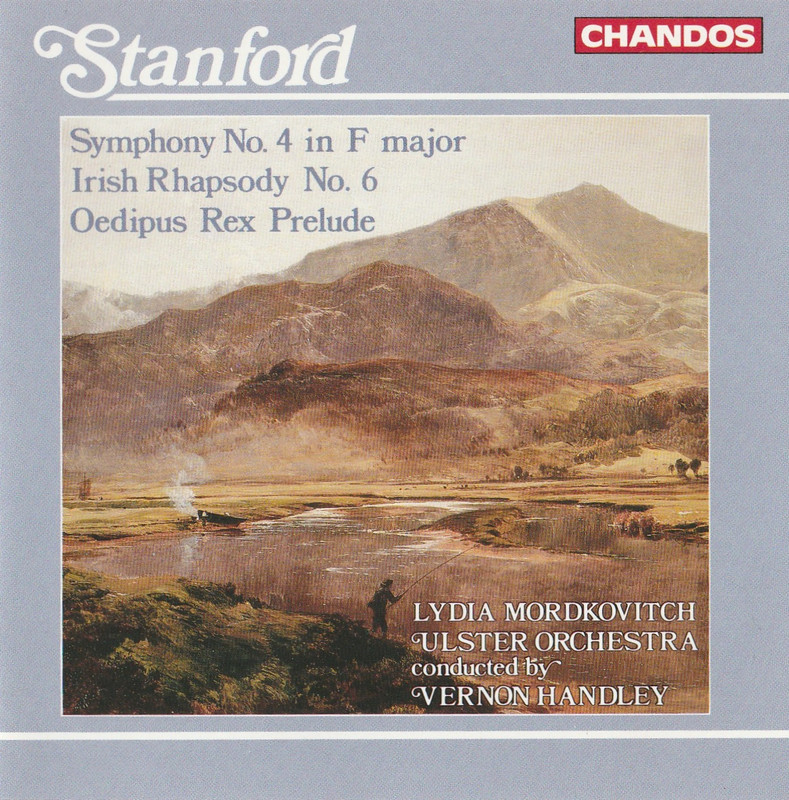
While most will point to Johannes Brahms as the main influence apparent in Charles Villiers Stanford's Symphony no. 4 in F Major, something I won't disagree with, I hear the opening of the first movement brimming with pastoral life in the wake of Beethoven. The F-Major key is not lost on me either, shared with the earlier composer's Sixth Symphony. Little pops of brass punctuate what is otherwise ruled by strings and winds, not to mention small musical outbursts here and there.
The beginning movement itself is crystal clear structurally as well, where I can here every motive, each sonata-form section, plus their return and modifications, set apart as brightly as a summer day with no clouds. Conservative yes, unwelcome no; I enjoy this movement very much, even if Stanford relies a touch heavy on early Romanticism to open this symphony.
Once past this opening movement, however, I hear a much firmer personality of late-Romanticism present. Thoughts, perhaps wrongly on my part, of Liszt, Wagner, and Strauss are odd bedfellows for the conservative Stanford in these areas, and yet they bubbled to mind in small moments of these inner movements, aside that of the more present Brahms-ian shadow.
The second movement explores a gentle triple-meter dance while the third movement also bears some subtle dance-like attributes later on, but set in duple meter. This makes the middle of the symphony rather genial and light overall, with bouts of musical darkness showing up in the third movement more strongly in its first half. Only wind solos with harp break up such a sour turn in the mood of the symphony, although the movement ends in the minor mode.
If there is any portion of Stanford's Fourth Symphony which sounds British to my ears, it must be the fourth and last movement. This is almost a return to the conservative early Germanic Romanticism found in the first movement, again with echoes of Beethoven, but set in a much different musical mood, one with pompous brass and strings over a walking bass line. Later on in the movement, the music turns towards a genuine march feel, making the British stereotype even stronger.
If I fell in love with Stanford's Third Symphony, the gentle nature of his Symphony no. 4 generally fails to capture me in the same way, despite many moments of fondness I have for the work.
As with the other Stanford symphony releases on Chandos, the Fourth Symphony comes paired with the composer's Irish Rhapsody no. 6 in D minor. This one calls for a substantial concertante role for solo violin. Most of the piece dwells in a lyrically minor-keyed song, where only in the last quarter of the 10-minute rhapsody does any feeling of Irish fiddling burst forth in an uptempo. As with the other Irish Rhapsodies, I assume Stanford is utilizing actual Irish tunes here, an aspect which gives these pieces a little more credence as Nationalistic concert works.
I enjoy the firm tone of Soviet violinist Lydia Mordkovitch here, a musician who has surveyed a wealth of British concertos on the Chandos label. She captures the spirit of this music ideally, well balanced by Chandos.
If that wasn't enough, a Prelude from Stanford's incidental music to Oedipus Rex fills out the rest of the recording. I don't really hear the Greek tragedy in this music, so there must be other aspects to the story I am unaware of which adds to this music. The Prelude is perfectly genial music, if not particularly musically substantial, even at an additional 10 minutes or so to the album.

Works
Symphony 4 in F Major, op. 31 (43.42)
Irish Rhapsody 6 in D minor, op. 191 (10.11)
Oedipus Rex, op. 29: Prelude
Soloists
Lydia Mordkovitch, violin (op. 191)
Performers
Ulster Orchestra
Vernon Handley, conductor
Label: Chandos
Year: 1990
Total Timing: 64.34
Symphony 4 in F Major, op. 31 (43.42)
Irish Rhapsody 6 in D minor, op. 191 (10.11)
Oedipus Rex, op. 29: Prelude
Soloists
Lydia Mordkovitch, violin (op. 191)
Performers
Ulster Orchestra
Vernon Handley, conductor
Label: Chandos
Year: 1990
Total Timing: 64.34
Stanford's Fourth Symphony stands in the shadow of his popular Third Symphony.
Generous extras accompany the symphony, with Lydia Mordkovitch an outstanding contributor.

Find more Stanford recordings HERE!
Comments
Post a Comment