Atterberg: Symphony 7 & 8

Prelude
In this fourth Works Series entry of Kurt Atterberg's symphonies, I will be listening to Symphony no. 7 & 8 from CPO's 5CD set released in 2004.

I have determined Kurt Atterberg gives into the pleasure principle in his symphonies. The composer's music simply doesn't want to turn listeners away. Atterberg tips his hat that his Symphony no. 7 will continue this theme of approachability with its subtitle 'Sinfonia Romantica', a hard conservative stance compared to the currents in the music world of the time, especially considering the work was written in and around WWII, a period of great modernism in music.
Not all is sunshine and roses in the first movement though. Atterberg moves from a dangerous, adventurous spirit to inward melancholy, all of the sections preferring a sterner minor mode. I notice Atterberg forgoes attaching a key to the symphony, letting the subtitle taking center stage. Perhaps this is due to the thematic devices being foraged from an earlier opera, but one way or another, the lack of a key is a noticeable absence.
I notice Ari Rasilainen chooses to eschew the return of the 'Slumber Aria', a choice Atterberg gives the conductor towards the end of the first movement. It seems such a minor inclusion, I wonder why the composer had a change of mind regarding its inclusion.
I love the pastoral musical bookends of the second movement. These areas are effectively moody and wistful, with oodles of wind solos for listeners to delight in. The main central portion is more swooningly Romantic, with sweeping, surging ideas. The addition of celesta makes for an appreciable color difference in the movement, while the harp imparts some feelings of Impressionism to the colorful proceedings as well.
An Irish reel pervades the opening music of the third and last movement. I mention the upbeat Irish dance as a descriptor of the rhythms and melody, yet Atterberg sets the harmonies around the dance as rather nightmarish. This continues as the composer moves on to a more square folk dance, brass fanfares, and a richly upholstered ballroom dance, all given a dark, menacing quality opposite their intended melodic and rhythmic qualities.
I find this bit of musical humor on the part of Atterberg rather charming, bringing to mind his mischievous cheek from the final movement of his Dollar Symphony. In a way, this final movement reminds me of Malcolm Arnold, particularly that British composer's darkly comedic Tam o' Shanter. I could see some listeners finding this ending all too much, but I personally enjoy when composer's play with listener's expectations, especially when filled with such sardonic wit.
This volume of CPO's Atterberg set has conductor Ari Rasilainen leading the SWR Symphony Orchestra of Stuttgart, a different orchestra from the previous six symphonies. Rasilainen and the CPO engineers prefer a thick, heavy quality from the orchestra, with the strings way out front and the winds back some. When the string section is playing full bore, any doublings or counter ideas from the winds and brass move subtly in the background, an aspect I would prefer more clearly detailed against the strings.
In the end, I found Atterberg's Seventh Symphony a fun ride. Many classical music listener's balk at the term fun, but that is the best I can use to describe the work as a whole. If the first movement is darkly heroic, the middle movement colorfully Impressionistic, and the last movement wryly sarcastic, really the only thing the listener is missing is a solidly earnest conclusion, even if I am happy with the end product.
Symphony no. 8 again does away with a key in the title, nor does it bear a nickname to give the work extra color. This work is more closely connected to Atterberg's earlier Symphony no. 4, the 'Sinfonia Piccola', for once again he uses Swedish folksongs as the basis for his symphonic motives. While Atterberg presents the borrowed Swedish melodies clearly and unadorned, he does utilize them in true symphonic fashion rather than as a potpourri or fantasy of musical ideas.
The effect of procuring Swedish folk song for a symphony has the effect of laying modal harmonies across the entire work. The first movement is a prime example, where the music is sort-of upbeat, but also sort-of melancholy, all related to the modal harmonies which accompany said folksongs.
One thing Atterberg's use of folk tunes does is highlight the use of his themes every time they appear - ably identified each time they are played, easily hearing how they are modified or developed, and despite bi-tonality or overlapping themes, the listener is given a focused view of how Atterberg utilizes these themes, done so with great clarity. I personally appreciate such an approach, for I like to feel the music passing by in intelligent, detectable ways for the listener.
The second movement is nearly bluesy at the start, nearly continuing the music from the end of the first movement, yet put in a different guise. Atterberg's use of English Horn is always a pleasure, an instrument which fits these folk ideas perfectly. In a way, I hear echoes of Vaughan Williams, Holst, and Grainger in some of these moments, ardent composers of the folk-song revival. I suppose Grieg and Sibelius would be the more apt comparison, though.
Otherwise, the second movement is another swooning Romantic portion of the symphony, this time with solo strings and muted brass moments. These chamber-like textural differences are a noble quality in Atterberg's music, something the listener often gets a whiff of across his symphonies. I love the long crescendo in the final part of this movement, effectively done by Rasilainen here.
The third movement is a light, Mendelssohn-ian Scherzo, perpetually moving forward in an affable, joyous manner. The appearance of a heroic French Horn, and later trumpet, nearly turns the music Medieval, another example of the modal qualities of folk song rearing their head in Atterberg's music, although the composer's use of hemiola gives the music an additional contrasting quality.
A cinematic swashbuckling adventure permeates the fourth and last movement, a musical personality found littered across Atterberg's symphonies. Its appearance here gives the work a bold, heroic conclusion, an element I will never complain about in these works. Again, I will mention the pleasure principle, where Atterberg is inherently melodic, with pleasing harmonies, and entertaining musical settings and personalities.
I think due to the nature of the folk-song imbued Symphony no. 8, the balances of winds and strings are engineered better here, for the two importantly intermingle far more than in the previous symphony. The sound of the orchestra is again a bit impenetrable and imperious, heavy and dramatic, where I would imagine Mikhail Jurowski's recordings of the two symphonies, on Sterling with his Swedish orchestra, are more balletic in comparison.
Work Series
From Atterberg Symphonies on CPO
Works
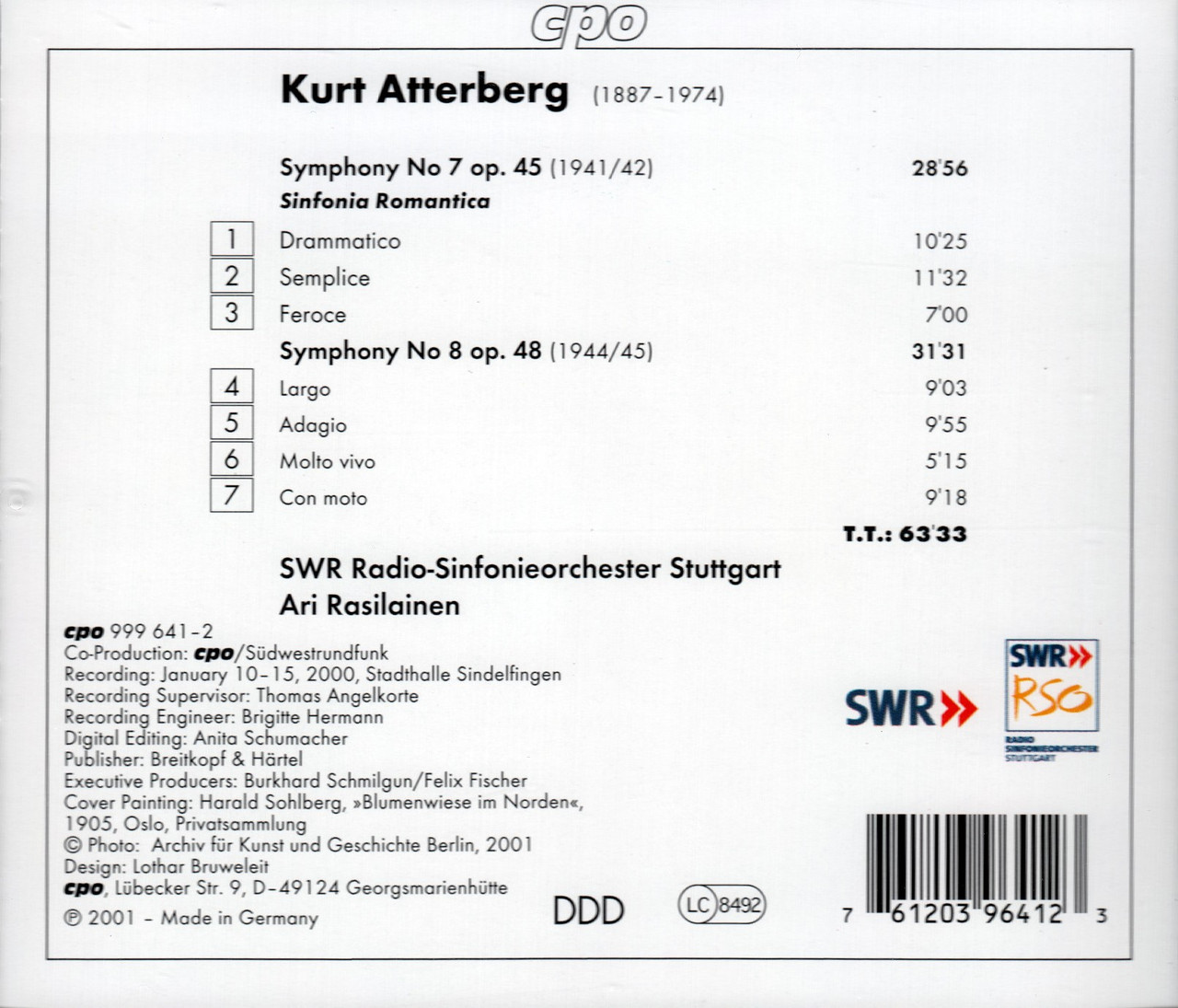
Symphony 7 'Sinfonia Romantica', op. 45 (28.56)
Symphony 8, op. 48 (31.31)
Performers
SWR Symphony Orchestra, Stuttgart
Ari Rasilainen, conductor
Label: CPO
Year: 2000; 2004 (set)
Total Timing: 63.33
Comments
Post a Comment