Parry: Songs of Farewell
While Hubert Parry's six Songs of Farewell represent the composer's finest achievements in a cappella choral writing. Parry's choral style is polyphonic ala the Renaissance, where texts often do not line up exactly, but also show influences from German composers such as Schumann and Brahms.
For me it is the last three songs of the set which show Parry's growth most of all. There is an Old Belief weds words and music most beautifully, as if employing light double-chorus techniques to enhance the choral texture. Parry goes farther in the final Lord, Let Me Know Mine End, completely written for double chorus, while the fifth At the Round Earth's Imagined Corners reaches out much further harmonically than any of his other choral works. Both of these last two songs push the limits of length, breaking away from the earlier, simpler partsongs to something more epic at 8 - 11 minutes each.
The rest of the program is a mix of Romantic-Era madrigals and English partsongs from Parry. The madrigals provide the listener some upbeat and rhythmic contrast to the largely soulful poetic settings. Maybe not a recording one would want to listen in one sitting, but a rare treat as a complete program of choral music from Hubert Parry.
Of these, Music, When Soft Voices Die is Parry's most popular, and indeed, it is a beautiful piece. The most substantial as far as runtime is concerned is La Belle Dame sans Merci, a song set in English despite its French title. Otherwise, there is a general mix of Romantic Era poetry and Sixteenth-Century verse which Parry enjoys setting to choral voices.
If I had to give all of my love to one aspect of this recording, it would be for the Rodolfus Choir. I am hesitant to engage in new, unknown choirs, for I can be rather picky regarding tone and vocal output. This British mixed ensemble is made of handpicked 16 - 25 year olds, with male altos mixed in with adult women altos and sopranos. While I enjoy vibrato in choirs, this Rodolfus group shows how it can be done divinely without. The top sopranos are absolutely heaven sent, while the balances are exquisite across the ensemble.
Thus congratulations are in order for Ralph Allwood, their director. He is a tiny bit quicker than the Carice Singers on BBC, really the only other recording directly gathering together a program of mostly secular choral music from Hubert Parry alone. Most recordings pair Parry's Songs of Farewell with music from other British composers.
The liner notes intimate 50+ singers make up the Rodolfus Choir proper, while a group of 16 singers, of which you might recognize the name of tenor Andrew Staples, comprises a secondary group. In a picture included within the physical-media booklet, around 32 singers are pictured, thus I am uncertain who performed what. I can say the Songs of Farewell were recorded a year apart from the others, where I did detect a difference in singing output between the two programmed sections, but nothing which ruins the proceedings, just a difference I noticed, be it in engineering or choral makeup.
The large acoustic of the Douia Abbey Church of Upper Woolhampton is captured in this recording. The engineers were adept enough to place the choir closely enough to feel the attacks from the singers with an appreciable percussiveness, yet not allowing the reverb to become too overly entangled with the performance. I only wished for a drier acoustic in the quicker madrigals, where some of the smaller details and musical nuances are blurred due to the Benedictine Abbey space.
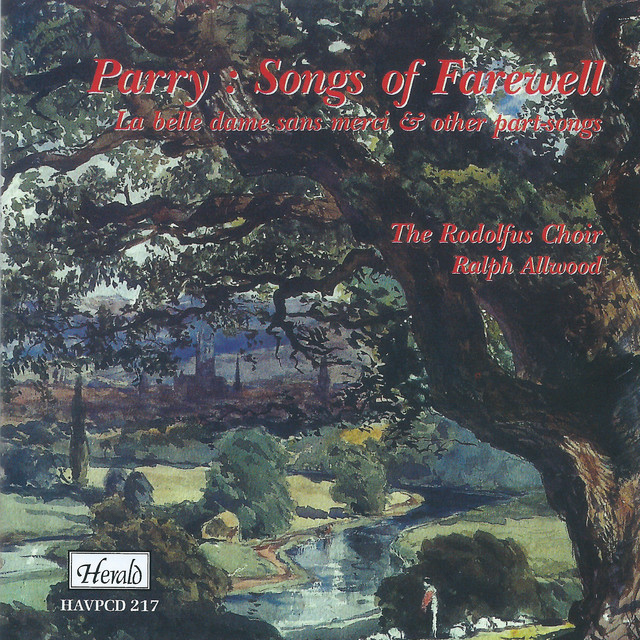
The cover art is a watercolor by Hubert Parry's father, Thomas Gambier Parry, a thoughtful choice on the part of the UK-based Herald label. In 2025, Signum Classics gained rights to this recording and re-released it under their label, pictured in the accompanying video below. Hopefully Parry's choral music will reach a new generation of choral enthusiasts from its reappearance; I can't think of a better recording to do so.

Works
Songs of Farewell (32.10)
There Rolls the Deep (2.56)
If I had but Two Little Wings (2.25)
Love is a Sickness (1.37)
Tell Me, O Love (3.02)
Phyllis (1.25)
How Sweet the Answer (2.34)
What Voice of Gladness (2.36)
My Delight and Thy Delight (2.38)
La Belle Dame sans Merci (7.16)
Sorrow and Pain (3.20)
Music, When Soft Voices Die (2.21)
Ensembles
Rodolfus Choir
Ralph Allwood, conductor
Year: 1998
Label: Herald
Total Timing: 66.24
My love for this recording goes to the Rodolfus Choir, who sound absolutely gorgeous throughout.
The a cappella secular music from Hubert Parry is also lovely, but rather less consistently inspired or engaging than the singing at times.

Find more Parry recordings HERE!
Comments
Post a Comment