Atterberg: Symphony 3 & 4

Prelude
In this second Works Series entry of Kurt Atterberg's symphonies, I will be listening to Symphony no. 3 & 4 from CPO's 5CD set released in 2004. While the box set pairs an early symphony with a later one on each disc, I will be listening to Atterberg's symphonies chronologically instead, breaking up the original programming.

While Atterberg's first two symphonies were monumental epics, often cinematically so, the following Symphony no. 3 in D Major is quite different. The subtitle 'West Coast Pictures' has nothing to do with California filmmaking; rather he is describing the area of an island in Sweden. Each of the movements bear a title - Sun Smoke, Storm, and Summer Night; thus this symphony is more visually evocative than the previous two.
Sun Smoke is nigh-upon Impressionistic so shimmery is its music making. Muted strings, countless solo instruments and individual sections, and long sustained moments with slow harmonic progression are highlights of Atterberg's style here.
Obviously, a Storm is going to kick up some dust compared to the intimacy of the first movement. This second movement is not a continuous downpour, however. Instead, there are three major climaxes across the movement, with dips in the action filled with a chamber group of solo strings, a new texture for this symphony. Otherwise, brass and percussion are a notable focus of Atterberg's Storm, with background rhythms moving the energy of the music along. The final big moment sounds remarkably like a Western to me, one of the few filmic sounds Atterberg makes in these two symphonies.
As far as structure is concerned, each movement of this three-movement symphony gains in length as the work goes on. Thus, Summer Night is the longest of the three, while Sun Smoke is the shortest. While there are plenty of quiet nocturnal evocations in Atterberg's Summer Night, this is a more active evening than one might guess. Of course, there are many bird calls, including the dreaded musical cuckoo, although at least Atterberg utilizes different instruments for the trickster bird.
Summer Night contains some stronger material as well, some which sound full of dread, although my imagination curated more of an ancient, eternal vibe from this music. At the midpoint of the movement, a light scurrying Scherzo is given wing, one which reminds me of Mendelssohn's fairy Scherzos. At around 13 minutes, Atterberg begins preparations for a very long crescendo to build over the next five minutes, bursting into a sunrise. This allows the composer a gloriously triumphant moment in what otherwise is a rather restrained, if not colorful symphony.
As far as the performance from the NDR Philharmonic Orchestra Hannover is concerned, I felt the CPO engineers made the quiet moments, of which there are many, too quiet. Almost at the edge of hearing in some instances. I don't remember this being a quality with the Frankfurt Radio Symphony Orchestra, but then again, those works were much burlier and heroic in nature. That said, the playing is excellent.
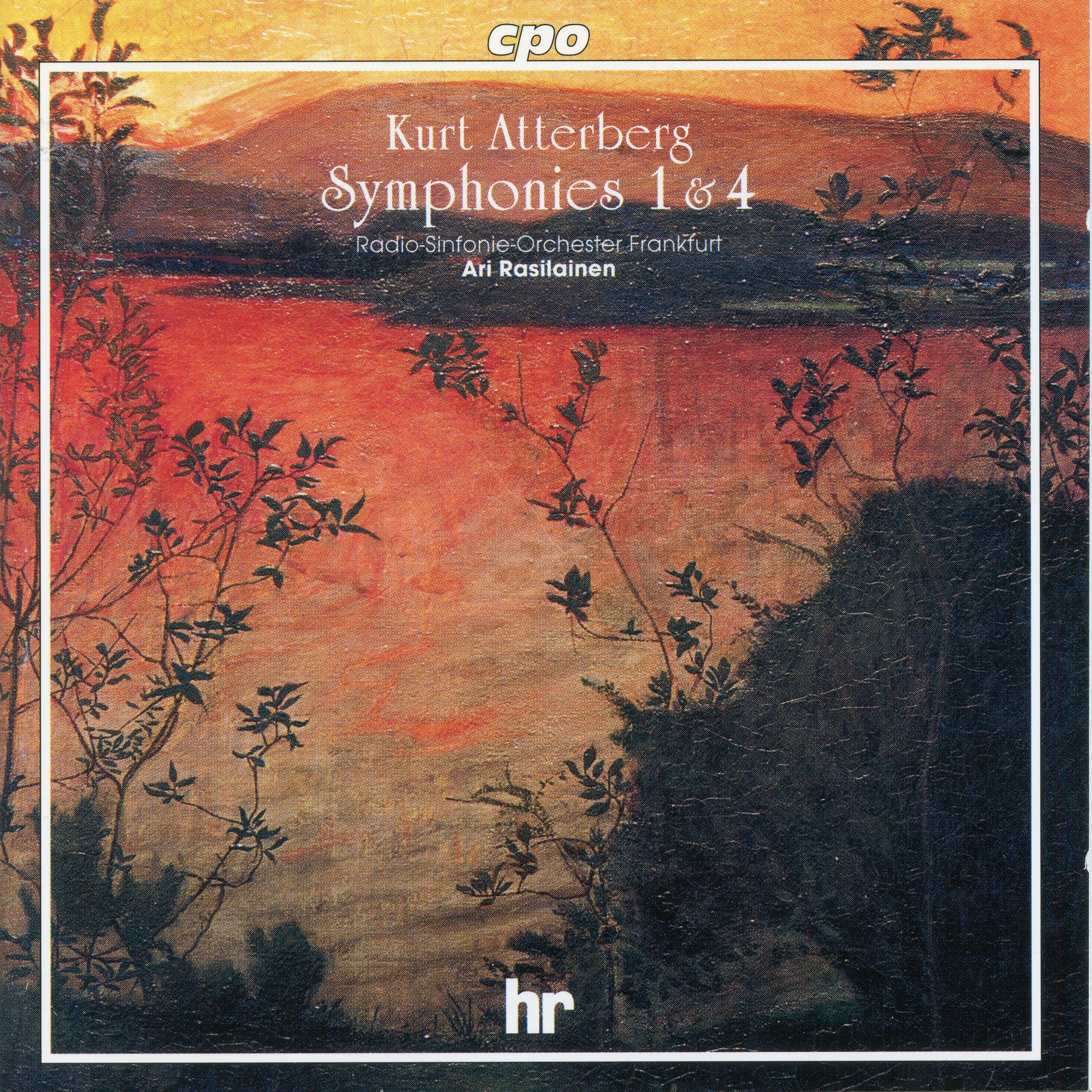
Not only is Atterberg's Symphony no. 4 in G minor given the sobriquet Sinfonia Piccola for its smaller stature compared to the previous three symphonies, all of the movements are based on folksongs, I assume from Sweden. The liner intimates listeners can use the music as a gauge to when these folksongs are being introduced, usually in moments when the full orchestra is set aside and just a few sections or a solo instrument is highlighted. The first such introduction for example has solo oboe/English horn and solo flute play a melody over vacillating accompaniment in the first movement.
Yet, Atterberg's Fourth Symphony doesn't sound like a folksong symphony to my ears. This isn't merely a rhapsody, fantasia, or medley based on themes, but rather the composer stays true to a certain symphonic fabric, while simply utilizing folk attributes as a means for the motivic material. Again, the liner notes highlight that it is the modal harmonies which accompany the folksongs which are important, thus the G minor title of the symphony.
I particularly enjoy the jaunty, dotted theme of the first movement, perhaps due to the pert solo instruments paired with that melody. If anything, Atterberg is a master of orchestral color, ably heard across all of these works. The second movement is expectedly melancholic, somewhat close to Holst's I Love My Love, here presented by solo clarinet among mesmerizing sustained quintals. A certain wistfulness carries another double-reed solo along in the central portion of this movement as well. Furthermore, I think this music could easily lie congruently to the British pastoral school of the early 20th Century.
A third-movement Scherzo is over just as it begins, so short is its runtime. Plus, the Scherzo runs into the fourth movement without a break, making for a continuous musical through line anyway. As to the music, the Scherzo swirls briefly before switching to a march sound, and then back again.
The final movement opens with a lengthy flute solo taken over by strings, surrounded by a building accompaniment and mocking retorts from the orchestra. While a modal tune is stated broadly by unison strings, the tempo picks up again for the flute to enter once more. Another oboe/English horn solo follows, with Atterberg bandying back and forth between a moderate and an uptempo. Obviously, it is going to be the manic reel which concludes the movement and work, but Atterberg doesn't make it simple for the music to reach its destination, creating many diverse sections, not to mention a humorous final bow.
Yes, I am generally more pleased with the sonic balances in this recording with the Frankfurt Radio Symphony Orchestra; one doesn't need to twist the volume knob so vigorously to hear the intimate moments here.
Work Series
From Atterberg Symphonies on CPO
Works
Symphony 3 in D Major, op. 10 (37.05)
Symphony 4 in G minor, op. 14 (21.03)
Performers
Frankfurt Radio Symphony Orchestra
NDR Philharmonic Orchestra (op. 10)
Ari Rasilainen, conductor
Label: CPO
Year: 1998-99; 2004 (set)
Comments
Post a Comment