Arnold: Concerto for 28 Players, Guitar, Harmonica, and Philharmonic Concerto

On the other hand, I do enjoy some neat textures he infuses, including a sort-of echo effect in the strings near the beginning of the first movement. I think one aspect which endears me to this particular concerto is that the composer treats the 28 players both as soloists and ensemble members, something he doesn't really do in the Philharmonic Concerto for orchestra. That, and the sneaky murder mystery atmosphere of the opening is fun, with rhythmically taut exhortations from various instruments coming and going pointilistically.
The second movement continues some of the interesting string textures, again with various instruments popping out unexpectedly every once in a while. This movement meanders interestingly across its 10 minutes, but never in expected ways, with the sustaining instruments as serious as the day is long, sometimes harshly astringent, while the popping-in instruments add quixotic colorings.
An oddly pompous march turns up in the third movement, although Arnold's lyrical melody o'er top does not quite fit the harmony that march creates. And instead of having the piccolo tootle in time, that instrument receives its own little area to express itself. Again, it is the serious and dissonant against the witty and rhythmic; which one wins out is up to the listener, is any do at all.

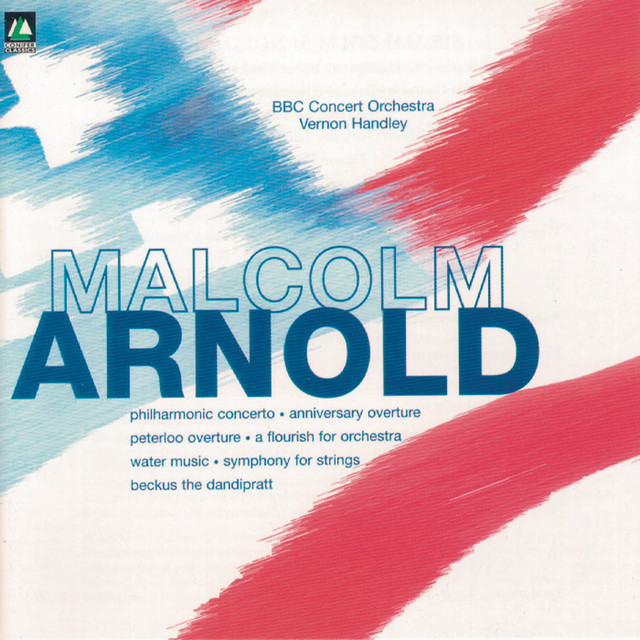
Its first movement is both an exciting curtain closer and highly dissonant, a curious mix, yet a hallmark from late Arnold works.
Unsurprisingly, the middle movement is more subdued, but hardly any less concentrated. The large role for harp is enjoyable here, adding a different color to the orchestral texture. As can often be the case, a proto-film ballad sits at the center of the movement, offering lush harmonies opposite the troubled outer portions.
I haven't mentioned it, but this is the only concerto out of a large set which bears titled movements. The final movement is a Chaconne, an older musical form where music progresses over top a bass line which repeats round and round again. Again, Arnold is rather flashy with orchestral virtuosity, selecting various sections to show off, including a large complement of percussion. I daresay, a circus atmosphere comes and goes throughout this short movement.
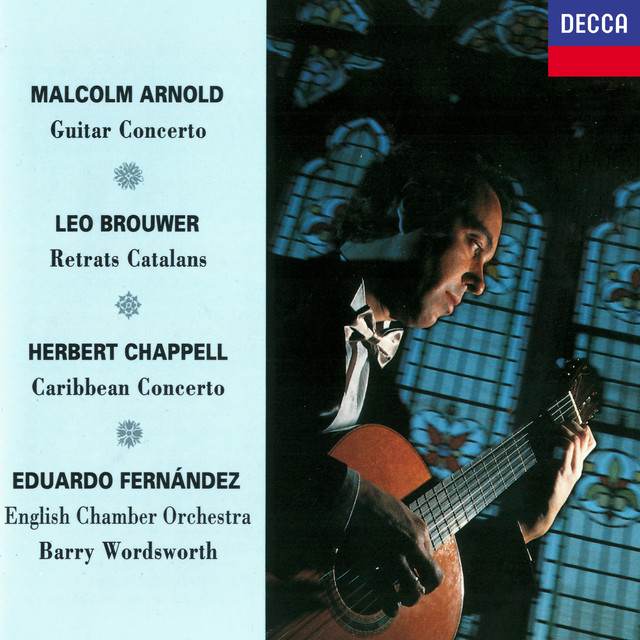
I don't quite think this Decca recording gets the balances right either. Truthfully, both are heard advantageously, with the guitar ably heard alongside the ensemble.
Where I become distracted is the upfront clear guitar aside the distant orchestra; I just don't think the two qualities complement each other. When the playing of the guitar is quiet, yet ably heard, and then you hear a slightly removed and reverberant English Chamber Orchestra playing their hearts out, that mix just doesn't match up in my mind. I don't the solution, I just know I was distracted whilst listening.
But I suppose, the focus should be on a British 20th-Century Concerto for Guitar, here played by Eduardo Fernández backed by Barry Wordsworth and the ECO. There are some wonderful interactions between orchestra and guitar in the first movement, one where the guitar sounds rather breezy while the orchestra is revved up for rhythmic interplay. It is a fun dichotomy.
The second movement is simply too long for this listener. All of the instrument glissandos make me a little seasick throughout, although the strings remind me a bit of a musical steam engine. A returning feature for flute and is quite lovely, however.
A Medieval consort is nearly recalled at the opening of the third movement. Something about the swift 3/4 dance time, although it doesn't take Arnold long to contrast this short formed idea in my head. I think the composer does a nice job balancing the melodic capabilities of the guitar with virtuosic scale and accompaniment figures.

Again, I imagine balancing harmonica to orchestra would be a feat, and once again, I don't think Argo quite gets it right.
I think the harmonic is not far enough forward against the orchestra. When the full ensemble plays, the mouth organ is simply overwhelmed. Luckily, this is mostly when the harmonica is playing accompaniment figurations, but overall, I think the instrument sounds too far back under the best of circumstances.
Sir Malcolm really gets the emotional quality of the instrument in the first movement, one which could be overly cheerful or menacing, but the setting here is perfectly sweet. I think the London Sinfonietta really wants to play out, though; for anytime the harmonica isn't playing, they really stretch their wings volume wise. The opening of the second movement is a good example of this, and even when the horns and trumpets plays their countermelodies later on, plus the mighty brass climaxes shortly after, the balance isn't quite right. Too bad!
The third movement broadcasts some homespun gaiety in Arnold's own brand of music making. I daresay I hear a Spanish-sounding exoticism in the movement proper, compounded by the presence of castanets. Otherwise, there is a puckish sense of humor which is greatly enjoyable here, including a horn-section whoop towards the very end.
Work Series
Vol. 4 from Concertos on Decca
Works
Harmonica Concerto, op. 46 (9.33)
Guitar Concerto, op. 67 (22.26)
Concerto for 28 Players, op. 105 (21.14)
Philharmonic Concerto, op. 120 (15.32)
Soloists
Tommy Reilly, harmonica
Eduardo Fernández, guitar
Performers
BBC Concert Orchestra (op. 120)
Vernon Handley, conductor
English Chamber Orchestra (op. 67)
Barry Wordsworth, conductor
London Musici (op. 105)
Mark Stephenson, conductor
London Sinfonietta (op. 46)
David Atherton, conductor
Label: Conifer / Argo; Decca
Year: 1979-1997; 2006
Total Timing: 69.05
Comments
Post a Comment