Sibelius: Pelleas and Melisande

Sibelius is certainly reverential, focusing his music on the love and death aspects of the story. I particularly enjoy the opening Prelude to Act I, which sets the scene at an old castle gate. There, the strings are divided and the harmonies are both forthright and lush, especially from Segerstam and Turku here. Sibelius creates a positively eerie atmosphere at the end of Act I in At the Seashore, plus there is one short vocal solo in the center of the 30-minute work, The Three Blind Sisters, here tackled by Finnish soprano Pia Pajala. Overall, this is gentle music making; one of a rather serious tone too.
On the flip side though, the Preludes to Act II and Act IV are happy-go-lucky, joyous affairs, countering the serious side of this stage music. So too, Melisande's Spinning Wheel Song is also rather perky, with the Turku winds showing what fine work they can do.
Accompanying Pelléas and Mélisande, are five shorter standalone works for orchestra. Most appealing to me is having the entire trio of op. 96 present. The central Autrefois features two singers, here Pia Pajala and Sari Nordqvist. While the two singers are a bit overly tremulous of voice, Sibelius' instructions of 'with sentimentality' is certainly provided by the pair.
Autrefois is surrounded by two concert waltzes, the Valse Lyrique and Valse Chevaleresque. These two get a fair amount of playtime on record, but hardly as a set. They are perky, sweeping waltzes for orchestra, although they hardly reach the heights of Sibelius' famous Valse Triste.
Even though it isn't in the title, Morceau Romantique is also an orchestral waltz of sorts, one moodily set in a ghostly melancholic spirit, with the harp added to the ensemble texture. That leaves the plainly titled Music to a Scene, a stern 6-minute piece which cheers up some in its middle. That central bit is full of Spanish spice, including trumpets, castanets, tambourine and all, although I could hardly call its triple-time meter a waltz in order to set it with the other works on this program. The outer portions are rather grouchy in comparison, making the music swing wildly from dark to light and back again.
As mentioned before, the Turku Philharmonic Orchestra sounds great here. When Leif Segerstam wants, he really lets loose on the music, but in general, he like to keep the music in check. The conductor really knows how to hold out a fermata and dwell over details too, often making his timings somewhat longer compared to other recordings. This isn't a bad thing, but an observable attribute of the conductor I have come to know. Sometimes I am in the mood for such things and other times not; here I feel fine.
Work Series
Vol. 3 from Incidental Music on Naxos
Works
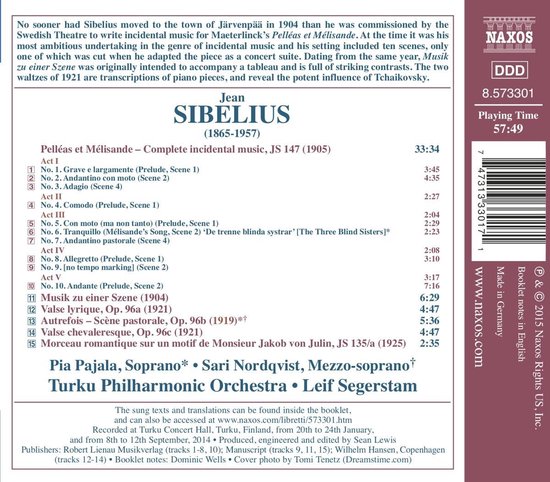
Pelléas and Mélisande, JS 147 (33.34)
Music to a Scene, op. 45/2 (6.29)
Valse Lyrique, op. 96a (4.47)
Autrefois, op. 96b (5.36)
Valse Chevaleresque, op. 96c (4.47)
Morceau Romantique, JS 135a (2.35)
Soloists
Pia Pajala, soprano
Sari Nordqvist, mezzo-soprano
Ensembles
Turku Philharmonic Orchestra
Leif Segerstam, conductor
Label: Naxos
Year: 2015
Total Timing: 57.49
Find more Sibelius recordings HERE!
Comments
Post a Comment