Mozart: Symphony 9 - 11
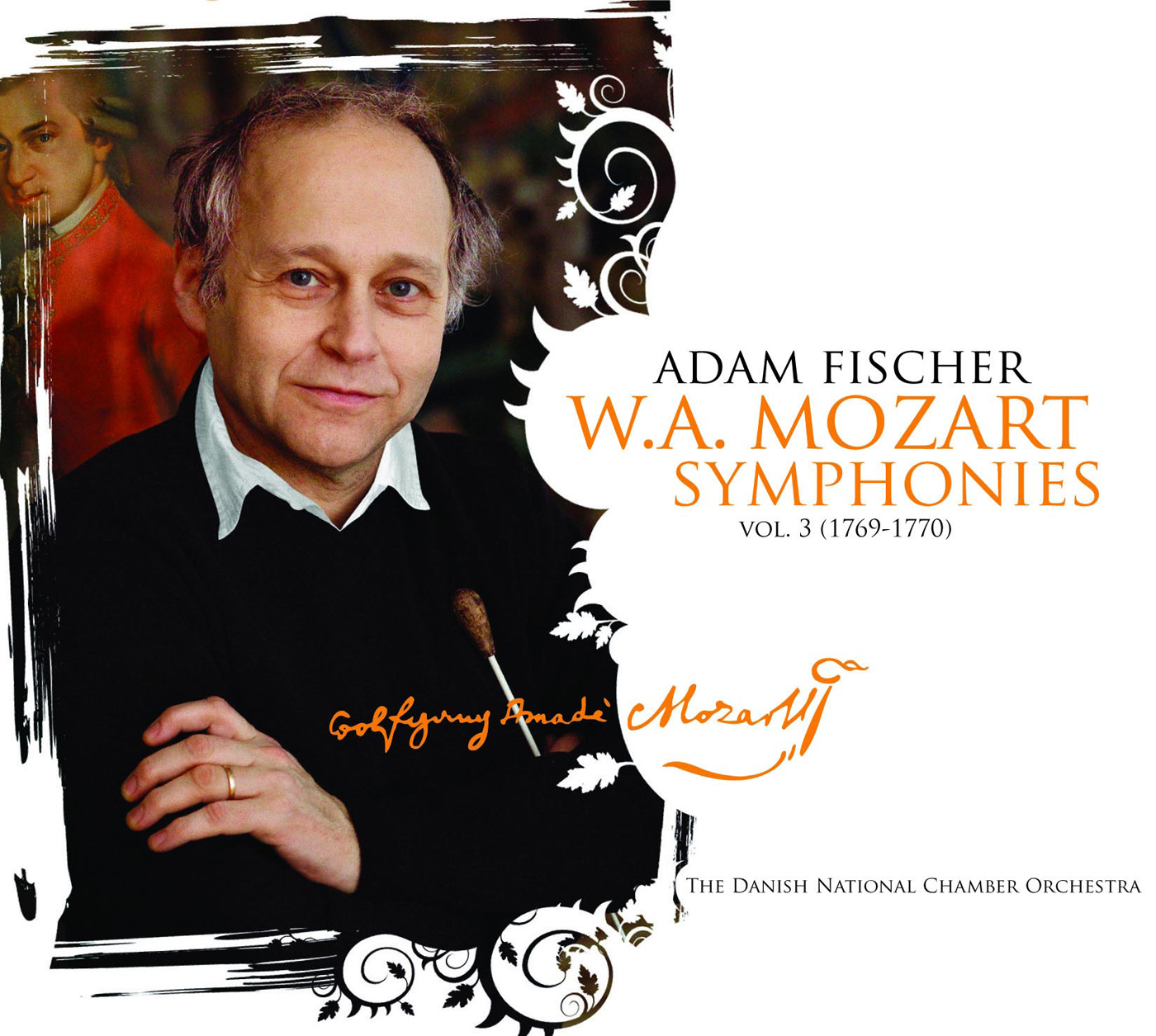
Volume 3 features symphonies which would have been composed around Mozart's travels to Italy. Scholarly research finds it hard to determine exact dates for this particular grouping of symphonies, and in some cases, are hard to even determine if these are actually from the pen of Mozart in the first place. Certainly the Köchel catalog (K6) numbering firms up the view of the tenuous grounds these works have lain upon.
For an overview of this volume, skip below for my generalized thoughts. Otherwise, I will do movement-by-movement descriptions and thoughts on Fischer's approach, best read while listening to the actual works.
Symphony no. 9 in C Major, K. 73 (75a)
Movement 1
Key: C Major
Meter: Common time
Tempo: Allegro; Fischer:
 = 162
= 162Winds: oboe, horn, trumpet timpani

Aside from the contrasts of soft and loud, it is the many string tremolos and the moving bass line which catches my attention here. But as with many of the symphonies in Volume 3, most of the movements are between 2 - 3 minutes with few inner repeats, adding to a feeling of slightness in these works.
That is the beauty of having Fischer at the helm. He makes these works sound so celebratory, even their rather insignificant musical attributes can be overlooked by the sheer joy coming from these players.
Key: F Major
Meter: 2/4
Tempo: Andante; Fischer:
= 57Winds: flutes
Mozart takes all of the winds away from the first movement and uses flutes to fill their absence. There is certainly a dainty texture to this movement, aided not only by the flutes, but also by having strings play on mutes.
Movement 3
Key: C Major & F Major (Trio)
Meter: 3/4
Tempo: Menuetto; Fischer:
= 156Winds: oboe, horn, trumpet, timpani
In this grouping of symphonies, there are few Minuets to be had. The ones we do hear, are very short, particularly the Trios.
Here, the Minuet is in a solid three-part form, with a little 'B' section breaking up the main idea. Mozart writes the Trio section for strings only, which Fischer gives over to the solo string players.
Movement 4
Key: C Major
Meter: 2/4
Tempo: Molto Allegro; Fischer:
= 208Winds: oboe, horn, trumpet, timpani
I love the little melody Mozart comes up with to string across this last movement. The upward 1 - 5 - 1 is simply delightful, plus the burst of timpani and trumpet adds a little sting to the music.
In the contrasting minor sections, Fischer has the strings play as if they were a Romani folk band. They are almost scratchy sounding here, particularly the motoric viola, making me wonder if Fischer is asking them to play sul ponticello in these portions. This is certainly a unique sound.

Movement 1
Key: D Major
Meter: Common time
Tempo: Allegro; Fischer:
= 162Winds: oboe, horn
Might I say, Mozart's writing for oboes is lovely here. They only have a few moments in the light, but their color adds so much to this music.
Fischer's instructions to the horns, though, is most apparent to this listener. First, their long held note at the very opening, during the time the strings have the main opening idea, horns are given a crescendo which ends up sounding rather rough at its end. No mistake, for upon its restatement, the same thing happens. Later on, the horns who have a low G below the treble clef, sting their notes hard, spouting out an aggressive, blatty sound. These are curious moments from the horns, but I think these choices make a rather plain movement come alive with rustic character.
Movement 2
Key: G Major
Meter: 2/4
Tempo: Andante; Fischer:
= 64Winds: oboes
The oboes continue their large role in the following slow movement, this time by themselves, and again, to good effect. The opening violins trade quavers back and forth among the 1sts and the 2nds, almost in an antiphonal manner. I don't know if Fischer divides the violins across the podium, but I would think this could be a neat effect if he did.
Movement 3
Key: D Major
Meter: 3/8
Tempo: Allegro molto; Fischer:
. = 106Winds: oboe, horn
The last movement is a quick galop, where the prominence of horns in some places remind me of the hunt. I should also note that most fast moving string figures, be they tremolos, semiquaver or demisemiquaver decorations, and other quick-motion embellishments, are played with special elan, sometimes furiously so. Certainly this aspect is often brought out by the strings, giving the music some added panache from these players.
Symphony in D Major, K. 73m
Movement 1
Key: D Major
Meter: Common time
Tempo: Allegro; Fischer:
= 164Winds: oboe, horn, trumpet, timpani
Speaking of furious string tremolos, you will hear them here, although not at the very beginning. If this sound reminds me of Vivaldi, please excuse any ignorance on my part.The trumpet and timpani are back, but they don't make quite as much of an impact in this symphony. Musical punctuation mostly.
Movement 2
Key: G Major
Meter: 2/4
Tempo: Andante; Fischer:
= 58Winds: none
There is a contrast of triplet and duple rhythms throughout this movement, one written for strings only by Mozart. It is rather lightweight, with little laughing demisemiquaver decorations providing some humor.
Movement 3
Key: D Major & G Major (Trio)
Meter: 3/4
Tempo: Menuetto; Fischer:
= 158Winds: oboe, horn, trumpet, timpani
Another brief Minuet makes its appearance here. Once again, Fischer hands the strings-only Trio to solo instruments, giving the music a decidedly chamber-music quality.
Movement 4
Key: D Major
Meter: 3/8
Tempo: Presto; Fischer:
. = 142Winds: oboe, horn, trumpet, timpani
Mozart sneakily adds tiny minor-keyed harmonies into this romp of a final movement, almost as if the composer was not supposed to do so. It adds a bit of harmonic color to a rather short symphony.
There is also a significant pause, brought about by an unexpected fermata before the final return. I can't say silence is a common trait from Mozart as it was Haydn, so its inclusion here is notable.
Symphony in D Major, K. 73n
Movement 1
Key: D Major
Meter: Cut time
Tempo: Allegro; Fischer:
= 188Winds: oboe, trumpet
There are some brief demisemiquaver figurations in this movement which show the attack those sorts of decorations receive under Fischer. Too much? It doesn't take anything away for this listener.
For those approaching this symphony for the first time, realize this first movement doesn't really end. The final chord is a lead-in to the second movement, not a conclusion. I assume this is an Italian overture format, but odd nonetheless if you are not expecting it.
Movement 2
Key: G Major
Meter: 3/4
Tempo: Andante; Fischer:
= 94Winds: flute
Flutes join the strings again to make for a rather lovely middle portion. It is quite odd to have a 3/4 metered second movement when there is a 3/4 Minuet to follow. At least I haven't seen much of such a thing from Mozart. Like the last symphony, there is another easy-going contrast between subdivided duples and triples.
Movement 3
Key: D Major & D minor (Trio)
Meter: 3/4
Tempo: Menuetto; Fischer:
= 164Winds: oboe, trumpet
I like the feeling of constant rhythmic motion in this Minuet, a movement which can sound heavy and trudging otherwise. In quite a change, Mozart sets the Trio in the parallel minor, making for quite a change. I daresay I hear the strings trying to inject a little vibrato into their playing here, a welcome warmth from the solo string players in this cold, minor-keyed section. Huzzah!
Movement 4
Key: D Major
Meter: 2/4
Tempo: Allegro; Fischer:
= 172Winds: oboe, trumpet
I never even mentioned the lack of horns in this symphony as of yet. This change of orchestration does provide a slight difference in timbre compared to what we have heard so far from Mozart, but it is a subtle one here, I think. No one is going to walk home and boo or hiss at the change.
Again, listen to the string's attack of the quick demisemiquaver decorations. In this last-movement setting, I am nearly reminded of Rossini, perhaps not an unkind comparison.
Symphony no. 11 in D major Major, K. 73q
Movement 1
Key: D Major
Meter: Common time
Tempo: Allegro; Fischer:
= 166Winds: oboe, horn
I do enjoy how Fischer emphasizes the downbeat, both from weight in the bass line and horns, but also through dynamic lead-ins and lead-outs.The secondary melodic 'B' section is an unusual one from Mozart. Usually, his creation of melodies consist of unbroken, connected notes. Here though, you get a few notes on beat one, but you have to wait all of the way until the pickup note to the next measure until the melodic idea is continued. I like the difference, for it is so unusual thus far, but I wonder if it will catch on in any meaningful way.
Movement 2
Key: G Major
Meter: 3/8
Tempo: Andante; Fischer:
. = 36Winds: oboe, horn
I really like this sort of middle movement from Mozart. There is a little more heart within the music aside from mere delicateness and lightness. Plus, both oboes and horns are allowed to stay, making the music feel a little fuller as well.
Movement 3
Key: D Major
Meter: 2/4
Tempo: Allegro; Fischer:
= 172Winds: oboe, horn
While I am not thrilled about the rather plain D-Major arpeggio which opens this last movement, which returns again and again, I like the light-on-its-feet textures throughout. There is no undue heaviness either, but rather, a rustic feeling of joy pervades.
The majority of triplet subdivisions certainly gives a feel of a compound meter, one which sounds natural in these early Mozart symphonies. Fischer uses solo strings in some of the interlude areas here as well, who ends this symphony on the lightest of ending notes.
Movement 1
Key: G Major
Meter: Common time
Tempo: Allegro; Fischer:
= 162Winds: oboe, horn
The strings really toss off their triple stops with unusual flair, the oboes get a bit to themselves in one wind-laden transitional section, and a lot of syncopated figures figure into much of the music making here.
Much like K. 73n, the first movement transitions directly into the second movement. Unlike that previous symphony, there is no pause or fermata of expectation; instead the music moves right into the next without stopping. Again, Italian overture elements are at play here I think, and would not have been completely unexpected in their time, or upon Mozart's visits to Italy.
Movement 2
Key: C Major
Meter: 3/8
Tempo: Andante; Fischer:
. = 40Winds: oboe, horn
There are some sly deceptive cadences and minor-keyed tinkerings which pop up briefly to give this middle movement some color and character. There is a nice balance of geniality and drama here too, a combination most uncommon in the slow movement, at least thus far.
Movement 3
Key: G Major
Meter: 2/4
Tempo: Allegro; Fischer:
= 178Winds: oboe, horn
This might be my favorite concluding movement to an early Mozart symphony so far. The main melodic ideas are winners all around and the harmonic motion is just so captivating, particularly that downward moving bass line. The echo effect in the minor section is wondrously effective for this listener.
What a great way to end a volume that was rather underwhelming musically.
Final Thoughts
I know I found most of these symphonies rather slight in scope, but what a surprise that my favorite portions came from the shortest compositions.
I have really come around to what Fischer and the Danish National Chamber Orchestra inject into Mozart's early music. As I portended in the first volume, perhaps I am warming up or getting used to this ensemble and their conductor's approach.
Whatever extra they add in this volume, it only gives what could be faceless and plain music some color and character. This description doesn't hide what is missing from a mature Mozart, but does imbue this music with an abundance of sunshine and joy. Couldn't we all use more of that in our lives?

Work Series
Vol. 3 from Symphonies on Da Capo
Works
Symphony 9 in C Major, K. 73 (9.34)
Symphony in D Major, K. 73l (8.45)
Symphony in D Major, K. 73m (8.24)
Symphony in D Major, K. 73n (9.59)
Symphony 11 in D Major, K. 73q (10.19)
Symphony 10 in G Major, K. 74 (7.10)
Performers
Danish National Chamber Orchestra
Ádám Fischer, conductor
Label: Da Capo
Year: 2013
Total Timing: 54.09
Comments
Post a Comment