Arnold: Brass Music

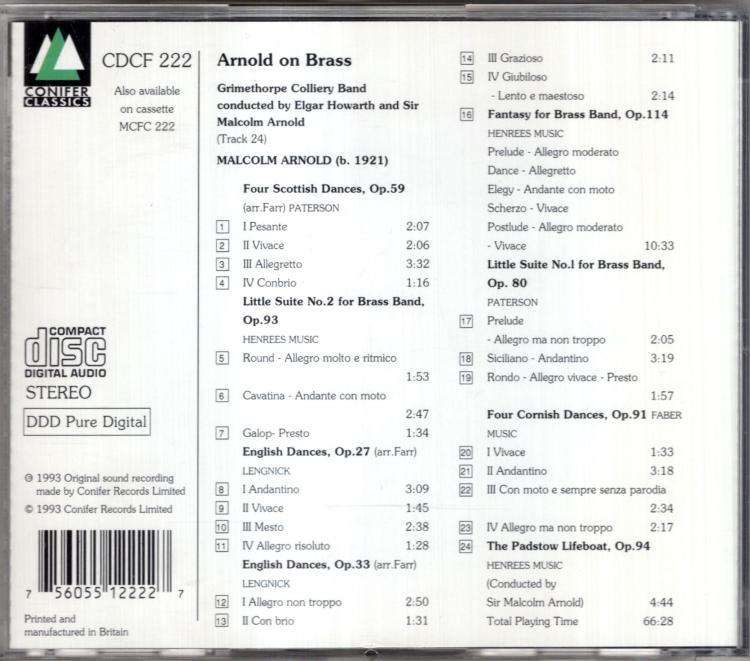
Most of CD3 from Decca's Malcolm Arnold Edition set is largely taken up by Brass Music as played by the Grimethorpe Colliery Band on Conifer. The only thing which disturbs me regarding the original Conifer cover art is the deer head. These Scottish lads and lasses are dancing about directing musical instruments floating mid air while the one in front has a deer head on a stick. Did he/she fashion it into a chanter and drone?
This recording is a mix of original brass music and orchestral music arranged for brass band. Of the former, the two Little Suites for Brass Band are short, three-movement suites of a contrasting nature amongst the movements. If you know the composer's numerous concertos or Little Suites for Orchestra, these are light works of great delight, with plenty of orchestral textures and bright melody-making to please the masses. They might not be the most memorable, but they are an enjoyable listen.
So too, the Fantasy for Brass Band is a ten-minute work of varying tempos and moods, but set in a continuous stretch without break. The Padstow Lifeboat March is a favorite however, where I love the musical-dinghy toot from the band every time it appears. Plus, in this recording, we have Sir Malcolm Arnold himself at the podium.
Arranged for brass band are the famous sets of English, Scottish, and Cornish Dances. The twelve which make up the English and Scottish Dances are full of original folk-sounding tunes which could have come straight from the countryside, put into Malcolm Arnold's own affable musical language. I don't know what Arnold thought of the Scots as a people, but both the Scottish Dances and the Tam O'Shanter overture feature a stumbling drunkard depicted musically.
The Cornish Dances show a breaking away from the folk-dance atmosphere that will feature more confidently into his later Irish and Welsh Dances. This mostly comes in the form of the two slower movements, where Arnold is more interested in musically depicting the barren husks of industry dotted across the landscape through dissonance and orchestral color. As Sir Malcolm's language became tougher as he aged, such as in the Symphonies, and the Dances are not immune to the effect.
Normally the tight, quavery vibrato of British brass bands, such as Grimethorpe, are anathema to me. Here, the band is very well behaved with its vibrato; only in solo moments do I really notice it, and of course, the sound of cornets makes a different timbre which takes some getting used to as well. Generally, though, I enjoyed the playing and ensemble sound here very much.
I generally find competing brass bands do not enjoy 'easy' or 'simple' music, even though those adjectives do not describe musical worth to this listener. Thus, in these pieces, the Grimethorpe Colliery excel in daunting scalular figures and rapid, persnickety rhythms, just as well as they traverse the baffling harmonies and textures of Arnold's slower movements, shading their ensemble colors in a magical way. Listeners should appreciate the speed and alacrity the players tackle all of these musical pieces.
As a side note to the Malcolm Arnold Edition I am covering here, the original orchestral versions of Arnold's set of Dances are not provided, with the exception of Sir Adrian Boult's 1954 English Dances performance. A marked absence, for sure, as the orchestral Dances are a fabulous experience as Arnold intended, which the brass arrangements can't replicate, yet complement nicely.

Brass Quintet no. 1
From 1970, comes the First Brass Quintet from the Philip Jones Brass Ensemble on Argo as an extra to the Grimethorpe contributions. Much like the Little Suites mentioned earlier, this Quintet is a three-movement work of varying tempos and moods.
Unlike the larger sized Grimethorpe Colliery, this is a chamber-scoped work for two trumpets, horn, trombone, and tuba for just five members of the Philip Jones Brass Ensemble. Across the runtime, each instrument is afforded solo moments, including a rather raucous trombone.
Unfortunately, Decca did not included Arnold's Brass Quintet no. 2. I assume this is due to the label not having recorded it by the time this set came out. If you check out the Just Brass album on Argo, it is filled with rarities and the unknown.
Vol. 3 from Orchestral, Brass, and Piano on Decca
Works
English Dances, op. 27 (9.08)
English Dances, op. 33 (8.57)
Scottish Dances, op. 59 (9.03)
Cornish Dances, op. 91 (9.50)
Quintet for Brass, op. 73 (12.03)
Little Suite 1, op. 80 (7.31)
Little Suite 2, op. 93 (6.24)
Padstow Lifeboat March, op. 94 (4.46)
Fantasy for Brass Band, op. 114 (10.35)
Performers
Philip Jones Brass Ensemble (op. 73)
Philip Jones, conductor
Grimethorpe Colliery Band
Elgar Howarth, conductor
Malcolm Arnold, conductor (op. 94)
Label: Conifer / Argo; Decca
Year: 1970, 1993; 2006
Total Timing: 78.31
Comments
Post a Comment