Mozart: Symphony 6 - 8
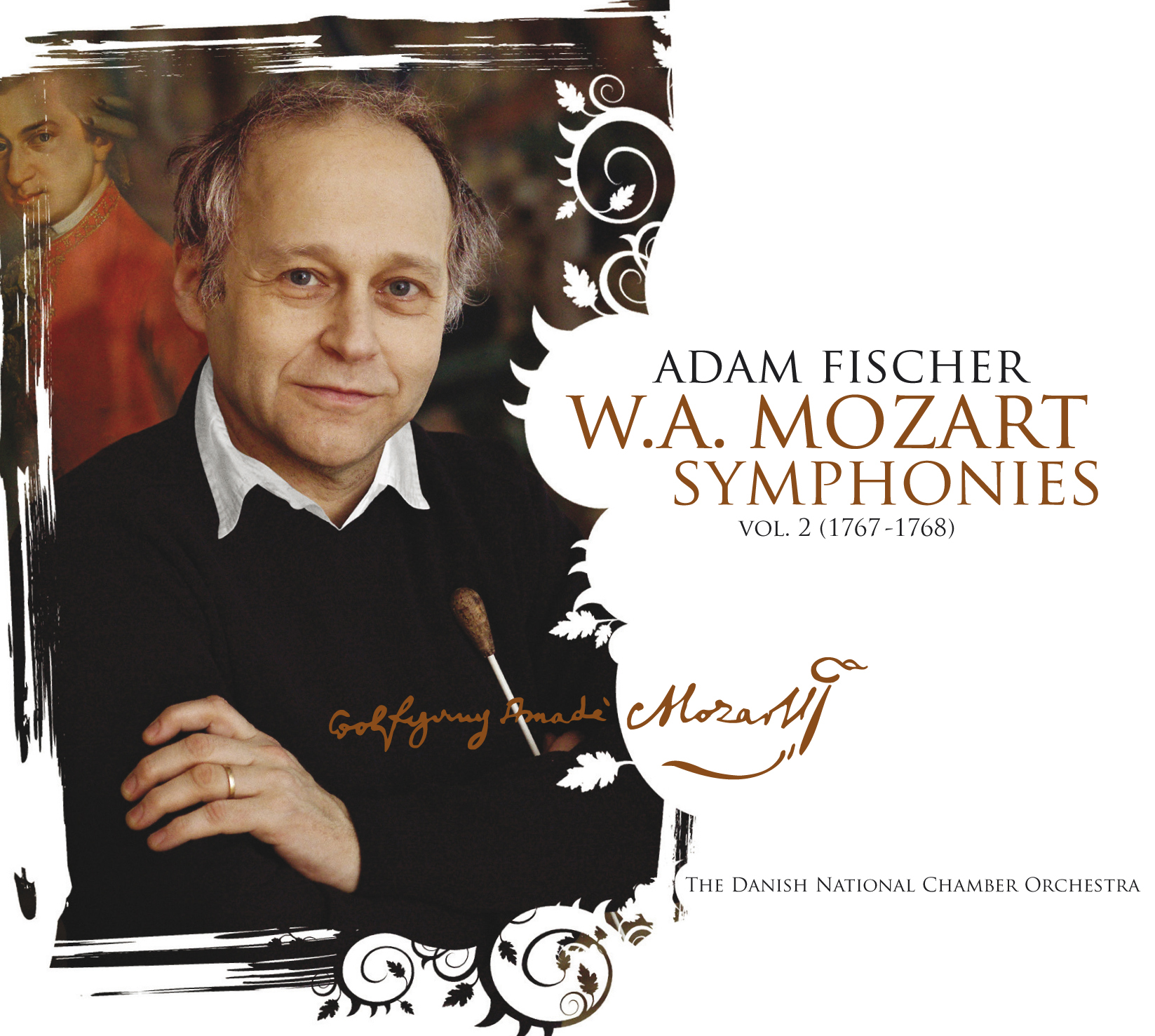
For an overview of this volume, skip below for my generalized thoughts. Otherwise, I will do movement-by-movement descriptions and thoughts on Fischer's approach, best read while listening to the actual works. I provided links to these recordings below for such an activity.
Or follow this link: Mozart Vol. 2
Symphony no. 6 in F Major, K. 43
Movement 1
Key: F Major
Meter: Common time
Tempo: Allegro; Fischer:
 = 158
= 158Winds: oboe, horn

How daring for Mozart to leap into the development section by a chromatic-mediant relationship. The move from C Major to A Major is a distant one, although that chord does allow the composer to get to D minor, the relative minor of the home key. The same surprise occurs when repeating at the end of the recapitulation too, moving from F Major to A Major.
Mozart gives a truncated recapitulation, given over more to the second thematic area than the opening one, which I don't believe ever comes back in it original form. Throughout the movement, Ádám Fischer leans into the Baroque terraced dynamic aspects as well.
Key: C Major
Meter: 2/4
Tempo: Andante; Fischer:
= 58Winds: flute, horn
For the second movement, Mozart swaps out the oboes for flutes, a lovely change in texture and timbre. This is a fairly charming movement, with the melody firmly fixed in the violins, here muted, while the rest of the ensemble chugs along merrily. Only the flutes are allowed to double with the violins occasionally.
How odd we don't receive an authentic cadence at the very end, with the flutes adding the tiniest feeling of a question mark at the last notes.
Movement 3
Key: F Major & B-flat Major (Trio)
Meter: 3/4
Tempo: Menuetto; Fischer:
= 158Winds: oboe, horn
A consistently falling triplet figure leads to the downbeats in the Minuet portion of the third movement. The second half of the dance changes the motion, by having the lead-in triplet figures move upward instead of the opening downward figurations.
The Trio section is for strings only, and Mozart continues the triplet idea into this area. Fischer has solo strings play this portions, as if a chamber ensemble, for a little textural variety.
This is a very short movement, but any longer, the attributes I mention above would start to grate, I think.
Movement 4
Key: F Major
Meter: 6/8
Tempo: Allegro; Fischer:
. = 140Winds: oboe, horn
Look at the speed Fischer takes in this compound-meter final movement. This thing moves, especially when the strings have semiquaver figures. Yet, the Hungarian conductor keeps things light, with flashes of Baroque dynamics once again.
Mozart uses a simple, but fun technique to vary the same musical material. At some transition point, the oboes and horns play for four measures, while in the following four measures, divided violas get to play the part instead. It is a simple technique, but an easy way to generate color interest without merely repeating the same thing over again.
All in all, this ends up being a decent symphony from the young master.

Movement 1
Key: D Major
Meter: Common time
Tempo: Allegro; Fischer:
= 154Winds: oboe, horn, trumpet, timpani
As opposed to the unison melodic start of Symphony no. 6, here in Symphony no. 7, three full-ensemble chords herald the beginning of the work. This is made all the more effective with the addition of trumpets and timpani arriving for the first time.This movement bears no inner or outer repeats, so the movement's structure is built in, although this one on the whole, lays rather on the brief side.
The melodic material here isn't particularly strong either. Instead, Mozart relies on an every-other measure loud / soft pattern. Despite these drawbacks, I do like how the composer moves the bass line around, both in pitch and rhythmically speaking, not making it merely static. Plus, he imbues inner-voice string decorations and imitations instead of making the string ensemble merely accompaniment supporting the violin melody.
Despite a rather tame first movement, these elements raise what could be plain and ordinary into something a bit more, and it is an aspect I can appreciate.
Movement 2
Key: G Major
Meter: Cut time
Tempo: Andante; Fischer: 𝅗𝅥 = 116
Winds: none
Mozart composes this second movement for strings only, another first of its kind thus far. Other than that though, there is not much to this movement. The second violins provide the perpetual motion, while the violin has melody and the violas and bass line move with the violin in harmony.
Movement 3
Key: D Major & G Major (Trio)
Meter: 3/4
Tempo: Menuetto; Fischer:
= 132Winds: oboe, horn, trumpet, timpani
This is another Minuet movement which uses triplets as it main rhythmic figure, although the violin has some 'scotch snap' figures to offer some variety. Like the opening movement of a symphony, here Mozart opens the Minuet in a unison ensemble setting.
The Trio is set for strings only, and Fischer uses solo strings once again. I must admit I really don't care for the vibratoless approach to this area, where a bit more folksy warmth would do this music some good. Instead, to my ears, this playing sounds anemic and undernourished as music.
Movement 4
Key: D Major
Meter: 2/4
Tempo: Molto Allegro; Fischer:
= 178Winds: oboe, horn, trumpet, timpani
Mozart uses unison dotted rhythms for the first four measures and offsets it with triplet figures in harmony for the next four measures, and then repeats that pattern. Eventually, Mozart overlaps the two rhythmic ideas, setting the dotted rhythms in the lower strings and triplets in the upper strings, bringing the two ideas together.
Fischer cooks in this movement, moving the music forward joyously in a bounding fashion when the dotted rhythms are traversed. With trumpets and timpani added, this becomes a rollicking hunt.
Symphony in G Major, K. 45a
Movement 1
Key: G Major
Meter: Common time
Tempo: Allegro maestoso; Fischer:
= 140Winds: oboe, horn
Mozart gets right down to business and gives the main melody to the basses, an oddity for sure. I really enjoy the upward movement of the first four measures where this bass feature occurs, wonderfully brought back in the development as well. The composer offsets with violins and violas only, beginning the transition to the next section, a technique I have enjoyed from the composer. As the movement continues, the violins do receive some of the melody, often with oboes doubling, but Mozart is happy to give the spotlight over to the bass line for much of the movement, even if it ends up being a lot of sequencing.
While 140 BMP is slower than his usual 158, I never detect the maestoso character in this movement, aside from the dotted bass lines. Fischer, I think, misses some of the character available from this tempo command.
Movement 2
Key: C Major
Meter: 2/4
Tempo: Andante; Fischer:
= 54Winds: horn
Ah, here Mozart writes con sordino into the score; I have been wondering if I would see this at all, a phrase which tells the strings to play with mutes. Now I need to go back and compare when I was unsure in Volume 1. Like those earlier Volume 1 symphonies, the composer takes away the oboe and leaves only horns to color the string ensemble.
I wonder if this movement could be played with more warmth and in less of a tick-tock fashion. It is hard to tell with early Mozart, but for my tastes, a little vibrato would go a long ways, I think; even the lightest bit. Otherwise, this is a violin-centric movement, with the strings generally providing accompaniment. It is the horns which add a lot to this music here, as opposed to what could have been strings only.
Movement 3
Key: G Major
Meter: 3/8
Tempo: Presto; Fischer:
. = 102Winds: oboe, horn
K. 45a, sometimes nicknamed 'Old Lambach', is a return to the three-movement symphony form from Volume 1. And like those earlier symphonies, a 3/8 Presto finishes off this work. Mozart beautifully gives some moments to oboe and horn as well, providing some lovely color to this concluding movement.
I do like Fischer's way with this last movement, giving the music a hearty swing instead of the usual forward-moving brisk treatment, although no one would ever call this performance slow.
On the other hand, when Fischer gives over the quieter string interludes to solo strings, they sound reticent and underplayed. My preference for vibrato aside, put some bow to the notes and enliven these portions, for they sound droopy when played like this. These could have been rustic and jolly, but that is not given here; our loss.
Symphony in B-flat Major, K. 45b
Movement 1
Key: B-flat Major
Meter: 3/4
Tempo: Allegro; Fischer:
= 158Winds: oboe, horn
This is another opening movement with no inner or outer repeats. It is one where furious string motion is offset with gentler moments of airiness, with only the violas keeping a constant quaver rhythm throughout.Otherwise, a short, slight beginning to the symphony.
Movement 2
Key: E-flat Major
Meter: 2/4
Tempo: Andante; Fischer:
= 52Winds: oboe
While Mozart often uses the second movement to showcase strings alone, or with horn or flutes, here he allows the oboes to join in alone for the first time.
Some chromaticism in the bass line and syncopated rhythms set aside this brief movement, one which could use some warmth in the strings when they play without the oboe.
Movement 3
Key: B-flat Major & F Major (Trio)
Meter: 3/4
Tempo: Menuetto; Fischer:
= Winds: oboe, horn
Again, I like when Fischer has a heavier hand in the Minuet movement, if nothing else than as a break from the slower second movement and the light-on-its-feet fourth movement. Even with the adjective heavy, don't take that description as a relinquishing of forward motion, for that is not the case.
An odd two-part texture opens the second half of the Minuet, one which initially sounds unusual due to its close intervalic position, although that aspect doesn't last long. Fischer gives over the string-only Trio to solo instruments, making for a well-varied movement.
Movement 4
Key: B-flat Major
Meter: 2/4
Tempo: Allegro; Fischer:
= 168Winds: oboe, horn
Despite sounding a little monochromatic, the final movement is a delight in its mood. Only one little diversion into minor, a mere six measures at that, brings a brief cloud of uncertainly, but not one which lasts for any length of time.
Another rather slight symphony, with proportions similar to that of K. 45.
Symphony no. 8 in D major Major, K. 48
Movement 1
Key: D Major
Meter: 3/4
Tempo: Allegro; Fischer:
= 140Winds: oboe, horn, trumpet, timpani
The opening violin theme covers a wide descending 1 - 5 - 1 over an octave on minims, but it is the fourth note, which travels down a ninth to the seventh scale degree of the chord, which is the unexpected moment. Mozart sort-of replicates this after four measures of semiquaver noodling, but instead moves upward an interval of an eleventh, up one half step, and then digs down to a twelfth. While violins can easily tackle these wide leaps, and often do in Mozart, it is the unusual angularity from the composer worth mentioning, methinks. Certainly, the development picks up on this idea again later on.Another new feature from Mozart is the unexpected rests, leaving the listener unexpectedly on a deceptive cadence. Not only that, but the music which follows continues to land their cadences deceptively where the composer draws out the listener's expectations until a final authentic cadence.
Also, the oboes are given tiny burblings to themselves during rests, adding a little ensemble color to the music, as does some ominous horn during the development as well, punched out by the Danish National Chamber Orchestra horns.
Movement 2
Key: G Major
Meter: 2/4
Tempo: Andante; Fischer:
= 66Winds: none
A curiously homophonic movement for strings only. It is not hymn-like or religioso at all, for its G Major key is all too pleasant for such things at this tempo. While I like its simplicity, the verdict is still out on this movement for me.
Movement 3
Key: D Major & G Major (Trio)
Meter: 3/4
Tempo: Menuetto; Fischer:
= 142Winds: oboe, horn, trumpet, timpani
This Minuet has a strong downbeat, lending itself to a dance feel right away. Akin to the opening movement, the downbeat is very low in pitch, while the remaining two beats in the measure cross a significant leap up for the instruments.
The Trio is unusually bold sounding, really just picking up from where the Minuet left off, and giving the music more of a development feel than a separate contrasting section. This is compounded by Fischer using the whole ensemble for the entirety of the movement.
Movement 4
Key: D Major
Meter: 12/8
Tempo: Molto Allegro; Fischer:
. = 168Winds: oboe, horn, trumpet, timpani
Fischer really presses forward on this compound-meter movement, giving a breathless feeling with the endless swirling of quavers throughout.
Here the main idea is similar to the Minuet movement, in that it has a strong, full ensemble downbeat, here followed by three quieter beats to fill out the measure. This is embellished and decorated later on, following the strong downbeat with six quavers, and ends up a delightful motive.
Final Thoughts
As I said at the top, I am not sure these symphonies build on the quality from Volume 1. Perhaps this is due to the inclusion of K. 45a and K. 45b, which were indeed slighter works to my ears. Perhaps it is only a year or two passed since those earliest symphonies.
I am sure I haven't seen the last of the symphony in three movements, but it is good to see Mozart adopting the four-movement structure quicker than did Haydn. Of course, by this time, Haydn had already composed 40-50 symphonies, and as Father of the Symphony, he was the one leading the charge in the genre.
I mentioned in my Volume 1 blog post I would come around to the sound of the Danish National Chamber Orchestra. I do like when Fischer accents off beats occasionally, and generally his use of solo instruments is a nice change of orchestral texture. Yet, I haven't come around to the loss of vibrato yet, particularly in string-only moments and the slow movements. Here, I want a warm string sound, but I am just not getting it. In Fischer's Haydn set, this was not a problem, for their approach had not yet come fully to fruit, but here these places strike me as cold, and as mentioned in individual spots, reticent or metallic sounding. I of course will give these aspects time to settle in my brain, but I have not come around to some of these issues as of yet. I will try not to harp on vibrato at every turn, for I know some greatly enjoy this sound, but I can only speak to my preferences.
I do appreciate the joyful flowing tempos in this set of symphonies. As they find the composer in his youth, I think any more dwelling on the music than necessary could render these early works as plain, or worse yet, boring. Not so here, although I hope some tenderness of phrasing is allowed in the second movements, for I fear a metrical tick-tock approach would be a shame. Fischer hopefully won't be afraid to phrase, shape, and shade in a friendly, heartfelt manner in the future.
Work Series
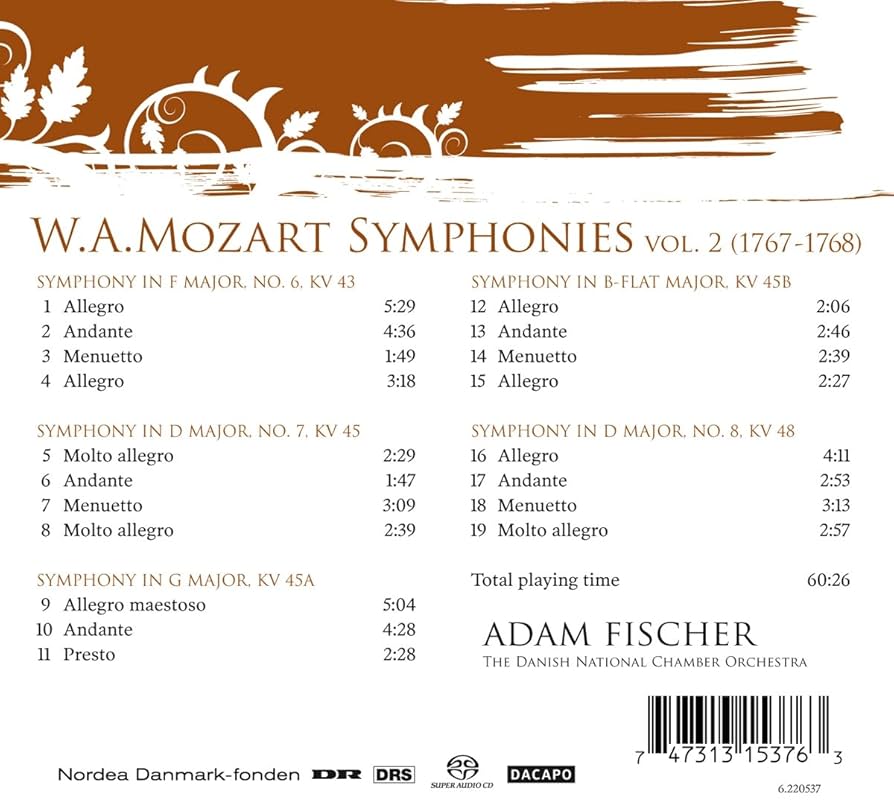
Vol. 2 from Symphonies on Da Capo
Works
Symphony 6 in F Major, K. 43 (15.12)
Symphony 7 in D Major, K. 45 (10.04)
Symphony in G Major, K. 45a (12.00)
Symphony in B-flat Major, K. 45b (9.58)
Symphony 8 in D Major, K. 48 (13.14)
Performers
Danish National Chamber Orchestra
Ádám Fischer, conductor
Label: Da Capo
Year: 2013
Total Timing: 60.28
Comments
Post a Comment