Rautavaara: The Myth of Sampo
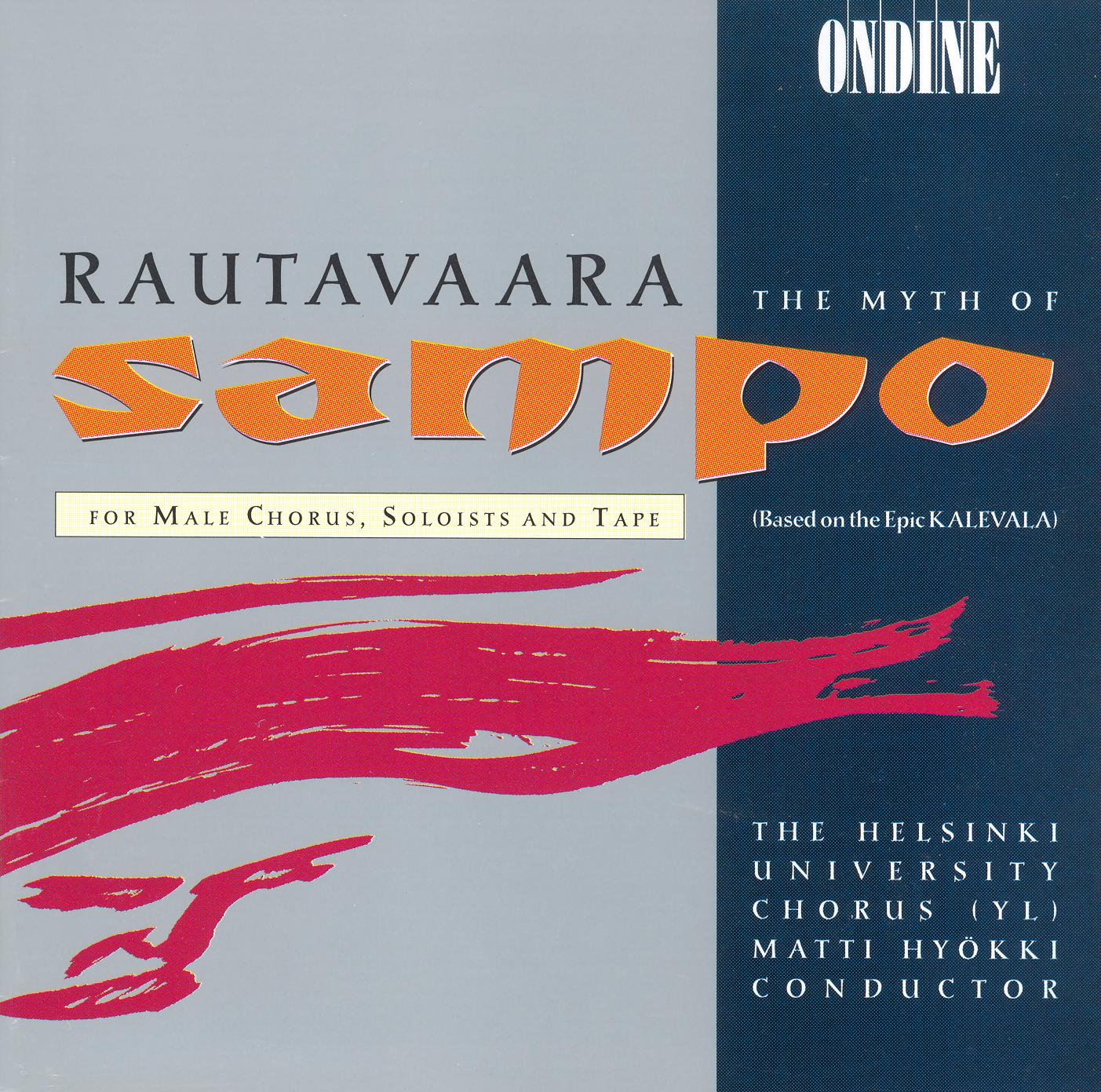
Well, if I thought I had traversed the strangest conceptions from the musical mind of Finnish composer Einojuhani Rautavaara in his True & False Unicorn and Marjatta, Lowly Maiden, along comes The Myth of Sampo.
If you know Rautavaara's Sixth Symphony, subtitled 'Vincentiana', you will know a little of what you are getting into. Instead of an orchestra, chamber ensemble, piano, or the like, The Myth of Sampo comes with pre-recorded synthesizer and electronica. Think Blade Runner or Flash Gordon. The male-voiced chorus and vocal soloists essentially sing a cappella, for the canned music is less pitched than it is trippy.
The subject of this cantata (cantata seems much more apt) comes from The Kalevala, a Finnish mythology also traversed by Jean Sibelius in his compositions. Mortals, Demigods, and Gods interact willy-nilly here.
The subject of Sampo is a trickier matter. Without knowing anything going into this recording, I assumed Sampo was a person or figure. Strike one! Sampo seems to be an indescribable object which everyone greatly desires, but eventually loses to time immemorial. This mystical item can apparently grant great wealth or generate unlimited food or gold, but nothing physical regarding Sampo is described in this story, other than it is rooted to the ground, possibly very heavy, so much so as to require a Pohjolan bull to uproot it, and Sampo has a beautiful cover. To my mind, think a mixture of The One Ring, the Djinn's Lamp, the Ark of the Covenant, Yggdrasil, and the Cosmic Mill.
More important than what this unexplainable object is, is its desirousness by others. In this case, Sampo is kept in Pohjola and is to be stolen by the main singing characters on this recording in order to keep it safe and away from harm or others. In a parallel to the 1960s song One Tin Soldier, no one ends up with Sampo and everyone would have been much better off leaving it alone in the first place. Some places name this work The Rape of Sampo, although perhaps The Burglary of Sampo would be a more contemporary choice. Although, those who have seen Withnail and I will find such a choice perverse, I think.
So what to make of the 50-minute work? The Myth of Sampo is not for casual listening, unless you play it for Halloween. I daresay, there isn't much direction reading along with the translation either, other than to secure the listener's footing by knowing what is going on. The pre-recorded synthesizers give an otherworldly, ethereal quality, as if what is occurring would never happen on Earth, but instead plays out amongst the Æther of Spheres. Those who have the capability of hearing the right-to-left stereo effects will receive a mighty treat in sonic splendor.
The choral elements are securely and excellently sung. Performing with pre-recorded material can be treacherous for unassuming ensembles, as timing and pitch can make or break works such as these. The Helsinki University Chorus continues to amaze me as a singing ensemble, dedicated to performing and recording Finnish music, no matter how conservative or modern it is, and fabulously at that. Kudos to Matti Hyökki for drawing such a robust sound from the group, as well as sheer musicianship, even in such an unusual work such as The Myth of Sampo.
The three male vocal soloists have taken on a thankless job communicating this strange story amidst unusual accompaniment and choral backing. I think they do admirable justice to their roles, plus the prologue and epilogue is spoken by Rautavaara himself, a rare meeting of composer, performer, and recording.
The recording itself is very atmospheric, placing the soloists, chorus, and recorded sounds together ideally. For some reason, the soundscape for the performers becomes very dry during track 11, as if the engineers forgot to add some reverb to the performing voices at that moment. Things right themselves again in track 12, but I thought I would share this sonic oddity.
I would say The Myth of Sampo is only for the Rautavaara adventurous. I love these strange pieces, where most would react with a 'what is this?'. In that vein, I think this music is approachable. The music is not particularly dissonant; it is simply weird if anything. Right up my alley!

Works
The Myth of Sampo
Soloists
Pasi Hyökki, countertenor
Tom Nyman, tenor
Sauli Tiilikainen, baritone
Antti Suhonen, bass
Einojuhani Rautavaara, narrator
Ensembles
Helsinki University Chorus
Matti Hyökki, conductor
Label: Ondine
Year: 1995
Total Timing: 53.17
The Myth of Sampo
Soloists
Pasi Hyökki, countertenor
Tom Nyman, tenor
Sauli Tiilikainen, baritone
Antti Suhonen, bass
Einojuhani Rautavaara, narrator
Ensembles
Helsinki University Chorus
Matti Hyökki, conductor
Label: Ondine
Year: 1995
Total Timing: 53.17
I could easily give this recording full marks, and maybe at some point in the future I will. The performances are truly excellent and I enjoy the sheer audacity of these outside-of-the-box compositions.
But The Myth of Sampo will have a limited audience, and I am not sure how often even I will give it a revisit.

Find more Rautavaara recordings HERE!
Comments
Post a Comment