Parry: Prometheus Unbound

Here, the AI image is blatant. The cover art is very exciting, I daresay much more than anything present on the recording aurally. Yet, I don't know whether to be insulted or impressed. Was this AI-created image used to boost sales, letting the eye-catching features to lure in listeners?
I suppose it matters not for an audio recording, for the most important focus is on the music. Prometheus Unbound, or more accurately Scenes from Shelley's Prometheus Unbound, is Hubert Parry's first large-scale choral/orchestral work. The liner notes make a big deal regarding the influence of Richard Wagner upon Parry, having already met the German composer before this work was completed. Truthfully, if there is an importance to this 60-minute cantata, it is the through-line of Brahms/Wagner to Hubert Parry to Edward Elgar, where the magical coming together of historical influences shows most brightly across time.
I have much the same feeling in Prometheus Unbound as I do for most of Parry's choral/orchestral oratorios and cantatas. The choruses are sturdy if not amazing, sagging from overly-flowery texts and intricate part work amongst the chorus. By the end, I am reminded more and more of Handel, with a particularly grand conclusion with a tried-and-true fugal choral setting. As a younger lad, I would have slurped a work like this up with a spoon, but now that I have heard innumerous pieces such as this, it is hard to get overly excited. Older age is so unexciting in this way.
On the upside, I absolutely love how Parry represents the appearance of the Demogorgon. Instead of loud chaos, with brass and percussion a-blazing, the Demogorgon is represented musically through hushed chorus, as if ancient and dangerous. It is an intimidating moment in the musical story, and an inspired choice from the composer.
The vocal solos are OK too, although I prefer the action scenes of Prometheus and Mercury, and the big Jupiter number beginning Act II. The two female solos, as spiritual commenters, seem redundant and unnecessary, simply adding scene dressing to an already well-bedecked work. Perhaps this is what reminds me of Elgar...
Parry gives plenty for the orchestra to do away from the chorus and solos, with preludes and interludes a-plenty, as well as sizeable introductory and concluding portions to the vocal numbers. The orchestra may not be the focal point of the work, but at least the instrumentalists are not relegated to mere accompaniment.
It is too bad Chandos couldn't secure an ensemble such as the LSO, LPO, RPO, Liverpool, Bournemouth, or the wealth of BBC orchestras as Chandos would have during the Richard Hickox years. While the London Mozart Players are a fine ensemble, I can ably sense the smaller scale of the string section in particular, although the group as a whole plays with a lovely tone and fine front-desk solos.
So too, the Crouch End Festival Chorus might not be the first symphonic chorus to come to mind on Chandos, but they actually traverse the music quite confidently. When the sopranos and altos have to split into six or eight parts, one senses this could have been an even larger chorus than the 80-or-so present on the recording already. Also, this is another straight-toned soprano section, a quality which irks me personally, here not necessarily affecting pitch, but rather vowel production in the women's sections.
What is it lately with high-caliber vocal soloists with too wide vibrato? I would say both Neal Davies as Prometheus and Sarah Connolly exhibit this vibrato element most unwelcomely, less so tenor David Butt Philip, who is somewhat tasked by the high tessitura. Soprano Sarah Fox comes out unscathed, and is my preference from the quartet of soloists. I can't say it ruined the production, for these are professionals, but by golly I would like to hear more pitch than wide ululations.
That leaves William Vann, a choral conductor I mostly know for his traversal of Ralph Vaughan Williams on the Albion label with the Royal Hospital Chelsea Chelsea Choir, a wonderful choral ensemble. I guess he is trying to make his way into the symphonic choral realm through two recordings on Chandos. Vann moves the music along well enough, where I don't think even he can make Parry's music rise to utter brilliance. This is a handsome production, and Vann can hold his head high; I simply have a lot of nitpickery to share. Welcome to the Big Leagues!
Ah... I didn't speak to Blest Pair of Sirens, widely considered Parry's choral/orchestral masterpiece alongside I Was Glad and Jerusalem, all noticeably shorter works. Since Chandos already has two recordings of Blest Pair of Sirens in the catalog, from Hickox and Bamert, it was wise for William Vann to move the music along in the mold of Robert King on Vivat. Certainly, the performers are really on their game 100% here, with not a crack in the pavement. I often use my wife as a barometer of what works on a recording we listen to, and she unequivocally believed this piece to be far and away the best on the album. She did mention a few tracks from Prometheus which she enjoyed, but she specifically mentioned Blest Pair of Sirens as her favorite.
Truth be told, knowing Parry's cantatas and oratorios from Matthias Bamert on Chandos (BLOG) previously, I had a feeling the earlier Prometheus Unbound wasn't going to outgun his later works, some of which which were not especial favorites of mine either. This recording makes for engaging listening, but very little of the music stands out on its own. Perhaps it is the AI cover art which simply promises too much.
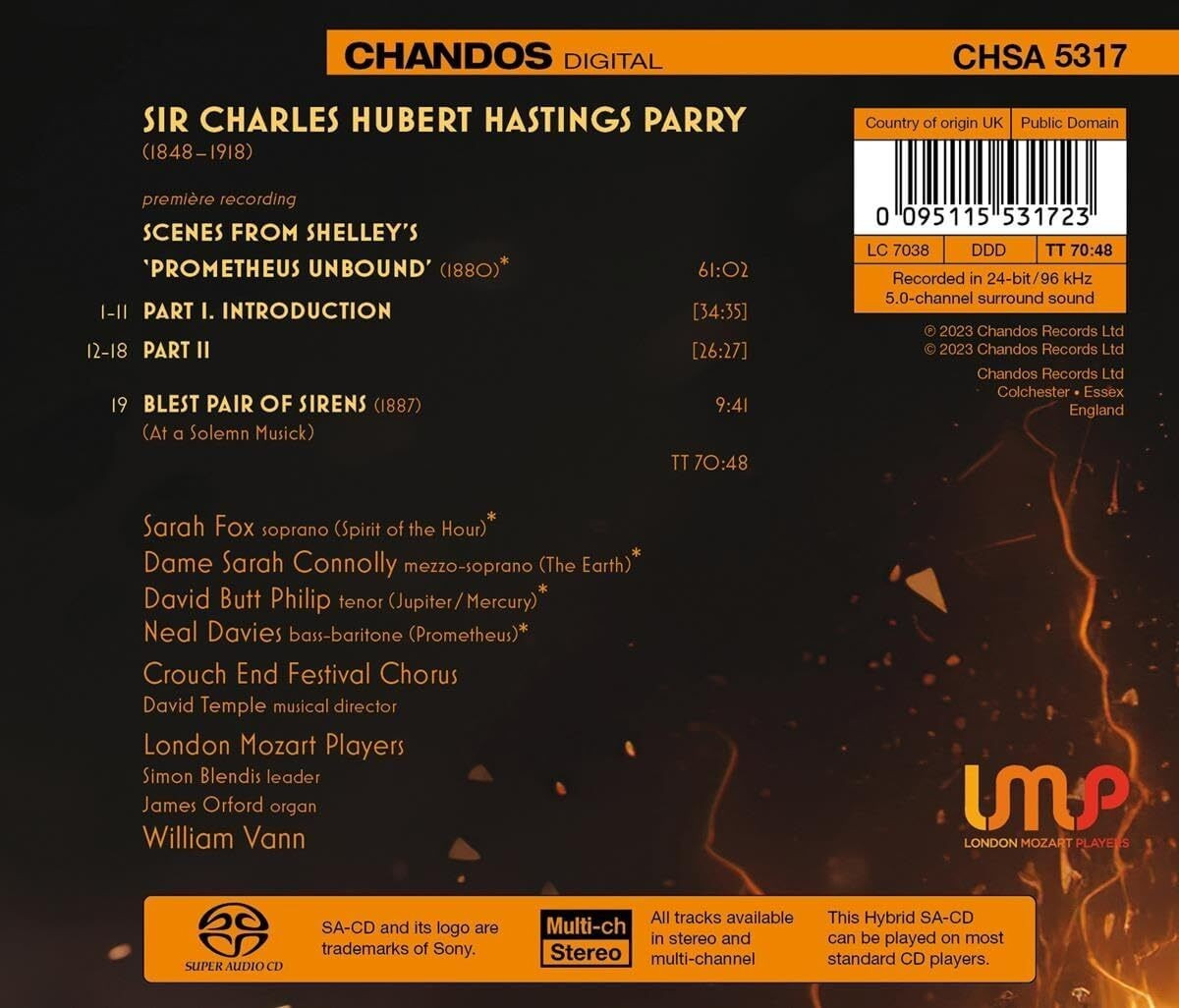
Works
Prometheus Unbound (61.01)
Blest Pair of Sirens (9.41)
Soloists
Sarah Fox, soprano
Sarah Connolly, mezzo-soprano
David Butt Philip, tenor
Neal Davies, baritone
Ensembles
Crouch End Festival Chorus
London Mozart Players
William Vann, conductor
Year: 2023
Label: Chandos
Total Timing: 70.48
Parry was a master of the Victorian-Era choral/orchestral work, of which Prometheus Unbound is an early example.
The performances are worthy, even if I have a nitpick regarding nearly every performing force at hand. The SACD sound is excellent however.

Find more Parry recordings HERE!
Comments
Post a Comment