Roussel: Evocations
While I don't find the work necessarily exotic, French musical Impressionism always had its own brand of exoticism about it to my ears. If there were a more exotic flavor to any part of the piece, it would be the second movement, with its pentatonic statements, ones which sound culturally ambiguous.
I adore the opening movement, which to me sounds like a 'Morning Moods', Earth awakening sort of start to the work. The horns and bassoons have a wonderful call to the day, evoking an atmospheric calm. The movement doesn't remain that way throughout its 13 minutes however, for there is a more dramatic uptick in tempo in the middle section, only to return to nature's reveries.
The second movement is a Scherzo of sorts, with a slower portion at its center, one of an airy mysteriousness. Otherwise, there is almost a folk-dance mischievousness in the upbeat outer portions, again, recalling far flung places at times, as well as a certain musical heroism when the horns show up.
The long third movement is somewhat befuddling, albeit an appreciative befuddlement. The chorus occasionally sings words, but more often than not, vocalizes on 'ahhs' as an orchestral texture, rather than a showcase ensemble with important texts to convey. The soloists enter one at a time, first tenor, then contralto, and finally baritone, the latter with a French patter-song setup, the trio never singing together. The work ends as calmly and airy as it began, this time with choir present.
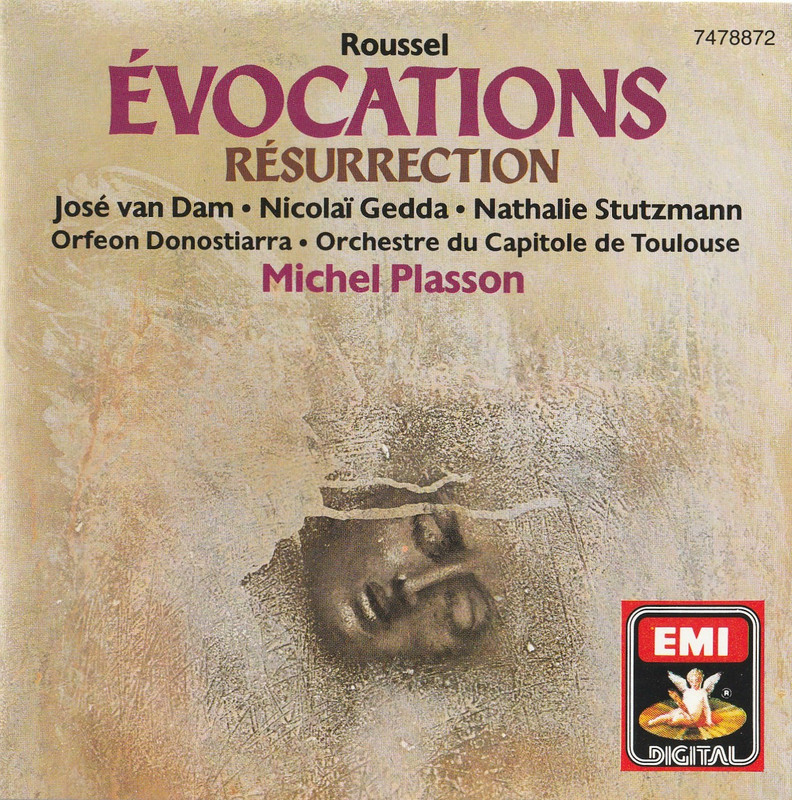
This recording was afforded an all-star lineup of vocal soloists, including Nathalie Stutzmann, now Music Director of the Atlanta Symphony Orchestra. Even starrier are the great Nicolaї Gedda and José van Dam, more than what this piece probably requires, although I am not complaining. The Spanish adult chorus Orfeón Donostiarra does fine work, but is generally not focused on over the orchestra.
As an extra to fill out the runtime on this Roussel recording, the composer's early Résurrection is performed. If there are Impressionist leanings in Évocations, Résurrection is full-on misty. I do like that Roussel uses brass instruments for his orchestral colorings, for his music is afforded a different sound than Impressionism usually infers, plus Roussel was never afraid of a melody once in a while, nor a turn into a muscly diversion or fleet tempo. That said, Résurrection is not a favorite of mine, even if I enjoy Roussel given over to some Romantic tendencies here and there. Give me the Suite in F Major any day!
As far as the orchestra is concerned, Michel Plasson had a fine ensemble at his hands. This recording is old enough that the Toulouse Capitole Theatre Orchestra retained a fine French sheen in the strings, with some piquant tang present in the winds and brass. I do wish the harp was a little more forward, for it is in use throughout these pieces. The EMI / Erato sound is warm, if not as focused with inner-orchestral clarity as Évocations received on Chandos. On the other hand, I wasn't as wild about the soloists there. I have still to visit Zdeněk Košler recording of the work on Supraphon.

Works
Résurrection, op. 4 (12.43)
Évocations, op. 15 (45.00)
Soloists
Nathalie Stutzmann, contralto
Nicolaї Gedda, tenor
José van Dam, baritone
Ensembles
Orfeón Donostiarra
Orchestre du Capitole de Toulouse
Michel Plasson, conductor
Label: EMI
Year: 1987
Total Timing: 55.06
Impressionism was never my thing, but thankfully, Roussel never fully committed to it either. Thus I can enjoy these works just fine.
The big news is the rare Évocations, here with a starry lineup of vocal soloists and a warm recording from EMI. I am not wildly attracted to the work as a whole, but it makes for an interesting listen, as is often the case with Roussel.

Find more Roussel recordings HERE!
Comments
Post a Comment