Enescu: Piano Quartet
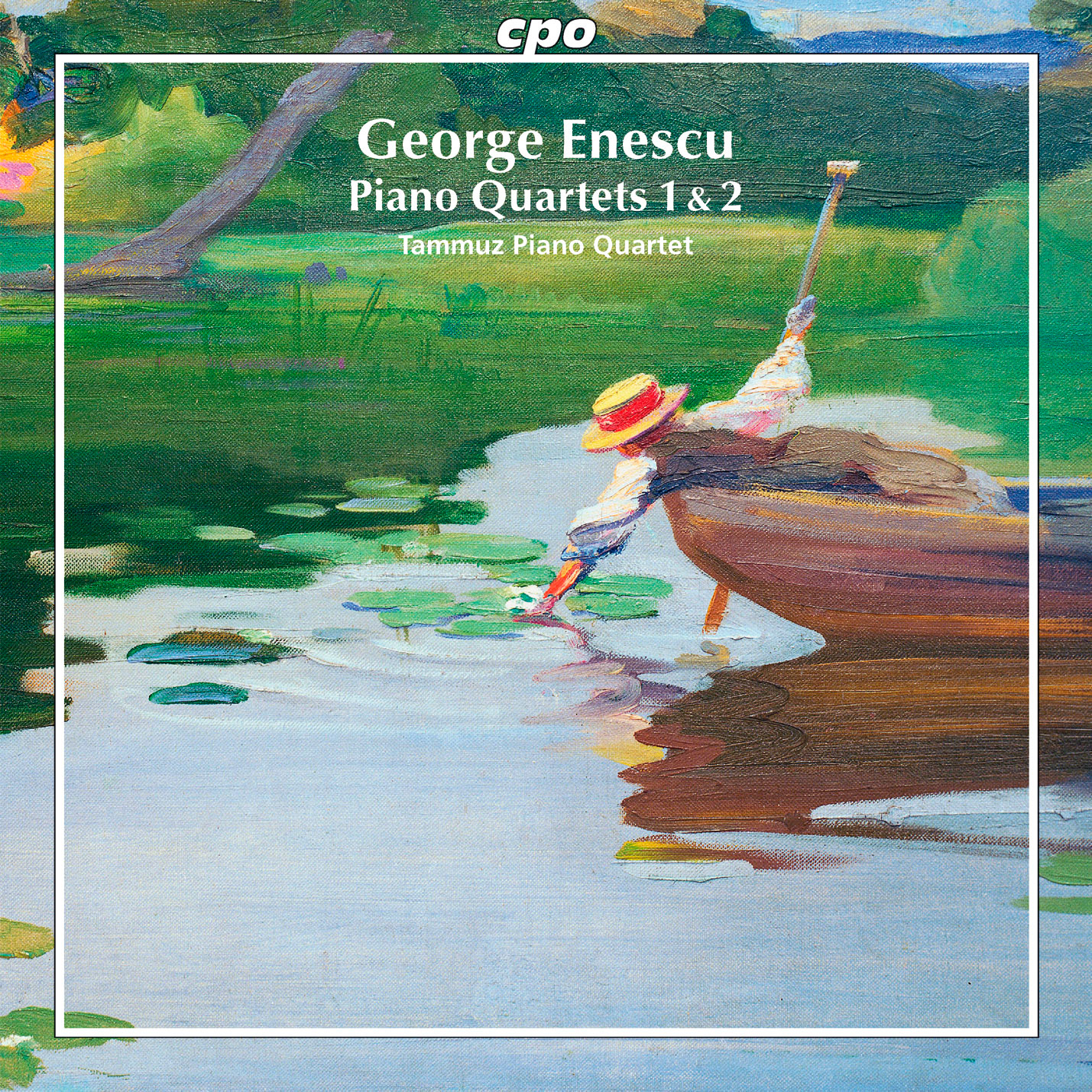
I have become rather discouraged exploring the music of Romanian composer George Enescu. Aside from some folk-influenced orchestral music I knew previously, a song cycle, the Dixtuor, and early fragments and sketches pieced together by people who are not Enescu, the composer's absolute music has left me wanting in one way or another.
That is until now. These two piano quartets connected with me immediately, a sigh of relief coming from this listener. I don't enjoy not caring for music, but such things are inevitable. Astoundingly, the piano quartets come from different compositional periods, yet they make a rather pleasing duo.
The first movement of Piano Quartet no. 1 in D Major is a blockbuster. Interesting too since Enescu opens with the instruments in unison, a unifying idea which returns later on, and a texture I have never been too hot for, unison-playing ensembles for any length of time that is. Somehow, Enescu makes the music bloom from these unison statements, with a style not too far removed from Rachmaninov at his most grandiose, I think; perhaps even a little Liberace sprinkled in too. If there were a grand ballroom, this would be the indulgent music to showcase the space, for sure. The rippling and cascading piano gestures are unending, although at the outset, it seems as if the piano was meant as a background to the string trio; such things do not last for long.
The second movement contains music as patient as Delius, although the static nature of the harmonies are decidedly French. Curious too, since the liner notes specifically quote Enescu as wanting to avoiding static motion. The composer teases the listener, for despite the lush chords, there is a feeling of drawing out a satisfying resolution, cycling through extended chords without really ever wanting to settle upon a defined home key for long. This is also where Enescu is at his most melodic, picking up a rather plaintive melody towards the beginning, later spinning into the plush Romanticisms reminiscent of the first movement. As ever, Enescu is very effective at bringing back the best material for his concluding thoughts, especially well done here.
The grand gestures return for the third movement of the First Piano Quartet, although here Enescu uses rising and falling chromatic half steps to build tension rather than hopping across far-flung harmonies. The piano is quite restless throughout the work too, and if this represents what Enescu's abilities were at the keyboard, he was quite a pianist, for this is virtuosic finger work. I enjoy the more aggressive attacks found across this finale, offering some reprieve from the luxurious music of the previous two movements, although Enescu still finds time for sweetness here and there.
By the way, has anyone caught a brief quotation of Wagner's Ride of the Valkyries at about the halfway point of the third movement? It doesn't last long, but there are essentially two extended musical phrases which remind me of that famous music before Enescu moves on to his Romantic noodling. Even shortly afterwords, there are tiny pop ups of the thematic idea on individual instruments, although cloaked among other musical lines going on simultaneously. Mystifying!
If there is a downside to the Piano Quartet no. 1, it is that the piece goes on for far too long. This has always been an issue I've had with the composer, and such feelings are no different here. The musical journey, however, is so much more captivating for this listener that its length bothers me far less.
Piano Quartet no. 2 in D minor is more spare than its sparkling earlier quartet partner. If this were a US-based a composer, I would assume the main melody of the first movement is Native American, so modal are its musical qualities. Instead, I must assume some of Enescu's Romanian influences show from time to time, brought on by a significant case of heterophony, an element from the composer I am glad the liner notes have brought to the fore in describing his compositions.
The minor key is not unduly morose, but there is a certain plaintive quality to this first movement which is beguiling. I am not wild about Enescu's climax in this first movement either, one which is a bit acrid in the thick chords he chooses to land upon in big moments. The ending, though, is extremely touching.
I should mention that Enescu does not delve into extended string techniques in the piano quartets like he does in the string quartets. Harmonics and sul ponticello are extremely rare, but can be found for the eagle-eared listeners. If anything, it is the use of portamento, a Romantic trait, which can be heard most prevalently.
As if picking up directly from where the first movement ends, the second movement uses the exact same material to open its doors. It doesn't take long for Enescu to return to Gallic musical qualities, although a bit more restrained and less flashy here. Like my first description of the Second Piano Quartet, there is a subtle bluesy element, where I am reminded of Samuel Barber from time to time, an unusual train of thought for me to have whilst listening.
The third movement keeps its secrets closer to its vest. It is not as concerned with melodies and overt virtuosity, nor does it seem Enescu is interested in a conclusion at all. Instead, the music whirls around at a rather moderate pace with more angular and spiky stabs of harmonies and textures. There is a sort-of stop-start feel to the music as well, one which never truly becomes resolved, with piecemeal motivic appearances. This is really the only time in these two pieces where I wasn't immediately taken with the music, oddly positioned at the very end of the work. Thankfully the chord preparation for the last two-or-three minutes is quite captivating, with a short reminder of the home key of the piece.
I appreciate how willing the Tammuz Quartet are to dig into this music. Never was I ever left with a feeling of ambivalence of emotion, nor of dedicated musicianship. They attack the music with passion, probably elevating this music from previous iterations. The CPO sonics and liner notes are a model of its kind.

Works
Piano Quartet 1 in D Major, op. 16 (36.31)
Piano Quartet 2 in D minor, op. 30 (28.33)
Performers
Tammuz Quartet
Daniel Gaede, violin
Lars Anders Tomter, viola
Gustav Rivinius, cello
Oliver Triendl, piano
Label: CPO
Year: 2010
Total Timing: 65.40
I had all but given up hope I was going to connect with the absolute music of George Enescu.
Leave it to the moment I come to the end of his chamber music find some pieces which tickled my fancy.
The Tammuz Quartet and the CPO production are excellent as well!

Find more Enescu recordings HERE!
Comments
Post a Comment