Arnold: Concertos for Two Violins, Viola, Oboe, Flute, and Recorder

I have really come around to Malcolm Arnold's Concerto for Two Violins, mainly through a recent recording on the Orchid label (BLOG).
The work has enough light, rhythmic wit amongst modern dissonance to maintain likeability. And as with all of these concertos, the scope is rather concise, especially compared to the longer, more emotionally heavy symphonies.
Sometimes Arnold is tuneful and lush, but he just as often will change on a dime to stark harshness. In the Double Violin Concerto, the composer often likes to have the violins in uncomfortably close intervals, making for some rather piercing harmonies at times. Sir Malcolm always relinquishes from these moments, but the middle movement is especially notable for these close-knit violin effects.
I particularly enjoy the final movement, which sounds to me like Murder-Mystery music. Those plucked bass lines and skitterish modal/minor harmonies catch me as likeable at every turn. Yet, there is also something about how the composer goes away from and comes back to these musical ideas which sounds special to my ears.

As is typical of Malcolm Arnold, the first movement mixes the serious with the light, here with little syncopated dance-like rhythms dotted opposite soaring lyricisms. To me, the opening finds the composer at his most cinematic, and as some of the other concertos here are written for string orchestra only, adds appreciable color through its use of ensemble winds.
Sir Malcolm gives a beautiful melody to the viola in the second movement, overlaid with interestingly clashing held-out polyphonic chords from various sections of the orchestra. Arnold's love of a moving bass pizzicato lines makes its way in here as well. At times, this middle-movement music is simply frightening, fraught with eerie tones.
Usually, the finale is all lightness amidst soloistic virtuosity. The bouncy tune in the third movement could come straight from Percy Grainger's folk settings, but there is more of the acerbic married to that idea. Of course, at just 2-and-1/2 minutes, the finale is nearly over as soon as it begins.

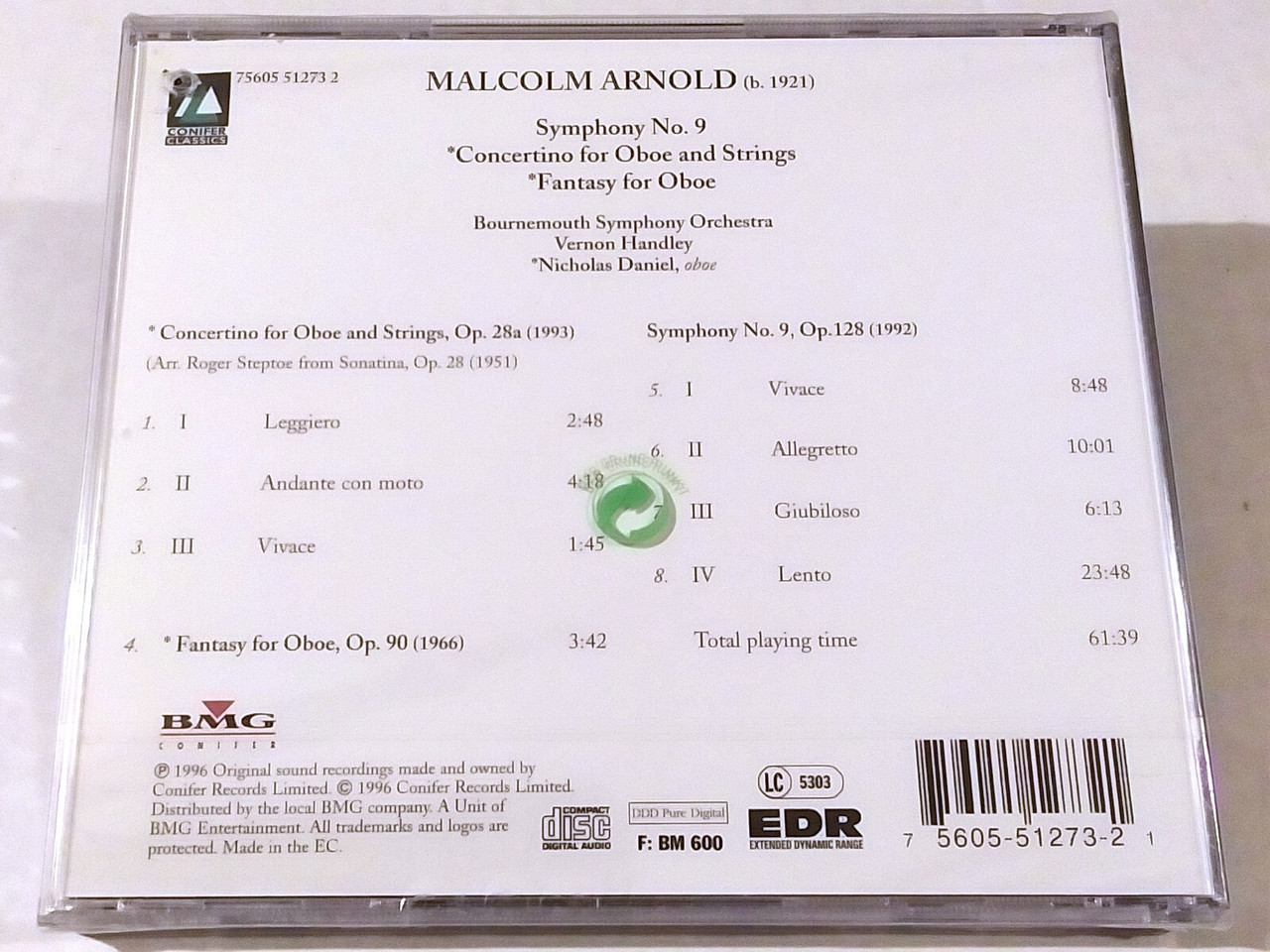
This is a wee little piece, which joyfully opens with the bright piping of Nicholas Daniel's oboe. Whatever sinister turns Arnold tries to inject into the first movement, the oboe brings nothing but sunshine.
The plaintive double-reed instrument is well matched to how Sir Malcolm likes to approach a central movement, again one longer than the surrounding two movements. Vacillating string chords cushion long lines from the oboe, with thick, lush string ensemble moments at its center.
As expected, the even shorter final movement is full of quick motion and rustic vibrancy. As I don't think anyone else has recorded it, hearing this short Oboe Concertino is a pure delight.

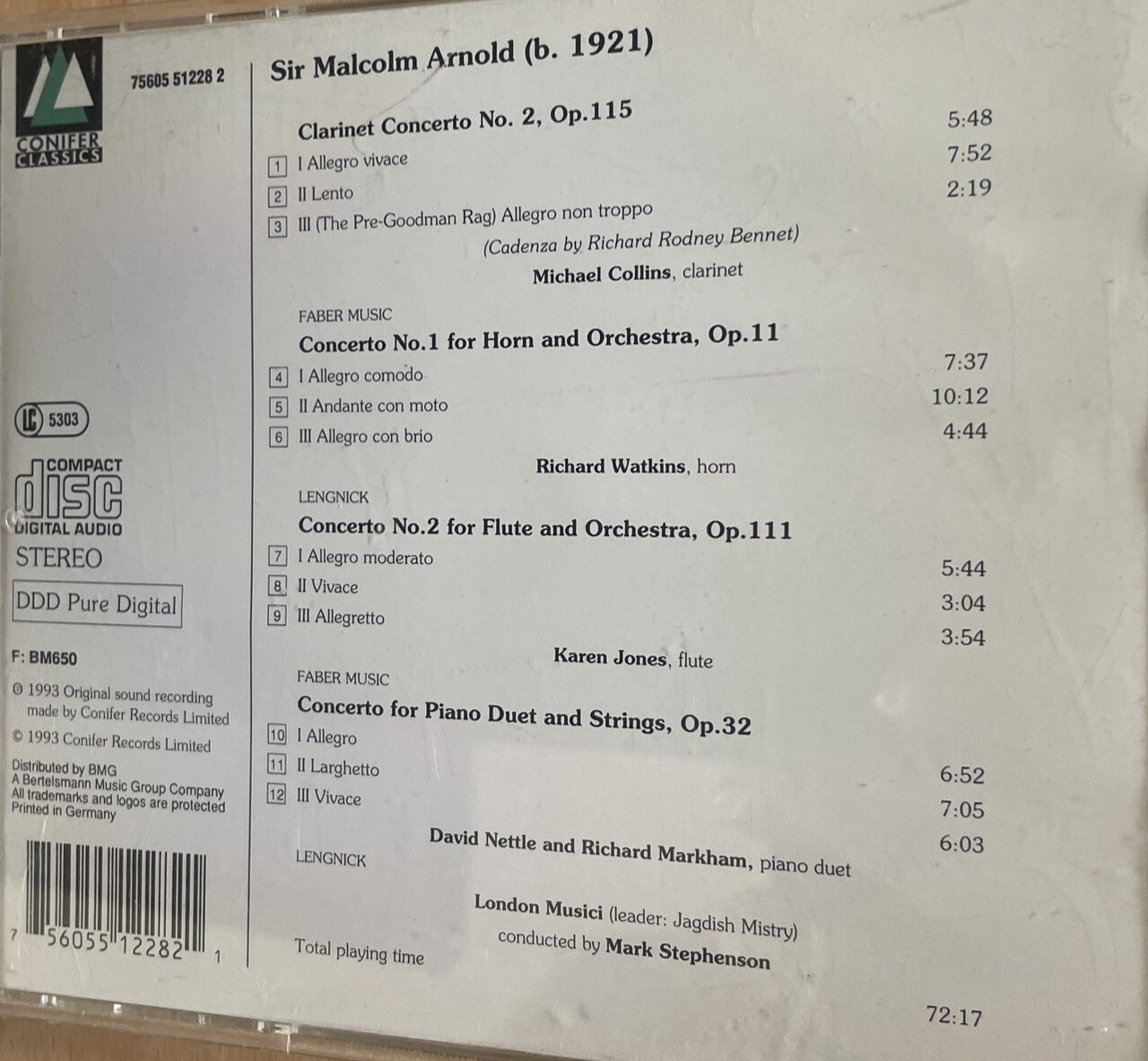
Where the middle movement is usually a place for Malcolm Arnold to inject angsty modernism, this second movement is amongst the composer's most divine. He does add flecks of striking dissonance, and again that pizzicato bass line is found here, but on the whole, this portion is a beautiful crown-jewel of his concertos, no doubt aided by Karen Jones' flute and the London Musici led by Mark Stephenson.
A jumpy, virtuosic finale ends the piece in fine fashion. I daresay, this might be Arnold's finest concerto amongst this grouping.

That said, Malcolm Arnold is very judicious in his use of orchestra in the first movement, often leaving the flute to play alone, while the orchestra jabs here and there. On the other hand, while the flute is resting, the orchestra is given sizeable moments all to itself, so there is plenty of give and take, all coming together towards the end of the movement.
Of the concertos represented on this program, the Second Flute Concerto contains the shortest center movement, plus it is the only work where the outer movements are longer than the single inner movement. Strange too, as the second movement is the fastest tempo marking, here at Vivace. I guess the first movement contained enough lyricism to satiate Arnold, with the composer placing the slowest Allegretto at the end.
Despite such a statement, the third and last movement is more of a dance. I would say it is a slow waltz, however the music sounds more erudite and proper than that; perhaps a society Minuet? Either way, Arnold walks away from his normal structures, even if all of his hallmark music is here. At least among the ones I am covering on this blog post.

This performance of Sir Malcolm Arnold's Recorder Concerto comes from RCA's release of Okko Kamu leading the English Chamber Orchestra with Michala Petri on recorder, for whom this concerto was written.
I love the conflict of a 20th-Century musical style married to a Renaissance instrument. It is done effectively here, even if the work sounds a little Neo-Baroque rather than in Arnold's singular style. I am oft reminded of Carl Nielsen to some degree in this music.
I notice the recorder has little in the way of dynamic variation, despite instructions from the composer to do so. I don't know if that attribute rests on the part of Petri or from her instrument's limitations opposite a modern orchestra backdrop. Either way, the recorder is ably heard against the ECO.
It is the middle movement, with its plucked bass line and murder-mystery atmosphere, not to mention eye winks at final cadences, which garners most of my attention. Otherwise, the outer movements have some wonderful arpeggios and slinky slides for the recorder to sail across, piping merrily no matter where the composer thrusts the instrument.
The Recorded Concerto could be an easy entry point for someone to discover the absolute music of Malcolm Arnold, at least amongst the concertos I covered here. This specific confluence of concertos comes from CD1 of Decca's Malcolm Arnold Edition.
As far as Malcolm Arnold's string and wind concertos go, these have little emotional baggage compared to symphonies, which I just covered (BLOG). Sure there is heavier-laced emotional settings here, but gifted to the listener in rather short measure. I like this aspect of these works, where Arnold provides delightful little packages of solo instrument and ensemble music.
Work Series
Vol. 1 from Concertos on Decca
Works
Two-Violin Concerto, op. 77 (15.32)
Viola Concerto, op. 108 (20.06)
Oboe Concertino, op. 28a (8.55)
Flute Concerto 1, op. 45 (10.49)
Flute Concerto 2, op. 111 (12. 50)
Recorder Concerto, op. 133 (11.08)
Soloists
Kenneth Sillito, violin
Lyn Fletcher, violin
Rivka Golani, viola
Michael Daniel, oboe
Karen Jones, flute
Michala Petri, recorder
Performers
London Musici
Mark Stephenson, conductor
Bournemouth Symphony Orchestra (op. 28a)
Vernon Handley, conductor
English Chamber Orchestra
Okko Kamu, conductor
Label: Conifer / RCA; Decca
Year: 1988-1994; 2006
Total Timing: 79.33
Find more Arnold recordings HERE!



Comments
Post a Comment