Arnold: Clarinet & Horn Concertos

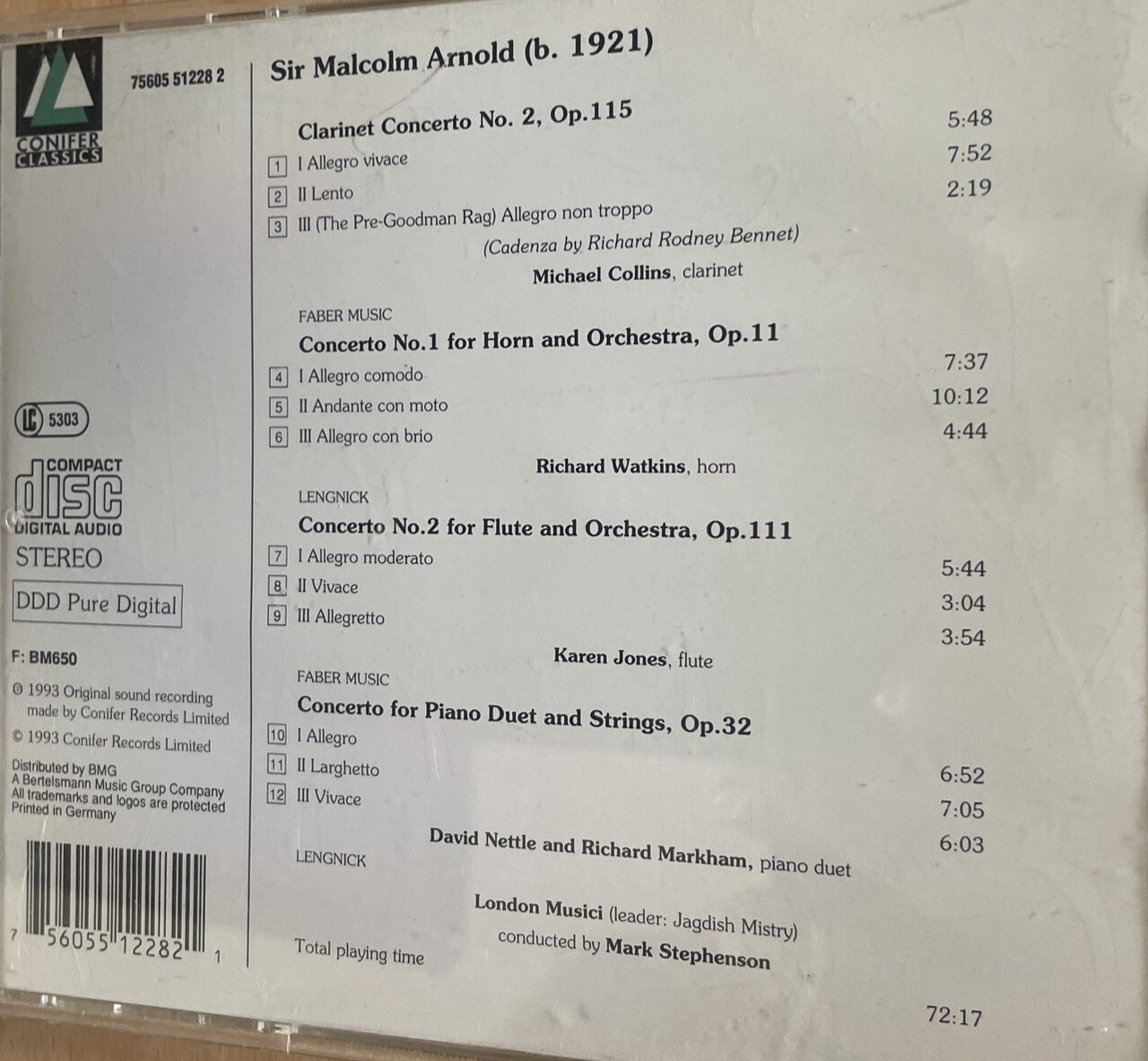
Of course, he had none other than Dennis Brain in mind for the horn role, so any virtuosity is unsurprising. Richard Watkins is the horn player on this recording, a British musician who held the Dennis Brain chair at the Royal College of Music, for a bit of connection to this music.
Horn Concerto no. 1 has a pert, pastoral quality at its start; an affable beginning to a longer concerto from Arnold. What makes the concerto so long is its 10-minute center movement, full of pensive and uneasy motions. The finale ends on horn whoops, easily making my wife chuckle. Otherwise, this last portion brings back the rustic feelings from the opening, but with much more wit and certainly more hunting horn figures.

In the first movement, Sir Malcolm divvies up cinematic moods alongside harmonic uncertainty, a hallmark of the composer.
I should mention the equal partnership of the orchestra with the soloist, for the composer loved the orchestra as a conveyance for music making. It seems in these concertos with the horn, Arnold gives even more presence to the ensemble in relation to the soloist. Conversely, Richard Watkins really assails any marking of fortissimo the composer asks for in the score.
The second movement is absolutely lovely, with a lyrical melody line in the horn and a gentle 3/4 time underlining the beauty. In the middle, Arnold stacks pitches in the strings, making for a unique sound from the composer, including horn smears. And as mentioned previously, the last movement is a fast romp making for a breathless horn workout. For horn lovers, these two concertos really give the whole gamut of what the instrument is able to do.

Odd how Conifer split up both the two clarinet and two horn concertos across two separate releases, pictured above. You would think listeners would want to gather them together instead of having them apart. Regardless, Conifer pairs the Second Horn Concerto with Clarinet Concerto no. 1 here. Arnold really understand the bright, cheeky quality the clarinet is capable of, and begins the First Clarinet Concerto in such a mood. The syncopated rhythms certainly add to Sir Malcolm's eye-twinkling wit.
The rest of the First Clarinet Concerto is rather forlorn, rarely coming back to the affability of the opening. I daresay the second movement is rather heavy in its dour mood, only held back by the clarinet's timbre and occasional quick figures. Even the latter can't shake the mood Arnold sets.
The composer strong arms the last movement to play out in a rather unfriendly way too, not wanting to let up its feeling of unease. Again, the clarinet tries, but the strings are unwilling to lift the mood towards a positive resolution. This makes for a rather uneven experience amongst his concertos, but not all together un-Arnold like.
Clarinet Concerto no. 2 opens in a continuingly unfriendly manner, hitting the listener with some gruff orchestral statements; although remember these two clarinet concertos are separated by nearly 30 years from one another. Continuation is only in terms of hearing the two works back to back. Like the Horn Concertos, Arnold really explores the range of the instrument here.
The first-movement cadenza is a bit of audacity on the part of the composer, asking the clarinettist to improvise in a 'way-out', 'jazzy' manner. British clarinet player Michael Collins begins this portion rather straight, but eventually relinquishes fully into virtuosic flourishes reminiscent of jazz.
Lush chords cushion the clarinet in the middle movement, almost evoking a cinematic ballad in the center of this concerto. The commission of the Second Clarinet Concerto from jazz-giant Benny Goodman is fully fleshed out in a rollicking third-movement ragtime style. This leads into a more lyrical popular song and later a parade march, with the rag returning for the last portion once again. This is pure virtuosity for both clarinet and orchestra, a riotous conclusion to an Arnold concerto, showing the composer had no end of wit and invention.
Work Series
Vol. 2 from Concertos on Decca
The first-movement cadenza is a bit of audacity on the part of the composer, asking the clarinettist to improvise in a 'way-out', 'jazzy' manner. British clarinet player Michael Collins begins this portion rather straight, but eventually relinquishes fully into virtuosic flourishes reminiscent of jazz.
Lush chords cushion the clarinet in the middle movement, almost evoking a cinematic ballad in the center of this concerto. The commission of the Second Clarinet Concerto from jazz-giant Benny Goodman is fully fleshed out in a rollicking third-movement ragtime style. This leads into a more lyrical popular song and later a parade march, with the rag returning for the last portion once again. This is pure virtuosity for both clarinet and orchestra, a riotous conclusion to an Arnold concerto, showing the composer had no end of wit and invention.
Work Series
Vol. 2 from Concertos on Decca
Works
Clarinet Concerto 1, op. 20 (16.05)
Clarinet Concerto 2, op. 115 (16.10)
Horn Concerto 1, op. 11 (22.37)
Horn Concerto 2, op. 58 (14.02)
Soloists
Michael Collins, clarinet
Richard Watkins, horn
Performers
London Musici
Mark Stephenson, conductor
Label: Conifer; Decca
Year: 1988-1993; 2006
Total Timing: 69.03
Find more Arnold recordings HERE!

Comments
Post a Comment