Sibelius: Partsongs for Mixed Chorus
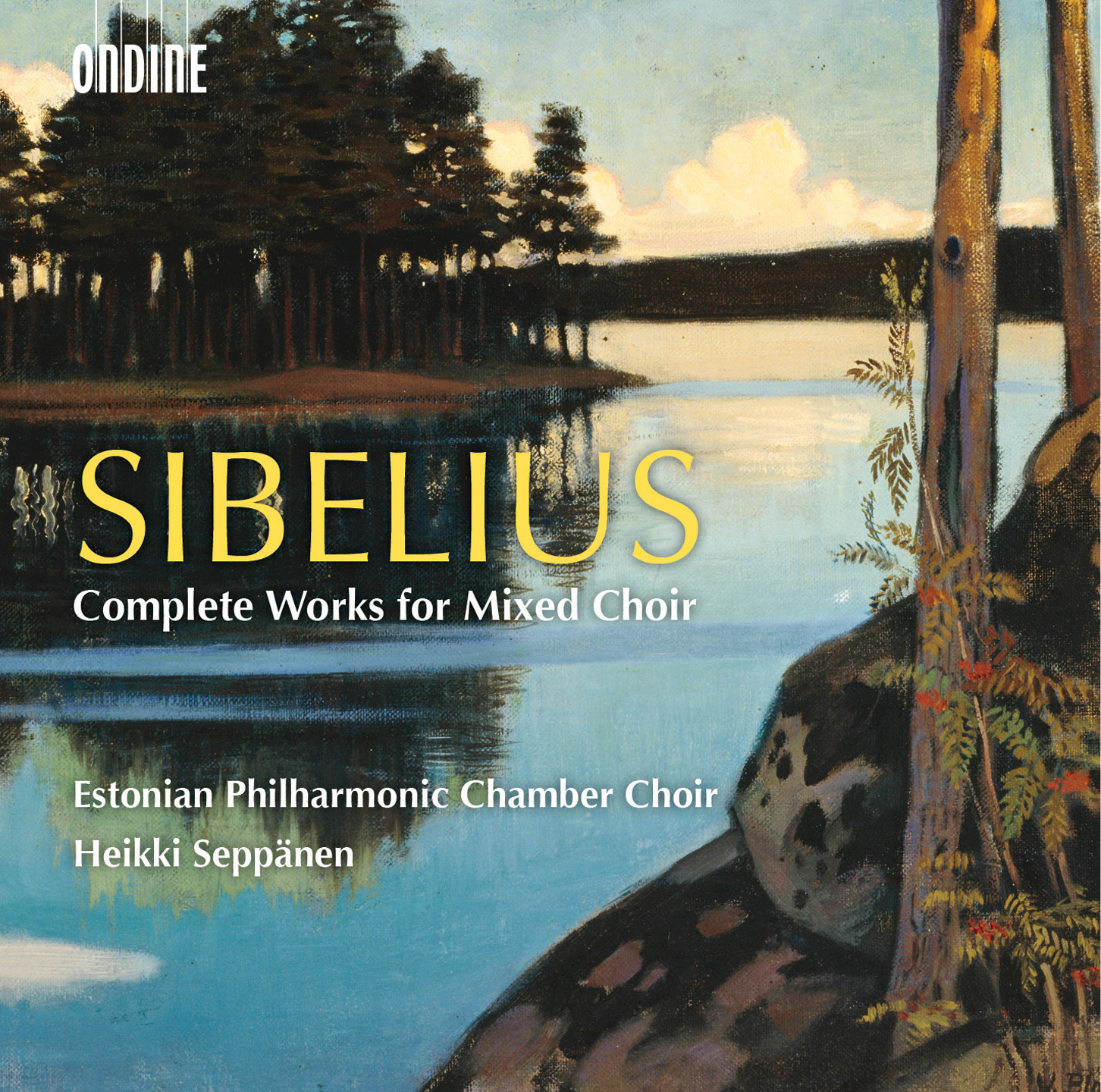
... I am not really taken with Sibelius' partsongs on the whole.
Some of them rise to the top with curious harmonic modalisms or differing textures. But as with the partsong genre in general, these works are meant for the general public to hear and perform, thus homophonic textures prevail and simple harmonic movement and vocal part writing is par for the course.
These aspects can sound quite exquisite, and indeed some do. The longer Rakastava is one of these, perhaps aided by the addition of solo voices, and where the difficulty is apparent. I think I may prefer Rakastava in its a cappella format, rather than the instrumental or combined versions. It is also perhaps the most famous on this long program. So too, the Nine Songs from the Promotional Cantata of 1897 includes soloists. The three vocalists across the recording are of a strong, unsubtle, and vibrato laden type, so preferences will vary. They do provide some variety amongst the smooth choral textures, though.
Most of the program is made up of individual choral pieces which range from 2 minutes in length to as short as 30 seconds. Some are strophic in form, as in hymns or very simple folk songs, but more often, there are a variety of moods showcased. Topics of Finnish patriotism to Christmas carols are represented, so there should be something for everyone, sacred and secular alike. Some composers work wonders with a small palate to work from, but I suspect Sibelius worked best on a larger landscape, even amongst his choral music.
There are quite a few songs written for school-aged singers, thus these pieces are of a stripped-down nature musically speaking. Carminalia comes with nine songs, three a cappella, three with piano, and three with harmonium. For a set of works for mixed choir, the number of choral songs written for sopranos and altos only is striking, mostly associated with these school songs which are the only ones coming with accompaniment. Three songs were written in English, and it is interesting to hear not only how Sibelius sets that language, but also how the Estonian singers tackle a Finnish composer setting English words to music.
The rest come and go pleasantly, but if listening to the entire album, a certain sameness runs across the program. We are even treated to two arrangements of The Finlandia Hymn, both from the hand of Sibelius. I personally prefer the A-flat version, for the F-Major arrangement has the men's singers hanging out in a higher tessitura, where the A-flat is spread out vocally. Seppänen tarries on neither, so if you are looking for a sappy, heartfelt rendition, this will not be it.

I have traditionally enjoyed the Estonian Philharmonic Chamber Choir very much. Some of my favorite recordings of important choral literature come from this group, such as in their fabulous Rachmaninov Vespers under Paul Hillier (BLOG). If I have a problem with this Sibelius program, it does not lie with these Estonian singers, for they have a lovely, well-balanced tone throughout. No, I suspect leader Heikki Seppänen could have simply led the group more characterfully and varied across the nearly sixty tracks of choral selections. Some of this might lie with Sibelius too, however.
Anytime a set has 'complete' in the title, I know not to be too rigid with such a description, yet I assume they get close here. I wonder if Ondine could have put this entire recording on a single SACD? Nonetheless, the physical media comes with a slip case and all of the songs come with printed texts in their original language and English.
Either way, this is a fine way to hear Sibelius' music for adult mixed choirs. The composer may be famous for his writings for male chorus, but often he arranged for both, making his creations available to a wider public. This is just another wonderful way to hear his talents applied to voice.
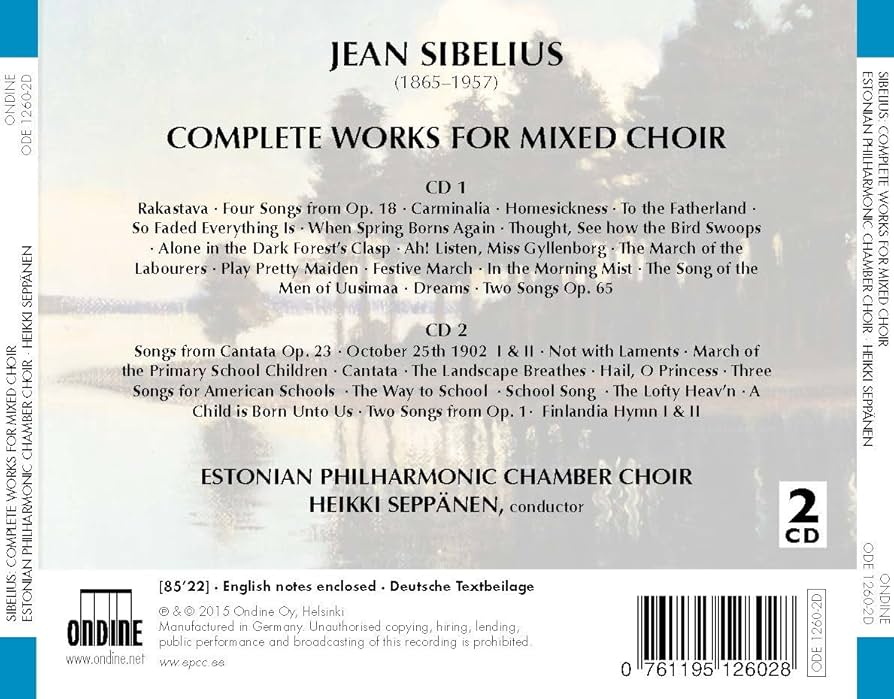
Soloists
Jenny Carlstedt, mezzo-soprano
Tuomas Katajala, tenor
Arttu Kataja, baritone
Folke Gräsbeck, piano & harmonium
Matleena Seppänen, triangle
Tuomo Lassila, cymbal
Ari-Pekka Mäenpää
Performers
Estonian Philharmonic Chamber Choir
Heikki Seppänen, conductor
Label: Ondine
Year: 2015
Total Timing: 1.43.51

Not Sibelius at his finest, but beautiful music all the same.
While I have nothing but plaudits for the Estonian singers, I think they might have been led by Seppänen with a little more variety and character.
Find more Sibelius recordings HERE!
Comments
Post a Comment