Saint-Saëns: Prix de Rome
For the Prix de Rome, French composers had to enter a vocal cantata on a pre-chosen libretto, essentially a truncated operatic scena, as well as a shorter choral work. As I understand it, the competitors spent the better part of a month locked up designing their compositions to be later pored over by a committee. The winner would have their works publicly performed and would travel to Rome for further studies.
Saint-Saëns entered the Prix de Rome twice as a composer; in 1852 and 1964. The first time the composer believed he was too young and overly ambitious to deserve the prize. The second time he was over the normal age limit for a composition submission, thus politics intervened to make sure he didn't win the prize. Politics, my friends, still exists in music competitions today, on of the reasons I don't particularly take to these sorts of musical honorariums.
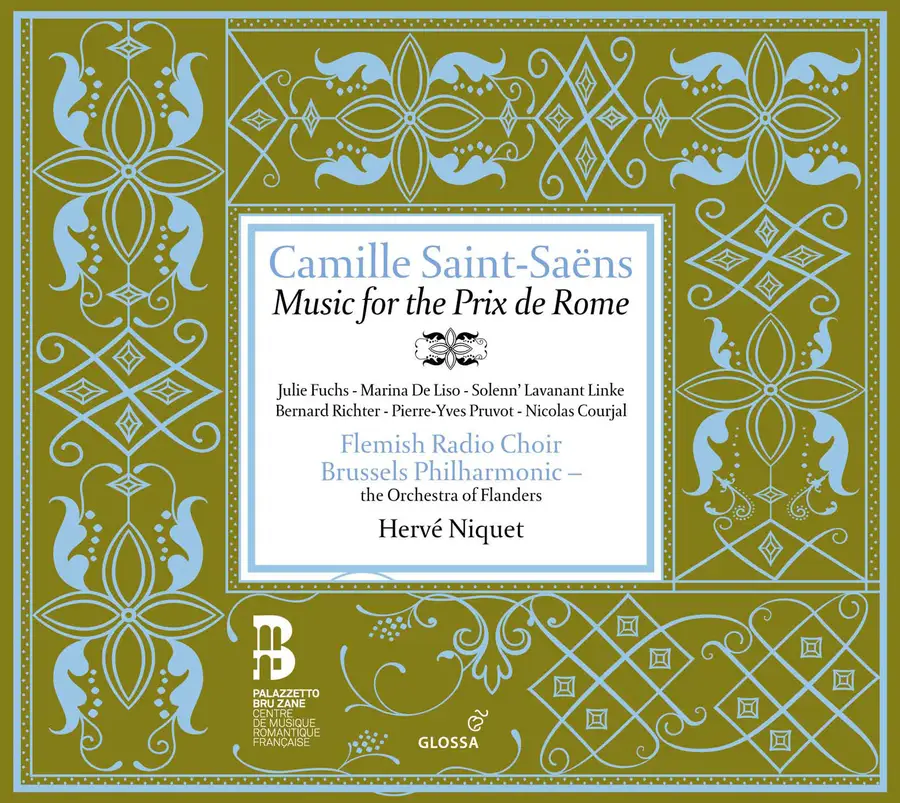
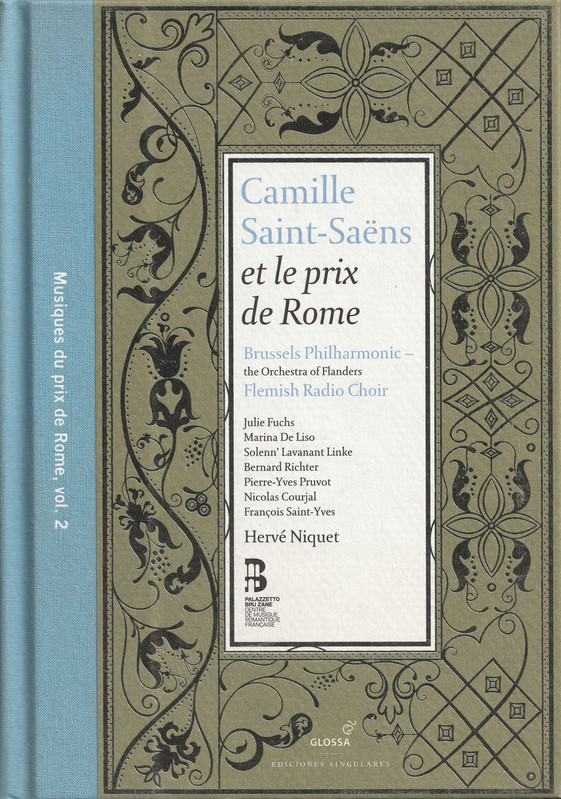
The Prix de Rome series from Glossa / Palazzetto Bru Zane comes in a standard CD release or in a book form. At the top, the image I provided is of the standard CD release, but I have the CD/Book version pictured later on in this post. For those interested, I have already covered the Paul Dukas recording in this series (BLOG).
The book is a prize for those who value information, for in addition to the 2CDs, no less than five essays and many historical images are housed within a lovely cloth-bound book complete with bookmark ribbon. The essays included are as follows:
- Saint-Saëns and the Prix de Rome: Scandals?
- Saint-Saëns testimonies of the Prix de Rome
- The evolution of librettos at the Prix de Rome
- Religious music under the Second Empire
- Saint-Saëns as a church musician
The two vocal cantatas of under a half-hour each are excellently performed here. I was especially taken with the singer for the role of Ivanhoé, tenor Bernard Richter, who comes in singing guns a-blazing, ready to fight for the love of Rebecca. Unfortunately, Rebecca only describes the fight through song, instead of having Ivanhoé and Brian de Bois-Guilbert sing it out, the latter a wonderfully evil name if ever there was one.
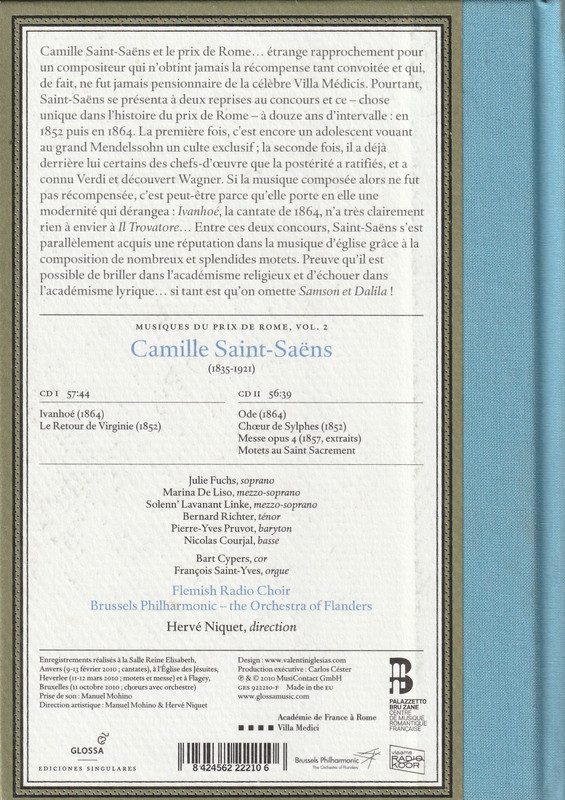
The Return of Virginia adds an orchestral dance to the mix in what is otherwise a dour and simplistic plot. The best allusion I can make to the action of The Return of Virginia is Waiting for Godot. Suffice to say, don't expect Virginia to show up any time soon.
The two accompanying Prix de Rome choral/orchestral works borrow more from Mendelssohn and Berlioz than Saint-Saëns' own originality, but they come and go pleasantly in a rather short amount of time.
Since these four pieces are the only submissions Saint-Saëns made to the Prix de Rome, to fill out the rest of the recording, two handfuls of sacred music are added to the recording. This is the reason Glossa included the two final essays concerning the direction of sacred music in France and Saint-Saëns' role in it as church organist and composer.
The Mass is a most surprising creation, for it more closely apes the clarity and textures found with Palestrina from the Renaissance Era. This recording only includes the Credo and Agnus Dei, whereas there are complete recordings of Saint-Saëns' entire Mass elsewhere.
Eight short Latin motets round out the remaining time, each coming with organ accompaniment. While often Saint-Saëns writes only for unison choir, men's or women's voices, or simply one or two choral sections total, these are lovely and somewhat tuneful motets. It is the Ave Verum Corpus in D Major, though, which is the prize of the lot. The added solo horn is simply magical, and finds Saint-Saëns at his most melodious and enchanted.
If you are a die-hard music collector, these Glossa books are mandatory acquisitions. None of the Prix de Rome music is essential, especially since these are occasional works, as well as experiments by youths vying to become top dog. Thus, if you have any interest at all in the composer or these works, the CD edition should be a fine investment, most likely coming with English liner notes attached.
As it is, I love these Glossa book editions. They are of fine quality, a luxurious product for sure, one which quells the inner musicologist within me. Not for everyone, but no one should have any problems with the performances or sonics of this product.
Works
Ivanhoé (29.02)
Le Retour de Virginie (28.33)
Ode (6.19)
Chœur de sylphes (4.56)
Messe, op. 4 (13.12)
Credo (8.48)
Agnus Dei (4.22)
Inviolata in F Major (5.48)
Tantum Ergo in E-flat Major (2.42)
Ave Maria in F Major (4.31)
O Salutaris in E Major (2.11)
Deus Abraham in F Major (3.08)
O Salutaris in A-flat Major (3.41)
Ave Maria in A Major (4.23)
Ave Verum Corpus in D Major (5.15)
Soloists
Marina de Liso, mezzo-soprano
Bernard Richter, tenor
Pierre-Yves Pruvot, baritone
Nicolas Courjal, bass
Julie Fuchs, soprano (Sylphes)
Solenn' Lavanant Linke, mezzo-soprano
Bart Cypers, horn (Ave Verum)
François Saint-Yves, organ (Motets)
Ensemble
Flemish Radio Choir
Brussels Philharmonic
Hervé Niquet, conductor
Label: Bru Zane
Year: 2010
Total Timing: 1.42.09
I probably wouldn't rate this highly for Saint-Saëns' music alone. These hardly represent the composer's interests or passions in music found across his career.
But, how can I fault any of these wonderful performances and Bru Zane's effort to provide a high-quality product such as this?
I can't, so there!

Find more Saint-Saëns recordings HERE!

Comments
Post a Comment