Liszt: Symphonic Poems 5 - 8
Prelude
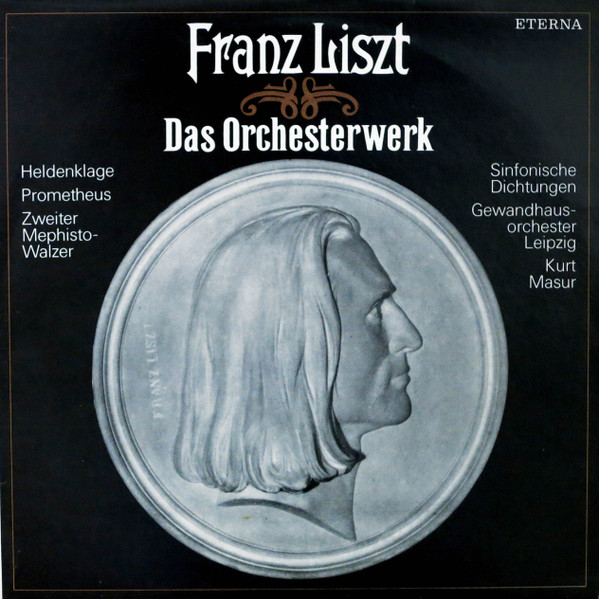
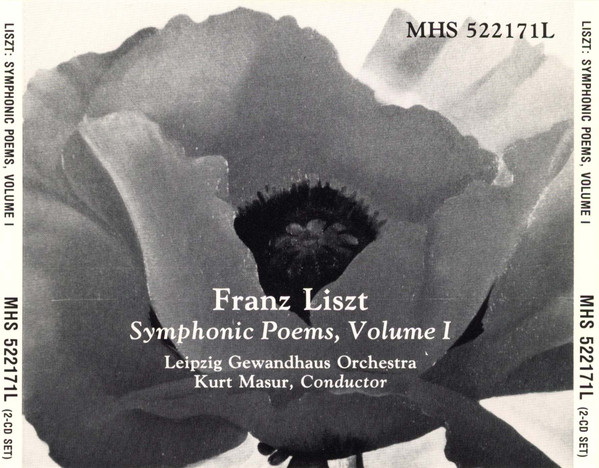
For this second Works Series entry of Franz Liszt's symphonic poems, I will be covering the composer's middle efforts into the genre of tone poems: Prometheus, Mazeppa, Festklänge, and Héroïde Funèbre. While I have inserted older cover art above and below, this blog post is actually my listening of the second volume (of seven) from EMI / Warner's 2011 box set of Liszt's orchestral and concertante music with Kurt Masur and the Gewandhaus Orchestra performing. Thoughtfully, this set arranges Liszt's symphonic poems in catalog order, so I will be covering them in that way as well.

Liszt follows up his fourth symphonic poem, Orpheus, with another Greek mythological figure, Prometheus. The character is most famous for stealing fire from Mount Olympus and gifting it to Mortals. He is punished by being tied to a rock and having his liver eaten by an eagle each day. While Prometheus is often referred to as a God of Fire, he is more importantly described as a creator or protector of Mankind.
Franz Liszt apparently wrote incidental music to go along with a staged Prometheus Unbound, and this symphonic poem grew out of that experience. Prometheus certainly provides more overt action than did the composer's previous Orpheus.
I had mentioned in my previous Works Series (BLOG), that I found the EMI / Warner recording rather bright sonically. A positive which comes out of that brightness is a rather visceral punchiness from the Gewandhaus Orchestra. One can hear this right at the beginning, where the strings tremolo crescendo finds the players sawing away in a wonderful 3-D quality, while the trumpets and trombones come through the texture excitingly as well. I am rather startled by the rough, raucous quality the Gewandhaus brass is allowed to play out here. I guess I have listened to too many Karajan / Berlin recordings.
One aspect which irks me across many Liszt orchestral works is how the composer stops the action for small-scale utterances, often just paring the orchestra back to just a few instrument sections or solos, bracketed apart by endless silences. I am sure these moments serve a purpose, however I can often lose the connective musical thread across these 15-minute works when Liszt does so.
Mazeppa is based on the legend of Ivan Mazeppa, a Ukrainian military commander put into verse by both Lord Byron and Victor Hugo, the latter forming the direction of Liszt's symphonic poem.
A big swinging tune represents Mazeppa's horse ride as punishment for indiscretions. It is a winner of a tune, not too far removed from a similar one found in Les Préludes. While the music bounds ahead, the orchestration retains a certainly militaristic flavor in its use of brass and percussion. The more swooning contrasting section is also really quite fine, with rather colorful harmonic motion and terrific pizzicatos, the latter so well picked up in this recording.
While the opening main themes of Mazeppa come back a few times, by the time the middle of the tone poem comes around, these musical ideas are forgotten in lieu of a heroic homecoming, an unfortunate case, although at least the change in motivic material is equally effective and memorable. I am also not a particular fan of bare octaves amongst a full orchestral section or ensemble, and Liszt has these sorts of octaves littered throughout this piece. And did I hear a reference to the Anvil Chorus near the conclusion?!?
While many of Liszt's symphonic poems are based on literature, Festklänge, or 'Festive Sounds', was actually written for Liszt's own wedding, one which never materialized. Despite that turn in events, this works ends heroically.
To my ears, this piece sounds a little more pastoral in nature compared to the others, often bursting out into quaint, rustic dances and romantic nature scenes. I am slightly reminded of Beethoven from time to time too, although the brand of Romanticism is purely Liszt's own. Here, the timpani plays a large role, although that instrument is heard subtly and muted in its appearances.
If the translation of Héroïde Funèbre is truly Heroic Funeral Elegy, this must be the least consoling musical elegy I can remember. I daresay, this music is more threatening and menacing, although its military aspect is fully plumbed. Listen to the blatting trombones for the scariness, the soft drum cadences for the honorific tribute to those lost in war, and the tolling bells for the funereal aspect.
Of Liszt's symphonic poems thus far, of which this one is No. 8, Héroïde Funèbre is perhaps the most modal and Nationalistic I have heard from the composer. The main big tune moves in such odd harmonic directions, although Liszt ably repeats it enough in order to get said melody within the head of the listener, utilizing sections around the entire orchestra to have a chance at playing it.
As an extra, Liszt's Mephisto Waltz no. 2 is added to the Vol. 2 program. I have a couple of problems with this works. First, the music is set in 6/8, hardly a waltz time, although I suppose if the waltz swirled fast enough, it could fit within the two dotted-crotchet beats; a stretch methinks. I also surprisingly don't get the Mephisto element, but perhaps I am looking too far into the matter.
I actually enjoyed myself quite a bit in this second volume, despite my written druthers from Liszt above. These four symphonic poems are more action oriented and somewhat briefer than the four earlier ones, thus making these following ones a little easier to digest.
Work Series
Vol. 2 from Liszt Orchestral Works on Warner
Works
Prometheus, S 99 (13.14)
Mazeppa, S 100 (15.59)
Festklänge, S 101 (17.57)
Héroïde Funèbre, S 102 (17.43)
Mephisto Waltz no. 2, S 111 (10.48)
Performers
Gewandhaus Orchestra
Kurt Masur, conductor
Label: EMI / Warner
Year: 1977-80; 2011
Total Timing: 75.59
Comments
Post a Comment