Liszt: Symphonic Poems 1 - 4
Prelude
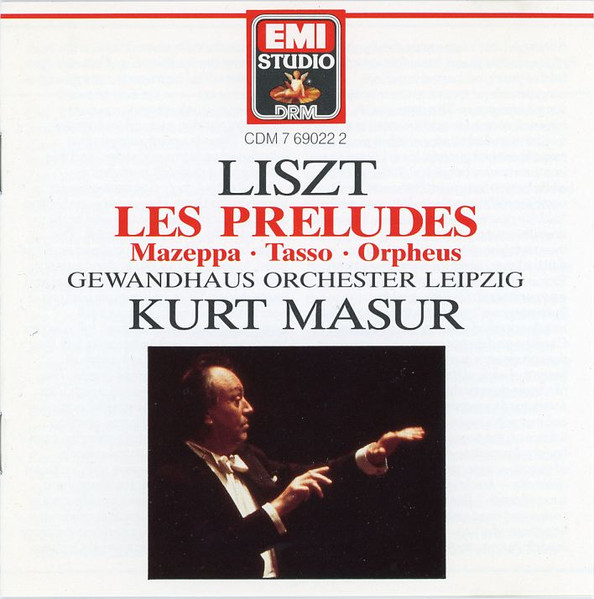
For this first Works Series entry of Franz Liszt's symphonic poems, I will be covering the composer's first four forays into the genre of tone poems: Ce qu'on entend sur la Montagne, Tasso, Les Préludes, and Orpheus. While I have inserted older cover art above and below, this blog post is actually beginning my listening of the first volume (of seven) from EMI / Warner's 2011 box set of Liszt's orchestral and concertante music with Kurt Masur and the Gewandhaus Orchestra performing. Thoughtfully, this set arranges Liszt's symphonic poems in catalog order, so I will be covering them in that way as well.

Sometimes referred to as his Mountain Symphony, Liszt's Ce qu'on entend sur la Montagne, or What We Hear on the Mountain, is the composer's very first symphonic poem. The French title actually comes from a poem by Victor Hugo (HERE), a short piece of verse which wraps up the grandeur of nature with the complexity of humanity, a prime example of popular Romantic-Era poetry.
The tile invites comparison to An Alpine Symphony by Richard Strauss. That work is another 20-minutes longer than the 30-minute Montagne, yet far more captivating, whereas too many of Liszt's symphonic poems contain areas of longueurs, ones which drag out eternally for this listener. While I recognize all of Liszt's linking motivic ideas, their re-appearances seem random throughout, rather than moving organically or cohesively as a whole. Really, it all goes on for far too long for its material, with many swirlings of musical 'filler' material.
You can hear the sort-of grainy roughness of this recording here too. The trombone chorale is not lush nor full, but slightly ragged and unbalanced. There is plenty of clarity across the orchestra however, including a well-placed harp, even if this all has a certain overly bright sonic quality to it.
Tasso: Lamento e Trionfo is based upon the years Italian poet Torquato Tasso spent in an asylum, although the music more directly springs from Lord Byron's poem The Lament of Tasso. While cellist Jürnjakob Timm is credited for an appearance in Orpheus, it is actually here where he makes his short solo appearance.
The bipartite form of a Lament and Triumph seems a wonderful fit for a Liszt-ian symphonic poem, where each section of the 20-minute piece is broken into further parts within each half. It takes Liszt a fair while to finally arrive at the Lament proper, but once there, works effectively enough. While I expected the Triumph portion to be all guts and glory from Liszt, there is a rather winsome triple-time dance which whisks the listener away, beautifully laid out by Masur. Again, like Montagne, I feel this music simply goes on for far too long.
The first time Franz Liszt explicitly uses the term symphonic poem comes with his third such composition in the genre, and is probably his most famous, Les Préludes. Whether the basis for the music comes from verse by Joseph Autran penned in an earlier composition, or an Ode from Alphonse de Lamartine probably makes little difference, although academics like to argue about such things.
One can immediate identify why Les Préludes is among Liszt's most popular works. The 15-minutes are tightly constructed, albeit episodically, and the melodies are unusually well crafted, at least compared to the previous two symphonic poems. While Liszt drags out the conclusion for much too long, the aggressive conclusion is a bonafide audience pleaser. While I have commented on Masur's speeds in some of these other symphonic poems, he imbues a nice swing to the main heroic segment.
From a programmatic point of view, if I am not familiar with the literature linked to the musical works above, at least the US education system still covers Greek mythology. Thus, Orpheus is a known quantity, moreso since I am a music lover, although whether or not the quest surrounding rescuing Eurydice from The Underworld is involved is uncertain. My guess is not, but rather the taming of beasts through music.
The most identifiable musical attribute of Orpheus is in its two harps, heard well in this performance. If they aren't as heavenly and lightly, sparkly toned as other recordings, presence is ever important. I have struggled with the gentle musings and atmospheric nature of Orpheus in the past, thus Masur's 9-minute reading works best for me I think, not necessarily stopping to smell the roses all too often, but not feeling overly rushed either.
 I always thought Kurt Masur and Franz Liszt were odd bedfellows. Masur could sometimes be a cool customer on the podium, an East-German Patrician cum Kapellmeister in the central Austro-Germanic orchestral repertoire, whereas Liszt's music practically begs to pulse and throb with overt emotion, an element you would assume Leonard Bernstein would glorify. Somehow the two come together fairly successfully, where Masur's Liszt is mostly defined by its startling forward motion.
Masur was the General Music Director of the Gewandhaus from the 1970s through the 1990s, although he made recordings with the orchestra in the 60s, perhaps even further back in the 50s. Here in Liszt, the Gewandhaus Orchestra is combustible enough when need be, and manage the more oft chamber-like, instrumental-section combinations with ease.
If I am not pleased with an aspect of this recording, it is the rather bright quality of the late-70s sonics, remastered in the 90s. Listen and compare the Gewandhaus here in the 70s to the Chailly era in the 2000s and you will hear the remarkable difference in audio warmth and orchestral depth. Otherwise, the Leipzig orchestra is balanced strings forward, with the winds and brass set back some, although the many instrumental solos burst forth nicely.
While I may be overly critical of Liszt, his compositions, and the EMI recording quality, I believe I was rather charmed by this recording. It took me a very long time to come to terms with Liszt's two program symphonies, thus I am hoping Masur will have much the same effect on me into the orchestral music of Liszt. A promising start.

Work Series
Vol. 1 from Liszt Orchestral Works on Warner
Works
Ce qu'on entend sur la Montagne, S 95 (28.18)
Tasso: Lamento e Trionfo, S 96 (20.37)
Les Preludes, S 97 (15.02)
Orpheus, S 98 (9.36)
Soloists
Gerhard Bosse, violin (S 95 & S 98)
Jürnjakob Timm, cello (S 96)
Performers
Gewandhaus Orchestra
Kurt Masur, conductor
Label: EMI / Warner
Year: 1977-80; 2011
Total Timing: 73.48
Comments
Post a Comment