Vaughan Williams: Heroic Elegy & Triumphal Epilogue
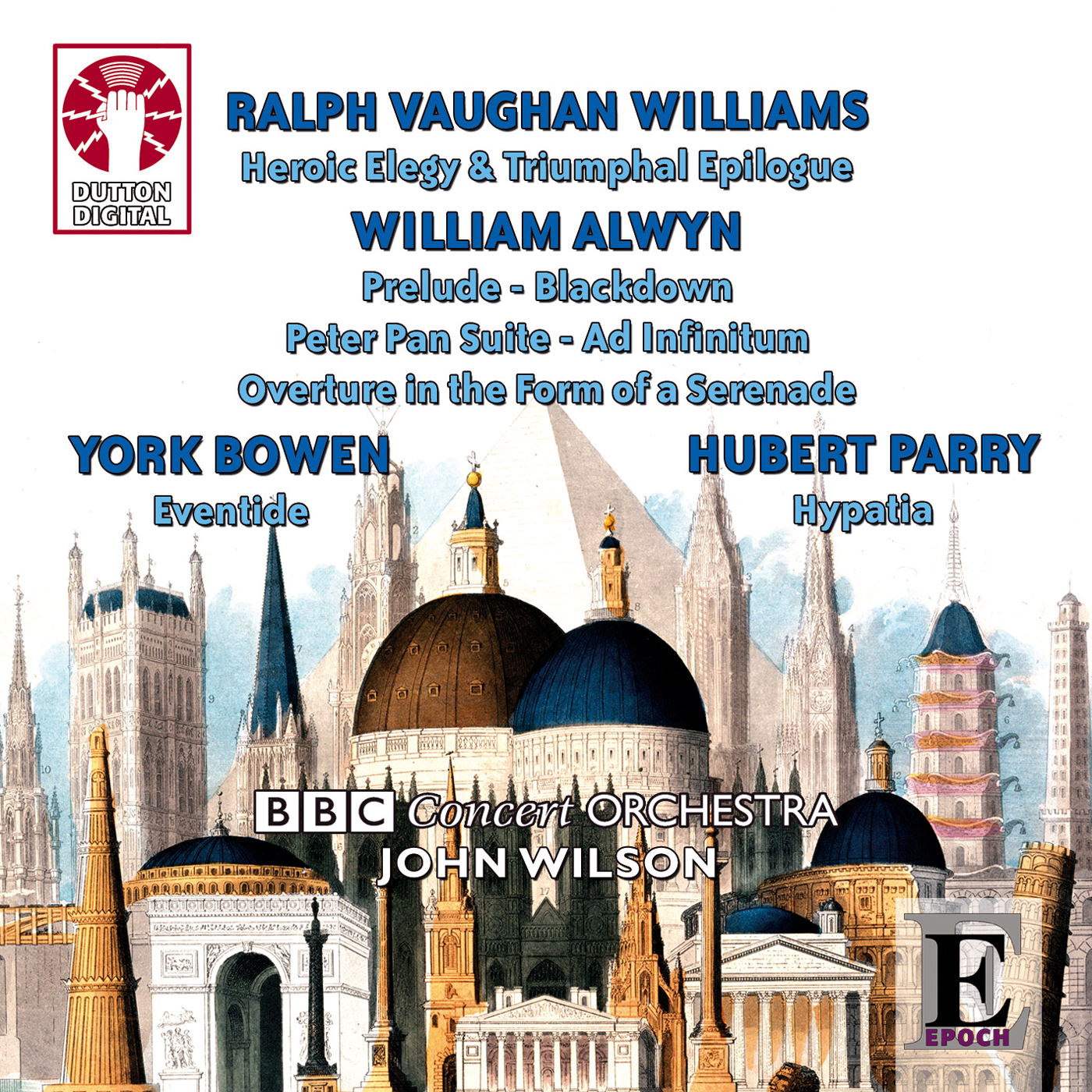
For all of the great work Chandos and Hyperion have done for British music and performers (to name just two), Dutton Epoch often gets lost in the shuffle. Too bad, as they find many unrecorded scores to release instead of rerecording the same old favorites. On the other hand, their product has always been rather expensive, especially for shipping overseas, although now they they have been out there a while, finding these recordings in the used market is getting easier, and Dutton Vocalion seems to appear more online as well.
I am not a multi-composer recording collector; I almost always prefer single-composer recordings. But with Dutton recordings, there is almost always a collection of British composers put together to form their programs. In this way, though, they expose listeners to composer who are less well known, while still giving the big hitters.
Most of the runtime on this recording is given over to the music of William Alwyn and Ralph Vaughan Williams. Vaughan Williams is represented by a single piece, a diptych entitled Heroic Elegy & Triumphal Epilogue, a terribly wordy title. It is an early piece, reminding me some of Toward the Unknown Region, A Sea Symphony, and maybe even the Tallis Fantasia too.
I am actually more enchanted with the first Heroic Elegy portion, where the shimmery modal music takes my breath away, nearly climbing into cinematic qualities. It is the trombones who receive the spotlight in this section, an unusual choice from the British composer.
The longer Triumphal Epilogue isn't quite as dynamic as I expected; instead it is much more episodic in structure, with fanfares bursting out amongst subdued lyrical passages. An insistent timpani threads the piece together rhythmically, and Vaughan Williams lays into rhythmic ostinatos and sustained pedal points across this second area of the work. Once the brass and the pipe organ set going in the last quarter of the movement, Vaughan Williams' ideas being to coalesce.
I am less familiar with the music of William Alwyn, who I mostly know from his film music. He was a composer who worked strongly towards and around modernism, thus I have stayed away for the most part, yet I expect I will get to him after a while. As it is, the five works from Alwyn on this recording are not terribly representative of his mature style, so comparisons are moot for the most part.
The most ambitious from Alwyn on the program is the Overture in the Form of a Serenade, another gangling title, which comes with wordless, non-lexical soprano and chorus. This is a pretty splashy work, one which occasionally draws back from its outgoing concert-opener energy into eerie, shimmering vocal colors, melded into the musical fabric as if they were orchestral textures. The Peter Pan Suite sounds like children's music to me, something akin to the Wand of Youth Suites form Elgar. Twee and atmospheric, it is the Captain Hook episode which offers the only bit of musical wit to the entire proceedings.
A dotted, upward leaping figure comprises the entirety of the 2 minutes of the blandly titled Prelude, although it comes closest to Alwyn's true compositional nature, I think. It is certainly filled with a rough, bustling nature, with some acidic brass exhortations, plus two harps! Much the same could be said of Ad Infinitum, with opens with surly brass, leaping downward across an awkwardly distant interval, informing the motive of the piece in no uncertain terms. Again, Alwyn seems to enjoy a perpetual swirling motion which constantly drives the music ever forward. Contrastingly, Blackdown finds Alwyn fully in British pastoral mode, evoking ruralia from the Surrey Hills through modal melodies and sweet solos from within the string and wind sections.
Aside from having seen it, York Bowen is not a composer I have heard from before. His 13-minute Eventide is highly atmospheric, mostly evocative of the natural world. I would call it Impressionistic, however the music is not as richly upholstered as something coming from, say, Granville Bantock, plus Bowen's use of horn is particularly Romantically heroic. The final piece comes from Sir Hubert Parry, consisting of three movements of incidental music to Hypatia. This music is curiously inert to position at the end of this program, although the final march finds some personality from the British composer.
Just a few days ago, I heard another Dutton Epoch recording of Elgar and Parry recorded in the same Watford Colosseum Town Hall location. While I really enjoyed the position of the orchestra on that one, here the engineers capture far too much of the acoustical ambiance, positioning the microphones mid-to-back hall. This lessens the inner-orchestra detail to a degree, and at the loudest climaxes, the orchestra becomes boomy and overwhelming. Otherwise, I have no problems with the playing of the BBC Concert Orchestra nor this early recorded appearance of John Wilson leading from the helm.

Works
Vaughan Williams
Heroic Elegy & Triumphal Epilogue (20.03)
William Alwyn
Prelude (2.11)
Blackdown (5.00)
Ad Infinitum (7.02)
Peter Pan: Suite (5.24)
Overture in the Form of a Serenade (5.55)
Hubert Parry
Hypatia (13.04)
York Bowen
Eventide (13.10)
Performers
Micaela Haslam, soprano (Overture)
Roderick Elms, organ (RVW)
Ensembles
The London Chorus (Overture)
BBC Concert Orchestra
John Wilson, conductor
Year: 2009
Label: Dutton Epoch
Total Timing: 72.52
The music on this British orchestral recording should be widely appealing, even if individual works can sound lightweight or compositional Juvenilia.
It is excellently performed, although if you don't enjoy mid-to-back hall sonics, this one retains a little too much of Watford's acoustic, at least in my opinion.

Find more Vaughan Williams recordings HERE!
Find more Parry recordings HERE!
Comments
Post a Comment