Atterberg: Symphony for Strings
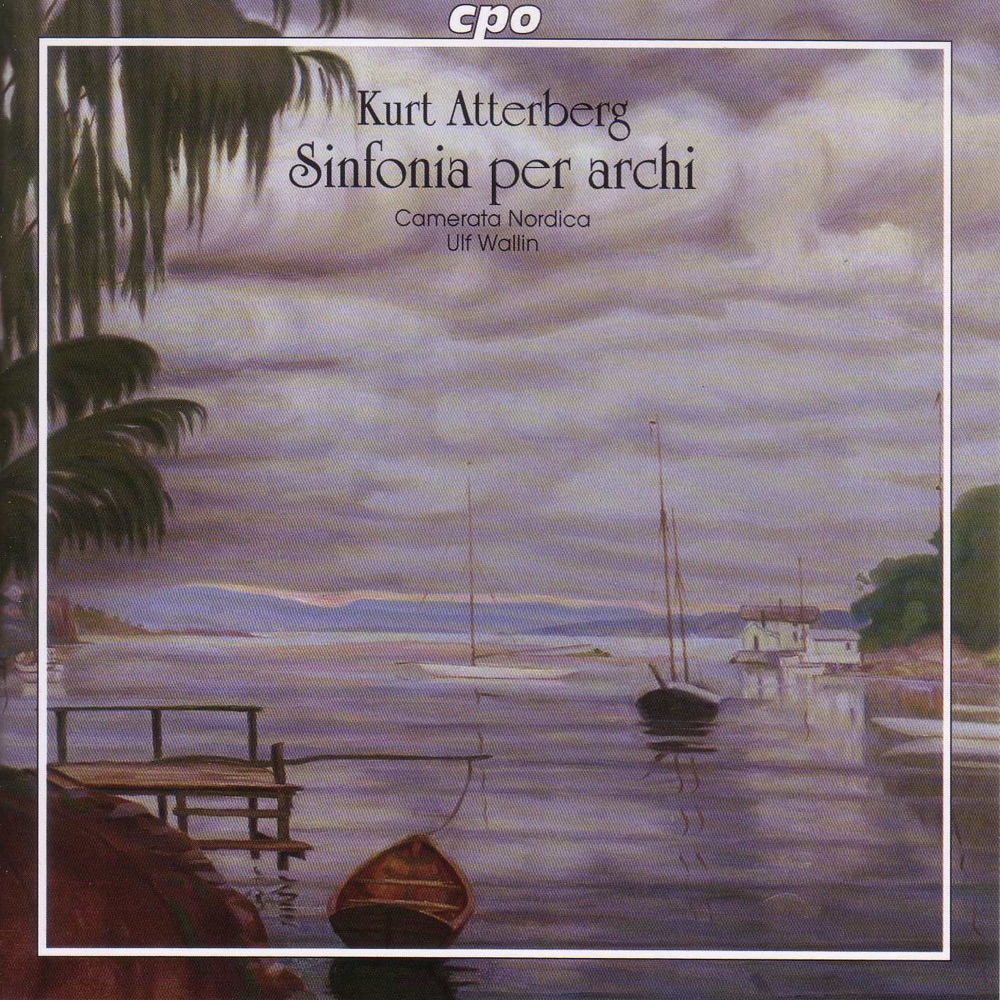
While I have known Swedish composer Kurt Atterberg's music to be effusively Romantic, I do not know him for being particularly Nationalistic, aside from a few works he purposefully dedicated to Swedish folk songs.
Atterberg's Symphony for Strings is highly modal, and hauntingly so. These modalisms do indeed sound Nationalistic, whether or not the composer intended it to be thus. Long soaring melodies float over top these harmonies in the first movement, and I do not believe anything here to be based on previous Swedish song. The second movement is an acidic Scherzo, the wiriest I have heard the composer in such a fast-tempoed setting.
The third movement of the String Symphony is the longest of the work, where I am most taken with the movement's central ghostly dance, while the final movement mirrors the first in terms of modal content and structures. The fourth movement might have more garrulous rhythms and textures for a final galop to the conclusion of the work, yet this is removed from any sunshiny, joyful endings due to its harmonic modal nature.
The composer's Suite no. 7 for strings is taken from incidental music meant for a Swedish production of Antony and Cleopatra. Chromatic lyricisms are found wafting across the second and fourth movements, while the exotic landscapes of Egypt and Rome receive equally exotic musical settings, most strongly pungent in the third and fifth movement dances.
Smaller individual pieces fill up the rest of the album. The tripartite Intermezzo is notable for its strutting pompous march, I assume in what was meant for an occasional ceremony. The brief Prelude and Fugue is remarkably smooth sounding, far from the reaches of the Baroque Era the title hints at. While commenters don't find Atterberg's Adagio Amoroso particularly amorous, I think the music speaks more to its solo violin utterances than any specific emotional program.
I do enjoy the playing of the Camerata Nordica, of which Ulf Wallin is both player and leader. While there is no picture of the ensemble in the physical media, plus no mention as to the number of players on this specific recording, the internet press images infers a core group of eight string players. To my ears, they sound larger than a mere eight instruments. This could be due to the Swedish church acoustic which fills up the sound of the group, especially in tutti portions, but I wonder if they add supply artists to the core membership when the need arises in order to accommodate for certain literature. The Camerata Nordica certainly sound more of a string orchestra than a chamber ensemble, an aspect which pleases this listener greatly.
I am not overly persuaded by this program of string-orchestra music however, but the performances are simply enchanting. I could see some listeners finding Atterberg's Symphony for Strings to be the composer's true Ninth Symphony, instead of the choral cantata that latter work turns out to be. The rest are charming works, although coming from the composer's cycle of symphonies, one misses the composer's way with winds. No matter, for CPO captures the Camerata Nordic closely to hear the grit the players commit to these performances, all the while affably collecting the resonance of the church location.

Works
Suite no. 7 'Antony & Cleopatra', op. 29 (13.30)
Symphony for Strings, op. 53 (29.17)
Adagio Amoroso (8.04)
Intermezzo (8.26)
Prelude & Fugue (3.11)
Performers
Camerata Nordica
Ulf Wallin, conductor
Label: CPO
Year: 2005
Total Timing: 62.38
Some might be much more taken with this music than I am, even if I find Atterberg's string orchestra music to be haunting and lovely as a program.
It is nice to become acquainted with the Camerata Nordica as well, who bear a beautiful sheen on CPO.

Find more Atterberg recordings HERE!
Comments
Post a Comment