Stanford: Symphony 1
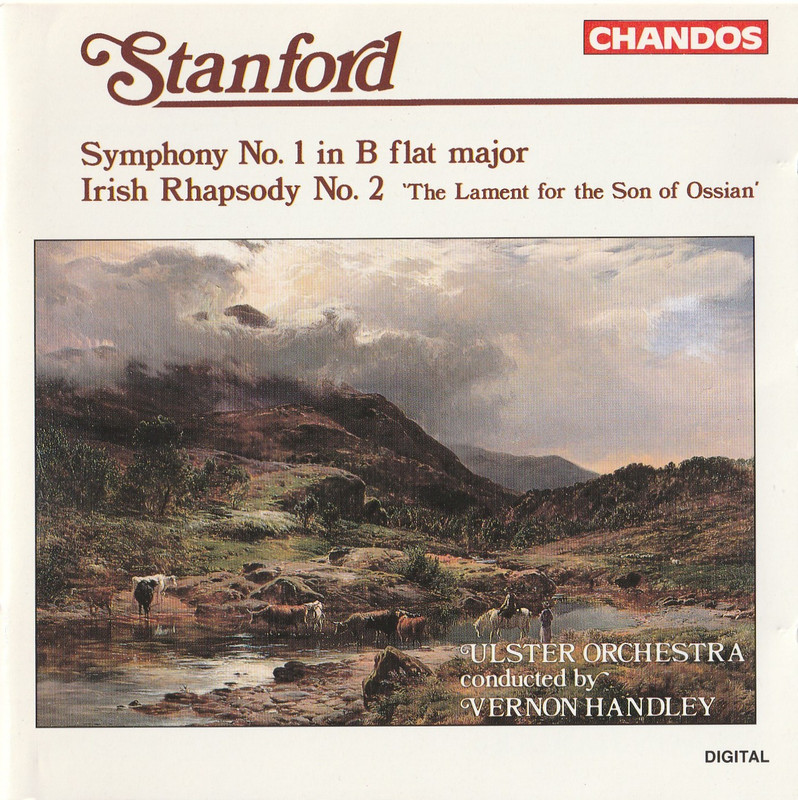
I would normally make my initial entry into Stanford's symphonies as the first of my Works Series. However, I usually use that series when I traverse a box set, but wish to comment on the individual CDs. In this case, I own all of the original separate Chandos recordings which were issued before they were boxed up later.
There were a few reasons I didn't invest in those box sets. First of all, the symphonies came on a 4CD set by themselves, shearing the extras that were found on each individual release. While Chandos eventually rounded up the extras on their own 2CD set, actually done so twice, one contained the Irish Rhapsodies with the Clarinet Concerto, Oedipus Rex Prelude, and Concert Piece, while the other set contained the Irish Rhapsodies with the Second Piano Concerto and Dead Men Variations.
In the end, I decided I wouldn't invest in the various sets, and simply hang onto the originals. It is also possible that the condensed sets were prohibitively expensive when I searched them up, as can often happen with many years following their initial release. Of course, more interesting, David Lloyd-Jones recorded the symphonies on Naxos over four separate issues in the mid-to-late 2000s. What a joy to have two sets on record!
With that out of the way, let me speak to Charles Villiers Stanford's Symphony no 1 in B-flat Major. Here is a work which is surprisingly gentle, especially the two inner movements. While titled a Scherzo, the second movement is more a gentle rustic dance rather than anything driving or humorous. Stanford might have been better off just leaving the tempo as the title rather than attaching the Scherzo to it, although the instruction 'In a Ländler tempo' provides some direction for the listener. I suppose the composer was a stickler for traditional forms, despite using them for his own purposes.
This means the third-movement Andante shares more in common with the previous dance movement than is generally the case in a symphony. It makes for a lengthy portion of pastoral music making, although Stanford is at least interested in exploring differing textures across the third slow movement. Some pizzicato and dreamy horn solos sustain this listener's interest, even if some might yearn for some starker vivid contrasts from Stanford. I daresay, the musical climaxes of the third movement make more of an impression upon me than does the second movement.
That leaves me with the outer movements. These are more noble evocations than they are anything hair-raising. While Vernon Handley does his best to inject orchestral fire, with Stanford, these are more cozy home fires than they are fires which set anything ablaze. I do enjoy the composer's way with orchestral colors, ones which are genial and sturdy, if not a tad Classically conservative. I do feel the first movement goes on a mite too long at sixteen minutes, which the final fourth movement improves upon over eleven minutes through a little more boisterousness. The musical busyness of the latter movement sets itself against the more structural contrasts of the former, where the opening drums up some storminess as well.
My guess is this First Symphony speaks to Stanford's temperament as a composer. I will say, while there is a an early-Romantic, Germanic aspect to the music, I can hear this work as British, or at least driving Stanford towards a 'British sound'. Certainly, the pastoral nature aids in such feelings, one which will lead towards the 20th Century English Renaissance. Timing wise, Handley and Lloyd-Jones are close in their respective recordings, with the first movement somewhat longer in the hands of Lloyd-Jones.
As if pairing the program based on disposition alone, Sir Charles' Irish Rhapsody no. 2 in F minor is generally a low-key affair. Perhaps the subtitle 'The Lament for the Son of Ossian' informs its rather elegiac nature.
Best of all, while I can hear the Irish musical elements across the 15-minute symphonic poem, these elements are quite subtle, as opposed to someone like Malcolm Arnold who proclaims any exotic Nationalisms in exaggeratedly vivid detail, (and to my delight as well).
I assume Stanford is using honest-to-goodness Irish tunes here, but I would be hard put to identify them, so effectively does the composer create an intelligent whole, rather than setting a parade of melodies and dances. The serious manner in which Stanford presents his music is effective, so those looking for a bright depiction may be disappointed. As my first look at Stanford's set of Irish Rhapsodies, taken out of order, I am glad there is a goodly amount of substance to them.
I have found Vernon Handley to be a trusted leader of British symphonic music. The Ulster Orchestra does not sound scrappy at all here, an aspect I remember of them from previous recordings. Perhaps Symphony 1 & 2 being the last these performers set down in their Stanford series created a comfort at this point, for I detect a warm and colorful sound, with Chandos' cushion-y sonics meeting Stanford's style well.

Works
Symphony 1 in B-flat Major (45.54)
Irish Rhapsody 2, op. 84 (315.49)
Performers
Ulster Orchestra
Vernon Handley, conductor
Label: Chandos
Year: 1991
Total Timing: 61.49
Symphony 1 in B-flat Major (45.54)
Irish Rhapsody 2, op. 84 (315.49)
Performers
Ulster Orchestra
Vernon Handley, conductor
Label: Chandos
Year: 1991
Total Timing: 61.49
One almost yearns for something completely different on this recording, but as it is, this is a warm, gentle program containing Stanford's First Symphony and Second Irish Rhapsody.
A fine start to the composer's cycle! This one will take your breath away by its Classical beauty rather than anything overly fiery or characterful.

Find more Stanford recordings HERE!
Comments
Post a Comment