Atterberg: Symphony 9

Prelude
In this fifth Works Series entry of Kurt Atterberg's symphonies, I will be listening to Symphony no. 9 and The River from CPO's 5CD set released in 2004.

Many consider Swedish composer Kurt Atterberg's Symphony no. 9 'Sinfonia Visionaria' the moment when he jumped the shark. Personally, all that I think is wrong with the symphony is the title of the music. The work is most obviously a cantata, yet it bears the moniker of a symphony. Sure, there have been many choral symphonies over the years, even vocal symphonies, but this one does not cry out for a symphony title.
The text of the work is taken from the Völuspá, most likely an Icelandic epic poem supposedly hailing from the late 10th Century. I had not read the lyrics before listening to Atterberg's Ninth Symphony, but I recognized repeated appearances of the words Ragnarök, Odin, Heimdall, Frigga, and Thor. This obviously led me to believe Norse mythology was at work in this symphony. In actuality, an ancient God is proclaiming the end of the world, using characters from the Norse mythologies, including the ones I mentioned above, plus Yggdrasil and others I am less familiar with.
The alto soloist takes the role of Heid, a Vala. The baritone soloist mainly asks questions of the ancient Goddess. In her descriptions, this is as much a description of creation as it is the destruction thereof as well. The chorus comments throughout, although it is the two vocal soloists who take much of the runtime. The orchestra gets precious little to themselves, other than adding color and weight to the proceedings. Thus, the genre cantata rushes to the mind.
Symphony no. 9 is quite sensitive musically, particularly in the opening five tracks, of which, CPO divides the 40-minute, one-movement work into 13 tracks. In track 6, the alto begins describing events of battles and characters associated with The Apocalypse, allowing the orchestra and chorus some musical gusto mixed with the solo vocal lyricisms. Otherwise, a large role is given to the harp in the lyrical portions.
Atterberg's musical language is much more chromatic in this work compared to the rest of his symphonies, perhaps indicating the mysterious primordial ooze of creation and the collapse which eventually follows. The baritone soloist repeatedly intones a modal melody in the first track, one which will appear later in the chorus, and a very effective one at that. The repeated choruses in the middle of the work are fearsome moments, where Atterberg unleashes percussion as well as the full ensemble.
There are many creative orchestral colors from Atterberg I enjoy throughout this piece, but nothing comes together as a symphony. In this specific case, naming could cure all; if it walks, talks, and smells like a cantata, a symphony it should probably not be. As a work unto itself, though, this is a decent piece of music, one which takes a few listening to wrap one's head around; not the usual case with Atterberg.
Let me speak to the rival recording of Atterberg's Ninth Symphony, from Neeme Järvi on Chandos. Järvi's comes in some six minutes quicker, where the Gothenburg orchestra is punchier and the choir is much further forward. Conversely, the CPO recording needs cranking, as it is engineered at a rather low level. The soloists and chorus are balanced more naturally, but some might enjoy the more prominent vocals on Chandos.
On the other hand, both the vocal soloists under Ari Rasilainen on CPO are much finer in my opinion. Satu Vihavainen has a less voluptuous voice comparatively, one which allows her to focus in her chest voice at times, a perfect realization for the ancient God. There isn't as wide of a gulf in preferences between the two baritone soloists, yet Gabriel Suovanen voice sounds firmer to my ears, where both of Järvi's soloists are tad over-tremulous. I have greatly enjoyed Suovanen in the past, most recently in Sibelius, and his vocalizations reminds me of Swedish baritone Håkan Hagegård, a compliment coming from this listener.
The NDR Philharmonic Orchestra plays wonderfully, although the soundscape is natural, with the winds noticeably behind the strings. In this way, Gothenburg has the edge with the winds and percussion jutting out colorfully, allowing more impact as an ensemble on Chandos. CPO has gathered both the NDR Choir as well as Pavel Kühn's Prague Chamber Choir to combine together as a symphonic chorus. The German classical-music label places this chorus naturally again, riding alongside the orchestra instead of in front of it as Chandos does. Really, I could go either way, for both performing ensembles on Chandos and CPO are of a high quality. Personal preference might be the determiner here.
Ari Rasilainen has always preferred a grandiose approach across the symphonies of Kurt Atterberg, whether speedy or slow, and it is no different here. Some might prefer the more incisive approach from Järvi and Gothenburg specifically in Symphony no. 9, plus Chandos' fuller sonics are captivating orchestrally, yet I think both are legitimate approaches. For me, quality vocal soloists make or break this highly vocal-focused symphony, so my allegiance lies mainly with Rasilainen on CPO in the end.
The River - From the Mountains to the Sea is a symphonic poem which is quite different compared to the paired symphony. CPO divides the work into seven tracks, but the music runs continuously. Each of the tracks meet Atterberg's visualized titles, such as Waterfalls, The Harbor, The Great Lake, etc., making for a scenic tone poem.
In Älven, we have an orchestral Cinemascope travelogue, reminding this listener of Atterberg's earliest symphonies. Melodies soar, harmonies please, and orchestrations make the listener's heart palpitate, all which are varied from location to location. The composer's ability to mimic specific natural locations and goings-ons is remarkably lifelike, utilizing the orchestra magnificently.
Let me pick out The Harbor as my example. Atterberg creates a dissonant din as the listener enters this area. It took me a while to realize this was the traffic of the harbor, with many pitched tugboat honks and ship motors coming and going. Eventually, this is overlapped with a sea shanty, one which is inserted incongruently, as if all of the harbor activity isn't tuned to each other, as it would be in real life. It is a glorious moment once realized, and there are many more to savor across its 20 minutes, including a concluding pipe organ texture to make for a stunning end.
This is a curious finish to CPO's Atterberg symphony cycle. Quite frankly, the symphonic poem Älven is more typical of the composer's symphonies than is Sinfonia Visionaria. No matter; I am glad Atterberg broke from the confines of his dutiful late-Romantic pleasures, even if it causes chaos to call the work a symphony instead of a cantata. The accompanying symphonic poem is simply glorious.
Work Series
From Atterberg Symphonies on CPO
Works
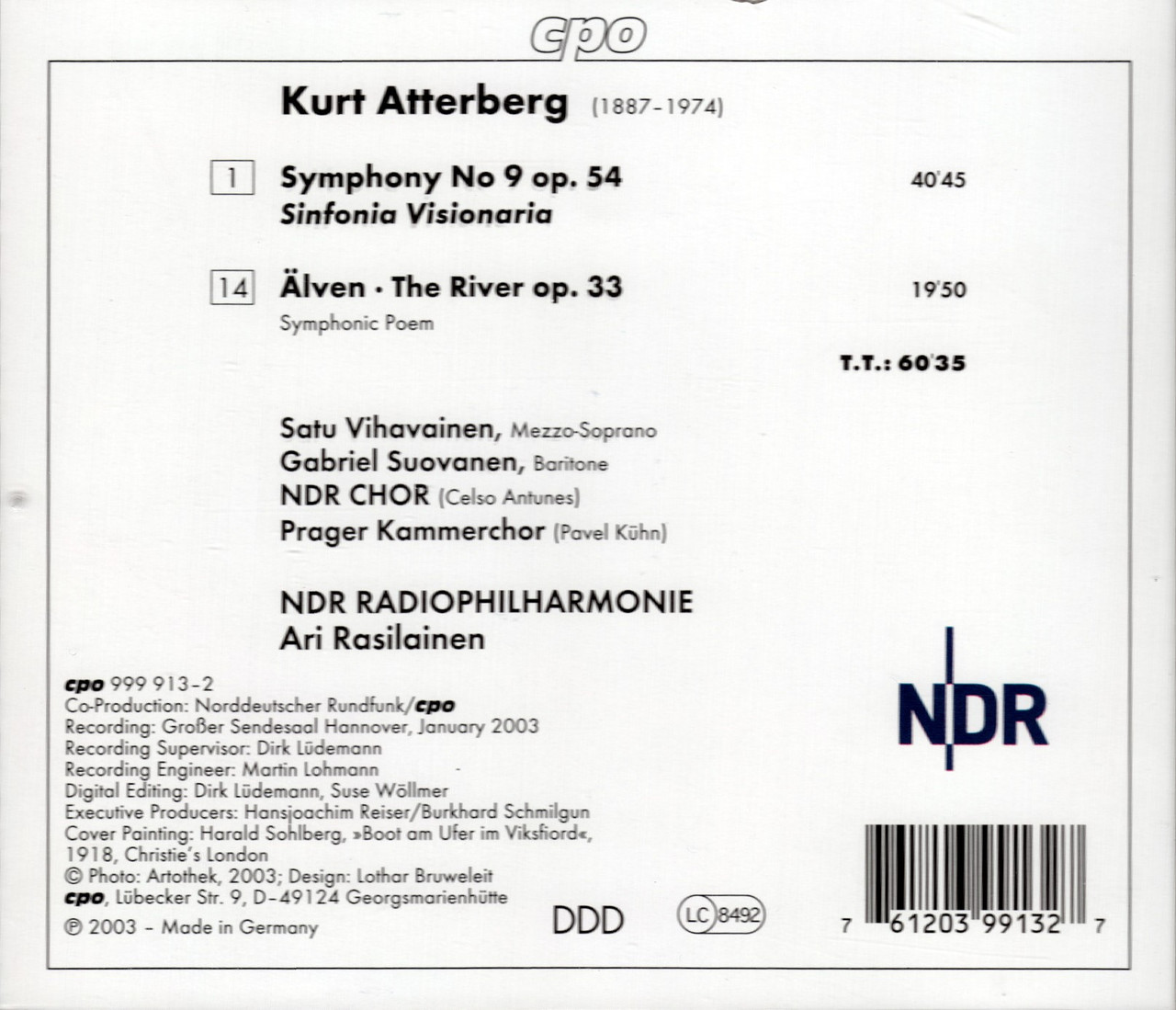
Symphony 9 'Sinfonia Visionaria', op. 54 (40.45)
The River, op. 33 (19.50)
Soloists
Satu Vihavainen, mezzo-soprano
Gabriel Suovanen, baritone
Performers
NDR Choir
Prague Chamber Choir
NDR Philharmonic Orchestra
Ari Rasilainen, conductor
Label: CPO
Year: 2003; 2004 (set)
Total Timing: 60.35
Comments
Post a Comment