Liszt: Prometheus Cantata

Hungaroton has done excellent work in finding and recording the dusty corners of Hungarian composers, particularly their choral music output. And not unknown composers either; there are countless volumes of choral music on Hungaroton from Béla Bartók and Zoltán Kodály for example, and that is discounting the other classical-music genres the Budapest-based classical music label has committed from these composers.
I believe Hungaroton made seven volumes of choral music for Franz Liszt, assuming all of the Liszt recordings were given a number. The transfer of these volumes from LP to CD has been piecemeal, so it is difficult to tell what exactly was ported over and which were reissued.
This recording under review is a perfect example. István Kis leads the Honvéd Male Choir in the Szekszárd Mass, recorded in 1969 for Liszt Choral Works II, while Miklós Forrai conducts the Hungarian State Orchestra and Budapest Choir in the Prometheus Cantata from 1972 for Liszt Choral Works IV. These combinations of works were gathered together and reissued in 2005 on CD, although I suspect there could be other iterations of both elsewhere with different pairings.
Most will be interested in Liszt's Prometheus Cantata. No, this isn't the symphonic poem, although that tone poem's birth comes from this earlier source. Indeed, cantata may be the wrong term, as this is very much occasional incidental music, complete with spoken narration between the choral/orchestral numbers.
For those interested, the speaking areas are separately tracked, a total of five minutes of German narration broken up into seven or eight tracks, except for one or two moments where orchestra and speaker overlap. For a 45-minute work, this should only amount to a minuscule irritant for most listeners, plus Liszt revised the work to shorten the original dialogue, which apparently wouldn't fit onto the original recording. That, and Adolf Peter Hoffmann is an effective and affable German narrator.
There are seven choruses evoking various aspects of the Greek mythological world in relation to Prometheus. It takes a while for the music to really get going, but once the Harvester and Drinking choruses enter, the music becomes a lot more interesting. I am not certain the freeing of Prometheus from his shackles and eternal liver torture is expressed well musically, and with a chorus title of The Powers of the Nether World, not every portion meets expectations.
The Hungarian State Orchestra is strong here though, even if they are a little thin of body for such a grand work. The solo instrumental moments work much better. The Budapest Choir excels, especially considering Liszt often splits up the women and male singers into separate numbers, often heavily divided. The few solo vocal moments are ably done as well, making for confident vocal output all around.
Liszt's Szekszárd Mass is a reworking of the composer's earlier Missa Quattuor Vocum ad Aequales. As I understand it, Liszt reduced the organ presence, reduced the difficulty of the choral and vocal soloist's music, and generally cleared the textures towards simplicity. What we are left with is a Mass setting from Liszt which is unusually conservative and chaste coming from the experimental Romantic Era composer.
I was surprised to hear the chorus singing out the Gregorian chant Gloria incipit in the very opening at full volume, one which Liszt uses as a thematic device, most interestingly as a fugue shortly after the opening. I sense some of the same in the Credo, with the chorus often singing repeated notes, but I am less familiar with that portion of the Mass to be certain.
Somewhere in the Credo section, I realized Liszt was nearly giving over the work to the soloists, leaving the choir very small moments in the last three movements. There is a shift at some point where this occurs, but it happens gradually enough that it only dawns over time that the soloists have taken over the latter movements. This isn't bad, however it remains a curious choice on the part of the composer, who utilizes the chorus strongly in the Kyrie and Gloria.
While the pipe organ plays throughout Liszt's Mass setting, it is done so in a scattershot manner. The chorus and soloists will often sing a cappella for extended portions of time, with the organ providing support willy-nilly, or so it seems upon hearing. The organ never receives solo moments, nor even connecting or bridging areas, and I daresay its registrations are too subtle among the quieter singing areas, perhaps a reason for the ensemble issues I mention below.
I am not familiar with the Honvéd Ensemble Male Choir, although I do have a few more recordings of them in the choral music of Liszt yet to come. Their loudest moments find the tenors virtually screaming and caterwauling, while the lowest basses seem to ever-so slowly droop in pitch, making for imperfect ensemble from time to time. The male solo vocal quartet though is excellent, with perhaps a touch too much vibrato from the baritone. Thankfully, I never hear a Slavic quality from the singing of this quartet of male soloists or the chorus.
Unlike the Prometheus Cantata, which has only really received this one recording, a few more can be found of the Szekszárd Mass. I believe the original version is performed by the Saint Ephraim Male Choir, and there is yet another version of the Mass with brass and winds coming from this very same Honvéd Ensemble Male Choir, also on Hungaroton.
All in all, I think this recording is more for the Liszt curious, but not for those wishing to explore Liszt's best and most essential music. The performers are fine, coming with a few quibbles here and there. The Hungaroton sonics are outstanding, for I had assumed these came from 2005 listed on the back of the physical media. To find out these came from the late 60s and early 70s was indeed a surprise, and a pleasant one at that. Let's not forget, there is quite a lot of music here as well.
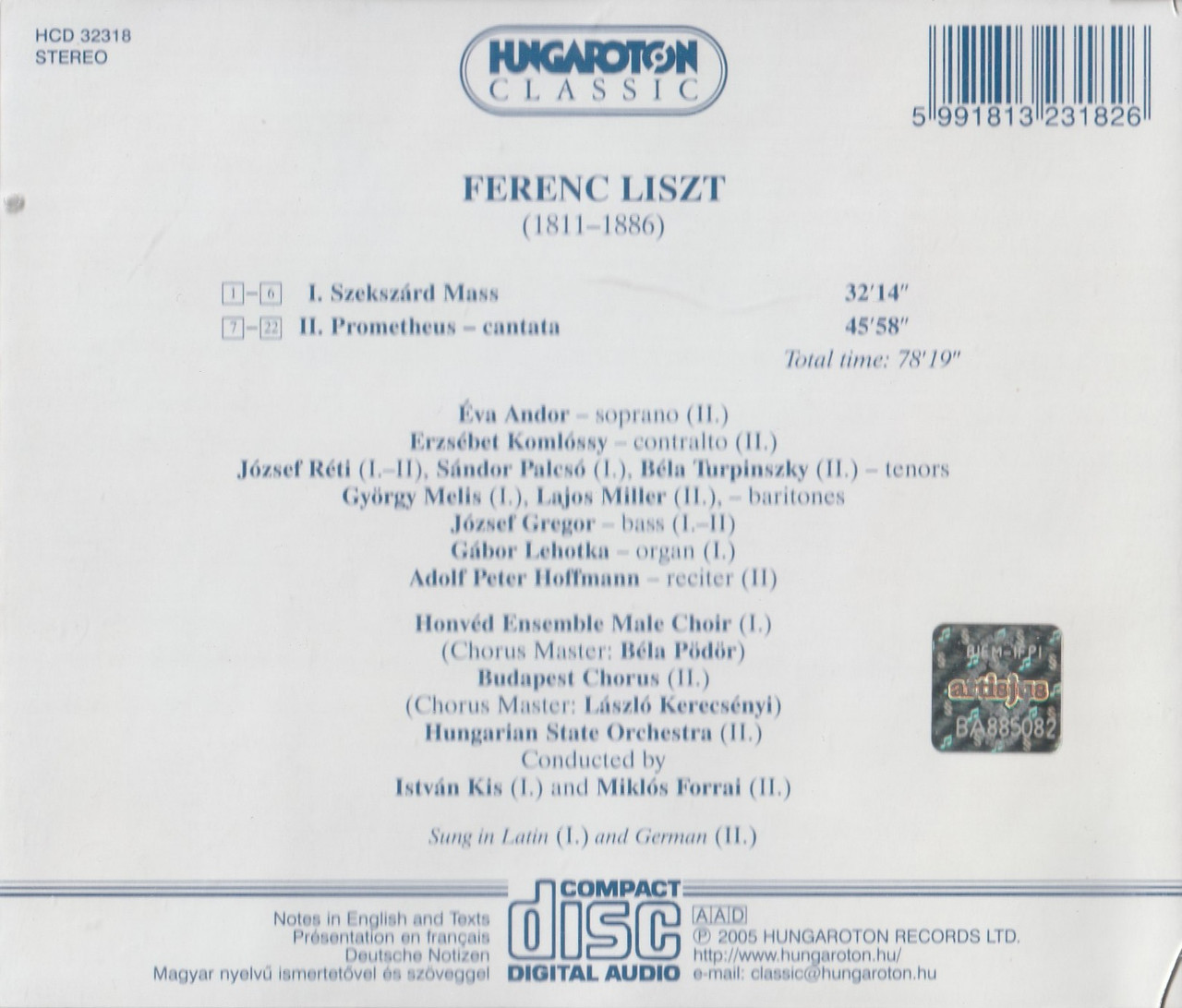
Works
Szekszárd Mass, S. 8/2 (32.14)
Prometheus Cantata, S. 69iii (45.58)
Soloists
Mass
József Réti, tenor
Sándor Palcsó, tenor
György Melis, baritone
József Gregor, bass
Cantata
Éva Andor, soprano
Erzsébet Komlóssy, contralto
József Réti, tenor
Béla Turpinszky, tenor
Lajos Miller, baritone
József Gregor, bass
Adolf Peter Hoffmann, narrator
Performers
Mass
Honvéd Ensemble Male Choir
Gábor Lehotka, organ
István Kis, conductor
Cantata
Budapest Chorus
Hungarian State Orchestra
Miklós Forrai, conductor
Label: Hungaroton
Year: 2005
Total Timing: 78.19
I would say both of these works are for Liszt completists only. They both have their moments, but the music never takes me away.
I like the performers from the 1972 Cantata performance more, although the 1969 Mass is fully committed; just not without flaws here and there. Truthfully, both have issues.
Hungaroton's sound, on the other hand, is outstanding!

Find more Liszt recordings HERE!
Comments
Post a Comment