Atterberg: Orchestral Bits 'n Bobs

For this entry of my Bits 'n Bobs series, I am covering smaller orchestral pieces from Swedish composer Kurt Atterberg. I never invested in the five volumes of Neeme Järvi Atterberg set on Chandos, so quite a few come from his extras which came alongside the symphonies. The rest I mined online.

Aladdin, here spelled Aladin, is a three-Act, two-hour opera. I am not sure if the entire work had ever been recorded before.
Atterberg's music is highly exotic, never afraid to lay into the Middle-Eastern setting. The overture bandies between lush Bantock-ian atmosphere and highly rhythmic areas evoking the activity of a busy marketplace or the like. Fanfares and wind ululations permeate these portions, adding to the character of the music.
Considering Aladdin was written in the years preceding World War II, hearing a highly Romantic, opera is quite unusual, although not unwelcome for this listener. The colors could easily have come from Rimsky-Korsakov some 50 years earlier, or perhaps moreso, a cinematic spectacular such as Lawrence of Arabia.
While I only listened to the Overture, there are a number of scene setting orchestral pieces which lie between the Acts of equally perfumed exotic quality. Knowing Atterberg's big, Romantic style, I wouldn't mind sitting down to listen to the entire opera at some point.
The CPO recording with the Brauschweig Staatsorchester led by Jonas Alber is glitzy and colorful, although I did not hear any singing to make any critique for the entire album.
Suite 1 'Orientale'
I thought I would give a listen to Atterberg's rarer Oriental Suite, as it contains the same amount of Arabic exoticisms as does his Aladdin from above.
The music is heavily perfumed with chromatic smears, oboe / English Horn solos, and light percussion to convey the atmosphere of 'The Orient'. To my ears, this equates to the Middle East again, perhaps the Fertile Crescent, and possibly even further east to India through to the Caucuses. Wherever the music is depicting, it is a dry landscape with modes far from Western Classical music.
While Marco Polo recorded a version of Suite no. 1 to be performed for piano quartet by the New Budapest Quartet, I was looking for the original orchestral version. All I could find was a YouTube video which cites Doron Salomon leading the Gävle Symphony Orchestra. For now, I have to trust that video upload to have provided the correct information, for I haven't been able to find any cover art (perhaps it never made it to record) nor other sources to verify its existence outside of two YouTube videos.
The music comes in three titled movements - I. In the Desert, II. Dance of Love, and III. Triumphal March. As mentioned earlier, the harmonic modes used are highly exotic, as is the orchestration, making for three colorful musical settings. Think Rimsky-Korsakov, Khachaturian, or the like. The piccolo at the very end of the final movement even brings to mind early Stravinsky to a small degree.
The recording itself leaves quite a bit to be desired. The orchestra isn't bad, but the sonic qualities are not great. Hissy and grainy with a fair bit of crushing when the orchestra plays are some of its attributes.
But as far as I know, this is the only orchestral version to be heard of Atterberg's Oriental Suite. For casual listeners, I think the Marco Polo piano quartet recording should suffice, especially if recording quality matters to your ears.
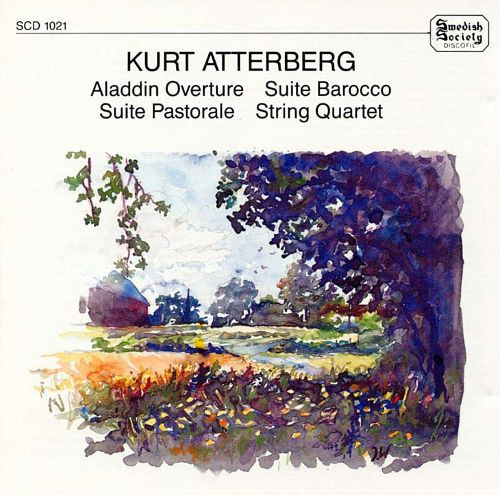
Suite 5 'Barocco'
Suite 8 'Pastorale'
'Wait a minute!', you say... 'The cover says Aladdin Overture; couldn't you simply have listened to this recording instead?'. Perhaps... and I did.
For years, this recording of Stig Rybrant leading the Berlin Symphony Orchestra was the only portion of Atterberg's opera to be heard. It is not a bad performance either. The BSO, note the lack of Philharmonic in the name, is a little scrappy, ported over from a mid-60s recording.
I daresay the Berlin horns swagger more here in Aladdin than the Braunschweig performance mentioned at the top of this blog post. Rybrant plays up Atterberg's Romantic profile more than the exotic musical elements heard from Jonas Alber in the full operatic experience. A wonderful comparison of orchestral execution. I have seen the Aladdin Overture title on this Swedish cover art blanked out on occasion; I wonder if it had licensing issues which needed to drop the Berlin performance.
Instead, though, I am primarily traversing this Swedish Society recording for Kurt Atterberg's two orchestral suites, ones which each look backwards in time through music history to mine their musical material. Despite subtitles of 'Baroque' and 'In an Old Style', I believe these meant to be played by a full Romantic orchestra, akin to Respighi in a similar mode. To be played by a period orchestra would be to lose the point of these compositions.
I lump both of these two suites together in my mind, for they bear a similar format, with Baroque dance forms making up six movements. Both end with a Gigue and a fifth-movement compound meter. Atterberg is more Romantic than Baroque, though, as the Sarabande sounds much more pastoral to my mind, and the harmonies float further afield. The Pastorale Suite seems to chromatically wander harmonically much more than the Baroque Suite, with the individual movements lasting longer in their musical material.
The composer Kurt Atterberg himself conducts these pieces with the Swedish Radio Symphony Orchestra. Atterberg is a sturdy conductor of his own music, where I could imagine more sparkle and more get-up-and-go in some places. The wind contributions are not the most flattering, with a far-from-sweet English Horn solo sounding of wet fowl, and the clarinet with a very fat sound. The strings fare somewhat better.
The sound is rather dry as well, telling the listener of this performance's age, although the recording is in stereo. Still, a fine outing from the composer at the helm.
I should mention that another recording of the Suite Barocco exists on Danacord. I think this latter one pleases more sonically, while the conductor and orchestra inject some vitality to the suite opposite Atterberg's more relaxed, congenial performance. The gavotte movement is a most telling comparison.

Ballad without Words
Atterberg's Ballad without Words is akin to taking a constitutional on a chilly, brisk day in early winter, one without snow, but instead with dormant foliage around.
I prefer the musical material in the bookend sections, with Atterberg spinning around the solos amongst the winds, most memorably from the trumpet. At 18+ minutes, the middle becomes muddled in my mind, yet the composer is at his modal best. If it doesn't come together for me as a whole, it is probably me trying to get my head around these non-symphony pieces from Atterberg.
Here we have a rare Atterberg outing on BIS. The orchestra is on their home turf, yet comes with a Japanese conductor leading them. I am not sure how familiar either conductor or ensemble are with this music, as I believe this might be the only one to be found on record.
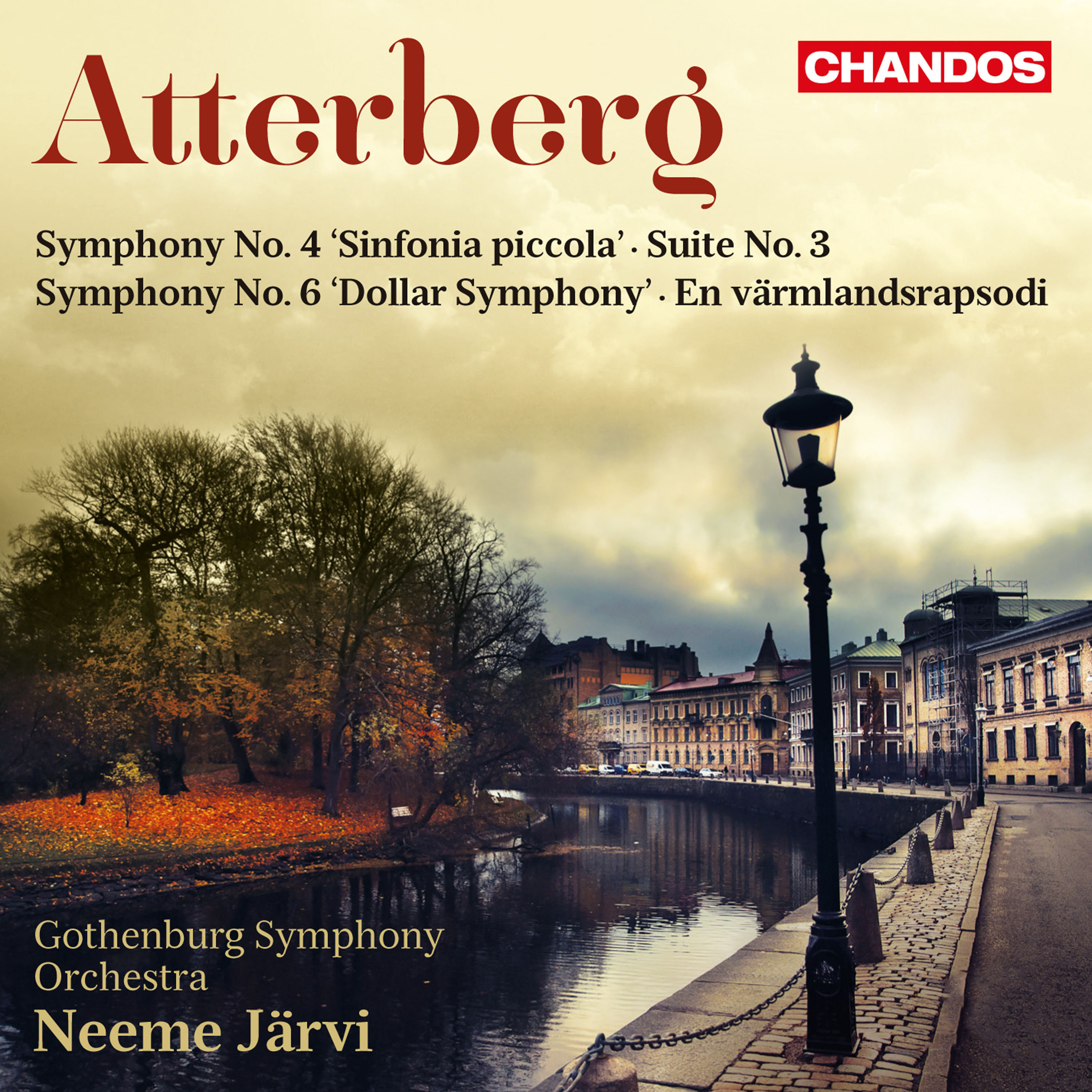
Suite no. 3
I separated Atterberg's Third Orchestral Suite from my comments on his First, Fifth, and Eighth Suites above, mainly because it is rather different than those others. It is not exotic, it is not aping an earlier musical style, and it is not programmatic. On the other hand, it is taken from incidental music, although there doesn't seem to be any intention of tying together a plot in this music, rather presenting the music as absolute music in a three-movement suite form.
Well, I can safely say I am in love with this music. It is highly Romantic, but more personal, more intimate, and more atmospheric than the other three suites. The addition of a substantial role for solo violin and solo viola, representing the characters of the play, aids the described moods of the music, both interweaving pleasurably. The final dance might be the most upbeat of the work, but even it is filled with wonderment and romance.
I see I am not the only one who enjoys this music, for this is probably the most recorded piece out of Atterberg's non-symphony, non-concerto music. Neeme Järvi seems at home in this music, although I would need to do further comparisons to see if he is pushing the music forward, as he tends to do. The performance sounds pious enough, although I could imagine an even more devout approach.
The string soloists are lovely sounding, and only one or twice did I question some rubato from the podium. Certainly, I like this music enough to investigate further.

Vittorioso
Three Nocturnes
Vittorioso is a discarded fourth movement from Atterberg's Seventh Symphony. As such, there is a lot going on orchestrally in this symphonic movement, moreso than many of the pieces I have heard from above.
Quirky orchestral colors are at the fore right at the start, coming from the pairing of piccolo and bass clarinet with shimmering strings and background winds punctuating quietly. It is obvious Atterberg is in a militaristic mode, or at least playing with the idea of a march. This one is not instantly jolly, mainly due to the composer's use of modes, but there is a definite playfulness at hand, one I can't but help enjoying. By the end, the music turns noble, a musical affirmation compared to where the music begins.
Pried out from Atterberg's opera Fanal, the title Three Nocturnes seems poorly translated. Nocturne insinuates, to my mind at least, a becalmed night piece, whether it is the atmosphere of the evening or the spirit of the drowsy.
Instead, these three short orchestral poems from the composer's opera seem dark musical tales of the night, more successfully evoking surreal nightmarish visions than anything dreamy or somnambulistic. Truly, I like this aspect from the trio, for they are not intent on wisking me off to bed, but instead wish me to fear the night instead.
A trenchant, swirling march rides aside fearsome brass, providing ghastly images from the winds in the First Nocturne. A sweeping tune finds the central section, not unexpected in music from Atterberg, only taking away from the initial atmosphere for a brief Romantic excursion.
The Second Nocturne is less intent on moving forward initially, but is equally menacing as the first. Again, it is the colors of the winds with the strings which really make this music work so well. I daresay, there is a sense of adventure brewing in this second musical essay, one which relishes the dire situation the music is insinuating otherwise.
In the Third Nocturne, I am reminded of Berlioz at the beginning, perhaps leading my mind to darker musical haunts in the music. Here, I sense the work trying to come to a more positive resolution, with screechy haunts moving in and out of the musical landscape.
Really, I found these Three Nocturnes a whole lot of fun; splendidly colorful tone poems of great character. I find there are so many moments such as these which come from operas that compel me to investigate the complete work further, something I rarely intend at the outset.
As far as I know, Neeme Järvi and Gothenburg are the only ones to have recorded either of these works, making their easy appeal an even greater virtue.
Summary
After hearing these individual orchestral works from Atterberg, I realize how special his symphonies actually are. Few of these suites and shorter orchestral pieces made much of an impression on me, with the exception of the extras found on Chandos' Atterberg symphony series from Neeme Järvi in Gothenburg.
Bits 'n Bobs
Aladdin, op. 44: Overture (6.01)
Braunschweig State Orchestra
Jonas Alber, conductor
CPO; 2023
Suite no. 1 'Orientale' (12.13)
Gävle Symphony Orchestra
Doron Salomon, conductor
???
Suite no. 5 'Barocco', op. 23 (17.11)
Suite no. 8 'Pastorale', op. 34 (19.49)
Swedish Radio Symphony Orchestra
Kurt Atterberg, conductor
Swedish Society; 1967 / 1988
Ballad without Words, op. 56 (18.29)
Norrköping Symphony Orchestra
Jun'ichi Hirokami, conductor
BIS; 1992
Suite no. 3, op. 19 no. 1 (14.30)
Gothenburg Symphony Orchestra
Neeme Järvi, conductor
Chandos; 2013
Vittorioso, op. 58 (8.22)
Three Nocturnes, op. 35bis (17.15)
Gothenburg Symphony Orchestra
Neeme Järvi, conductor
Chandos; 2016
Comments
Post a Comment