Parry: String Quartets

I enjoy his String Quartet no. 1 in G minor quite a bit. The Archaeus Quartet imbues a nice amount of hustle and bustle in the first movement, while the hymn-like attributes of the second movement are quite endearing. The final movement may be more sturdy than inspiring, but this is affable music from Parry nonetheless.
This leads me to the bad news. While I was pretty much onboard with the Archaeus' first movement, their seams showed more strongly in the second movement. It sounds as if the group decided not to tune with each other before recording, for there are far too many ear-wincing issues for a global release. This issue is not consistent, and not terribly front-and-center either, but one can easily sense the ensemble not gelling together and coming apart with one another. Plus, some tentative playing from individual players does not help matters, with the first violin balanced forward among the ensemble.
The Archaeus Quartet is not new to recorded media either, where they are praised for their traversals of chamber music by York Bowen on Naxos, plus Cyril Scott and Leonard Salzedo from the Dutton Laboratories. Just taking a swift glance through a few reviews of those other recordings, the Archaeus are heaped with praise for their playing abilities.
I don't what went wrong here; are they under-rehearsed? Too closely recorded? Was a new player(s) thrown into the mix? I certainly don't hear the church acoustic giving the engineers any problems on this recording, aside from a too close perspective, so I can only put the end result upon the players, particularly the higher-registered instrumentalists. A shame, for there is no other place to hear these early quartets from Sir Hubert.
While I was bummed and confused by the state of affairs on this recording, I positively forged ahead, if nothing else than to experience more of Parry's string quartets. This is The Way.
I was actually charmed by the playing of the Archaeus Quartet in the opening slow introduction of Parry's String Quartet no. 2 in C Major. The ensemble's sound is sweetly cohesive with no lack of passion on their part. If there is less of a feeling of ambivalence and ensemble issues, such things can be found in smaller, less frequent quantities nonetheless.
As to the Second String Quartet itself, I especially enjoy the folksy qualities of the second and fourth movements, musical qualities I don't usually associate with Parry. The second movement boasts drones sustained under, what sounds like, a fundamentalist folk tune from the Americas. If echoes of Dvořák comes to mind, at least the music makes more of an impression in this way.
The bustling first and third movements are more foursquare in comparison. Instead of an expected Scherzo in the third movement, the music plays out more as a contrapuntal exercise across the four instruments, although there is a fleet lightness attached to the movement as well. The fourth movement finds its way as a rustic, pastoral dance, one which perhaps lays too far on the civilized side from these performers.
String Quartet no. 3 in G Major is the longest quartet on the program, a work which is separated from the earlier quartets by a decade or so. That makes this music the most mature setting from Hubert Parry, in a genre he never came back to once he found success in large-scale choral/orchestral music.
The first movement's music sounds more spontaneous than anything which came about earlier, with Parry utilizing smaller musical cells and harmonic chromaticism to pepper his third string quartet iteration. While I am finding the sound of the Archaeus Quartet better, or perhaps I am becoming more familiar with their particular sound and style, they are a little too thinly textured to give Parry's music real meat to his soundworld.
Parry hasn't played around much with pizzicato thus far, but we hear its use firmly in the second movement, underlying a long-breathed serenade-like melody. Some of the harmony filling in between melody and plucked cello is a tad chromatically dense at times, however this change in approach is a marked difference from the composer here.
The third movement is more rhythmically menacing, where I could imagine a lot more bite adding to the contrasting mood in this portion of the work. The modal element in the centrally located pastoral Trio brings back pizzicato into the quartet texture, with both sections representing Parry's finest contrast in a string quartet thus far. Unfortunately, Parry's last movement is far too tepid and friendly to send off the piece properly, aided by the Archaeus Quartet's ensemble issues. On the other hand, Parry's fascination with pizzicato makes another appreciable appearance again, with a final mad dash to put a button on the end of the work.
As an added bonus, the short Scherzo in C Major is included. I like the textures and harmonies of this one, and am particularly fond of the opening ensemble flourish in particular, while the piece otherwise burbles along its merry way with little care in the world, with some fun rhythmic divergences.
I won't repeat my continual harping from above, but there is one other aspect regarding this recording which peeves me. The total runtime comes to 81 minutes and some-odd seconds, yet the music is spread across 2CDs. While the old CD limit was 79 minutes for countless years, we now have plenty of single CD recordings which spread well past 80 minutes in length. Better yet, how about a hybrid-SACD which contains more digital space? If you stream music, enjoy the freedom from these physical media bothers.
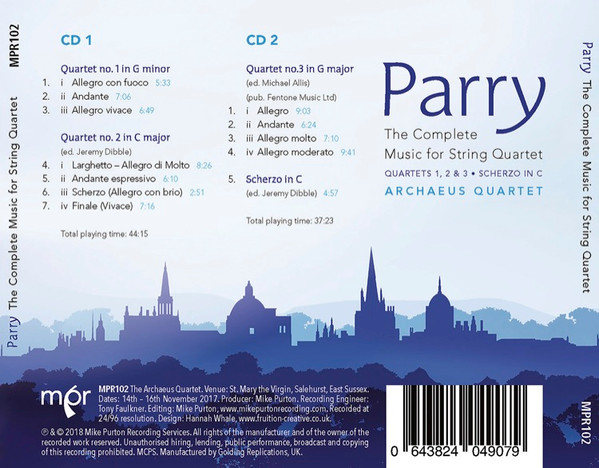
Works
String Quartet 1 in G minor (19.28)
String Quartet 2 in C Major (24.43)
String Quartet 3 in G Major (32.18)
Scherzo in C Major (4.57)
Performers
Archaeus Quartet
Ann Hooley, violin
Rosemary Lock, violin
Elizabeth Turnbull, viola
Martin Bradshaw, cello
Label: MPR
Year: 2018
Total Timing: 81.38
CD1: 44.15
CD2: 37.23
Parry's early contributions to the string quartet genre are not requisite listening, yet well worth hearing for fans of the composer and the genre, even if the ensemble playing them here is not.
If another recording comes along with Hubert Parry's quartets, I will gladly kick this one to the curb. As it is, this is what is available to our ears for the time being.

Find more Parry recordings HERE!
Comments
Post a Comment