Roussel: Symphony 3
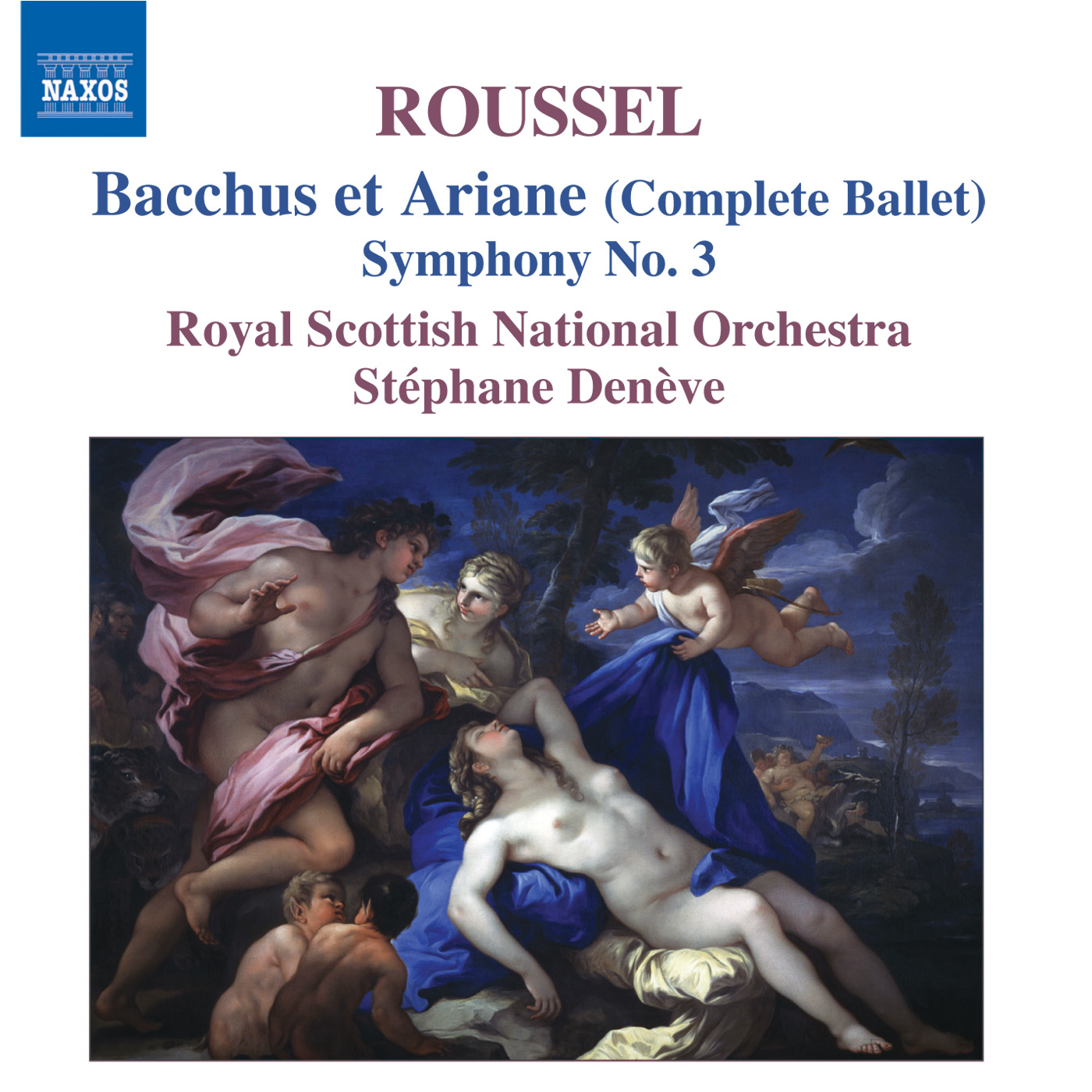
Albert Roussel's Symphony no. 3 in G minor must be his most popular to record, for there is a Who's Who of conductors and orchestras which have tackled the work. Aside from the French masters Martinon, Cluytens, Munch, Ansermet, and Boulez, the likes of Bernstein, Leppard, and Rosbaud have their names attached to leading the composer's Third Symphony, among many others.
Since I started chronologically with Roussel's First and Second Symphonies this go around, where the composer was airy and atmospheric with occasional tendencies towards sweeping Romanticisms, here Roussel mixes Neo-Classicism with Romanticism. Truthfully, I hear Roussel's first true absolute symphonic creation in his Third Symphony, abetted by efficient structuring and contrasting motivic development within movements and across the whole work.
The Neo-Classicist side has Roussel using angular intervallic relationships, with many more surprising motions compared to his previous symphonies, and much more willing to have the music and its melodic ideas leap around in odd directions. Dissonant yes, but more as a harmonic flavor than anything to scare listeners away during the meal.
Most engaging in the symphony is Roussel's extroverted musical voice. Even in the second 'slow' movement, the composer makes way for an impish pre-Scherzo as well as one of the most crushing climaxes heard from Roussel thus far. And what is to follow, but yet another Scherzo idea in the third movement, although I think the last two movements of the symphony head in musically lighter-hearted territories compared to the first two.
Stéphane Denève italicizes all of these points by driving the music hard, if not consistently through tempo, by way of sharp rhythms and hard-hit textures. Certainly, Roussel makes the symphonic ensemble more brass heavy, or the Scots are built that way here, and if I thought the flute, clarinet, and horn received undue attention in the earlier works, here it is the bassoons and solo string moments.
The cover of this Naxos recording labels Roussel's ballet Bacchus and Ariadne as 'complete', while the back cover lists two suites from the ballet instead. Since the music is played without stop in both suites, I assume we are given most of, if not all of the ballet in these suites, with Suite no. 1 covering Act I and Suite no. 2 similarly with Act II.
Surprisingly, it is the Second Suite which has received more love than the first. I say surprising since there is a whole lot of seafaring and swashbuckling in Act I, whereas Act II is filled with the love scenes. As far as the music, I would place this ballet as coinciding with Ravel's Daphnis and Chloé, albeit much later and less memorable than Ravel's masterpiece.
Once again, I really feel Denève pushing through Act I raucously, even if the Royal Scottish National Orchestra can handle everything the conductor throws at them. It is exciting, but if you are a listener who wants to stop and smell the roses occasionally, this won't be your cup of tea, I don't think.
The sonic picture from Naxos is clear and colorful. Those who don't care for a mid-hall presentation might care for a closer perspective, but those would be personal preferences. I do know I didn't hear the brief moments of celeste in either work at all, but the harp is also a little flung back in the sound, so perhaps that instrument was simply covered up or not used at all. Otherwise, as the first volume in Denève's Roussel symphony series, this was a electric start for the label and its performers.

Work Series
Vol. 3 from Roussel Symphonies on Naxos
Works
Symphony 3 in G minor, op. 42 (25.31)
Bacchus and Ariadne, op. 43 (37.37)
Performers
Royal Scottish National Orchestra
Stéphane Denève, conductor
Label: Naxos
Year: 2007
Total Timing: 63.08
Find more Roussel recordings HERE!
Comments
Post a Comment