Roussel: Symphony 2
I believe the Suite in F Major was the very first piece of music I had heard from French composer Albert Roussel. Here is a work with movement titles referring to the Baroque Era, but the music is purely Roussel's in the 20th Century. Boisterously rhythmic in the outer movements, only the central Sarabande offers exotic mystery opposite the mischievous merrymaking. If you haven't heard the marvelous Suite in F, make some time now; it is a corker from Roussel!
Symphony no. 2 in B-flat Major opens in a murky, primordial uncertainty. Indeed, most of this Second Symphony is not particularly keen on revealing its mysteries openly. Oddly, it is the outer movements, of three, which bear slow tempos, leaving the central movement Scherzo the only bit of purposefully structured uptempo. I use the term 'purposefully structured' since Roussel works in waves within movements, where the composer strikes out in a brief contrasting accelerandos.
I love Roussel's use of clarinet, piccolo, and horn in particular. In the first movement, the first major accelerando leads to a cheeky and uplifting section involving these very instruments, although the return of the opening ghastly moods returns in force. The music as a whole is almost evoking a struggle between optimism and darkness, with the latter taking precedence by the end of the movement, I think, although perhaps more calm and contented than grim.
While a Scherzo infers humor to some degree, here the second movement is a sturdier, lyrically sweeping setting rather than anything witty or uplifting. I suppose such things keeps this movement within Roussel's world-view thus far in the work. Once again, I enjoy the clarinet, horn, and piccolo in the Scherzo, providing a bit of wry brightness to the music.
Roussel slows the tempo down considerably for the Trio section. Introspective and moody, one is oft reminded of how the entire symphony begins, here textured by a harp in the background. Eventually the music finds its footing in happier, dance-like moods, with a fine solo for trumpet, another instrument Roussel writes well for, before returning to the Scherzo proper.
While completely different, Roussel returns to a sinister mood in the last movement. Again, there are waves of brightness and heroism which rear their heads, but the composer seems to prefer to have the cloudy moods take over at every turn. The contrasting sections are more characterful in this third movement though, making the long descent into quietude and unrest difficult in the last moments hard won.
While Roussel is working in a highly chromatic landscape in Symphony no. 2, mostly in slow-moving musical gestures, I find I am along for the ride with the composer, whereas in similar works of strong chromaticism, I would be put off. I am going to chalk it up to Roussel for delivering the goods as far as orchestral texture and colors, plus melodic and harmonic content, are concerned.
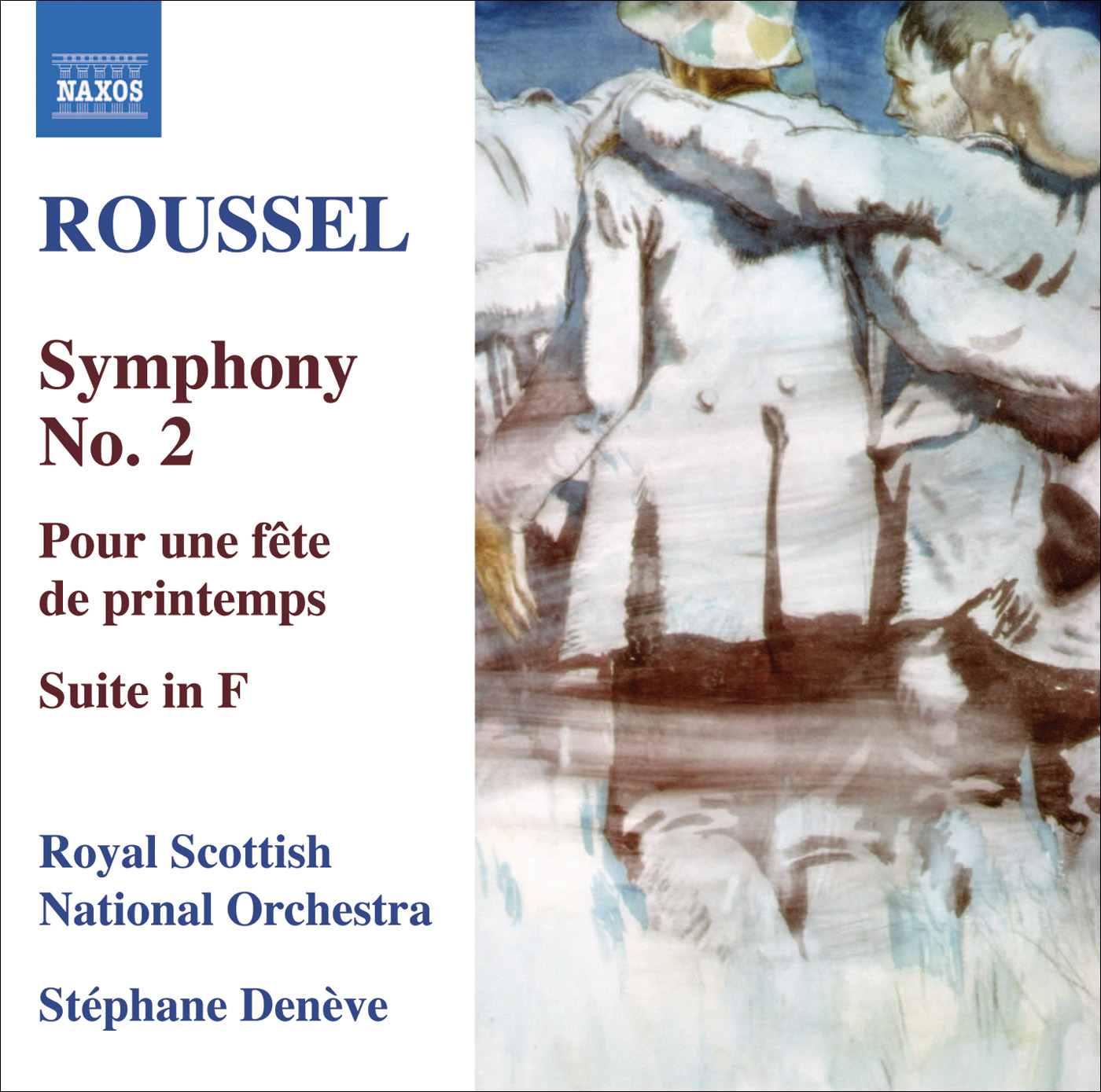
Even the grim, dour mood doesn't put me off of the Second Symphony, although it wasn't until I really looked at the cover art of this recording and the date of composition as 1919-1921, where I realized the effects of WWI might be behind some of the music making here.
As opposed to other Roussel symphony sets, which mainly provide the symphonies alone, I enjoy that Naxos has spread out the symphonies to four separate releases. This allows them to provide more orchestral music from Roussel alongside the symphonies. Not only that, but Stéphane Denève and Naxos has programmed these extra works from Roussel to come from the same time period as the main symphony, providing the listener a thorough chronology of the composer's evolution of musical stylistic traits.
Such meandering musings leads me to Pour une Fête de Printemps (For a Festival in Spring). One could imagine the opening orchestral evocations as a continuation of Roussel's Second Symphony, but in this case, it is the early morning set-up for a Spring Celebration. Three climaxes of festivities reach a peak before the composer tamps the music back down each time, although it is the high spirits of swirling revelry which win the day here, although the work concludes in the repose of night. If I am reminded of Respighi's Roman Carnivals, I am sure it is the shared party atmospheres which tugs at my mind strings.
Maybe it is the Henry Wood Hall Glasgow location, but I find the ensemble balances better here than in Symphony no. 1. My guess is that this is more serious music making compared to those early works, thus more effort might have been shined on this music over the lighter items. While French conductor Stéphane Denève is slower than most in Symphony no. 2, I think he gleans more menace and detail comparatively as well. Certainly, Denève appropriately strikes a more gregarious personality for the Suite in F, a well-needed balm from the gloomy mood of the symphony. The Royal Scottish National Orchestra seems more at home in this music too.

Work Series
Vol. 2 from Roussel Symphonies on Naxos
Works
Symphony 2 in B-flat Major, op. 23 (42.51)
Pour une Fête de Printemps, op. 22 (11.41)
Suite in F Major, op. 33 (14.11)
Performers
Royal Scottish National Orchestra
Stéphane Denève, conductor
Label: Naxos
Year: 2008
Total Timing: 68.43
Find more Roussel recordings HERE!
Comments
Post a Comment