Parry: Symphony 2 & 3

I am absolutely enchanted by the opening of Hubert Parry's Symphony no. 2 in F Major. The yearning, upward leaping musical idea at the very start soars Romantically, done so in a haunting minor key too. Best of all, Parry brings back this melodic motion for the third-movement Andante, a bit of a cyclical callback from the composer.
Akin to his First Symphony, this follow-up work is very much in a late-Romantic German mold, an aspect I am rather enjoying from Parry in these early symphonies. Following the opening description from above, Parry eventually makes his way to a string chorale of sorts, one which sounds much more 'British' than I have heard from him thus far. Otherwise, the music breathes and exhales nothing but the Schwarzwald at each musical utterance, very reminiscent of Richard Wagner at times.
The Scherzo, here positioned in the second movement, reminds me some of Mendelssohn. This one is more fantastical than it is witty or light, although there is enough forward motion to evoke an appreciable difference, at least compared to Parry's previous symphony. Of course, the Trio gives the winds a proper workout, delighting in a pastoral mood moving above a lengthy pedal in the bass.
As mentioned earlier, the melody in the third movement leaps up followed by a sighing downward scale, a replica of sorts taken from the opening slow introduction of the first movement. This is sweet, sweeping music of gushing amour, not too far flung from Wagner, with horns and winds constantly surging and retreating. It is a particularly beautiful opening, although Parry makes way for startling drama and tension before subsiding into dewy-eyed romance once more.
Strangely, the final movement is rather sturdy, not the manic conclusion one might hope for. Indeed, Parry seems more concerned with musical heroics rather than lightening the mood. Is this the British stiff upper lip we have been waiting for from Parry, once again induced by a later-heard pompous string chorale? Still, there is a pastoral nature to the music once again, recalling Mendelssohn to my mind.
While I praised the early Chandos sonics in the first volume of this works series of Parry's symphonies, here in the Second Symphony I think I detect too much of the acoustic. The strings are big, grand, and lush, while the winds and brass are definitely behind the strings, the distance picking up the church acoustic. Of course, I detected more of this on speakers than I did on headphones, so your results may vary. I should also mention Andrew Penny covers Symphony no. 2 on Naxos, where the RSNO are lighter and breezier than the LPO under Bamert. Some might enjoy the difference; I however love the thick, luscious performance here on Chandos.
Either way, I am unexpected taken with Parry's first two symphonies. There is romance, adventure, and magic, everything one would want from a novel, here in symphonic form. If Parry hasn't found an identifiable 'British sound' yet, I am not complaining during the wait.

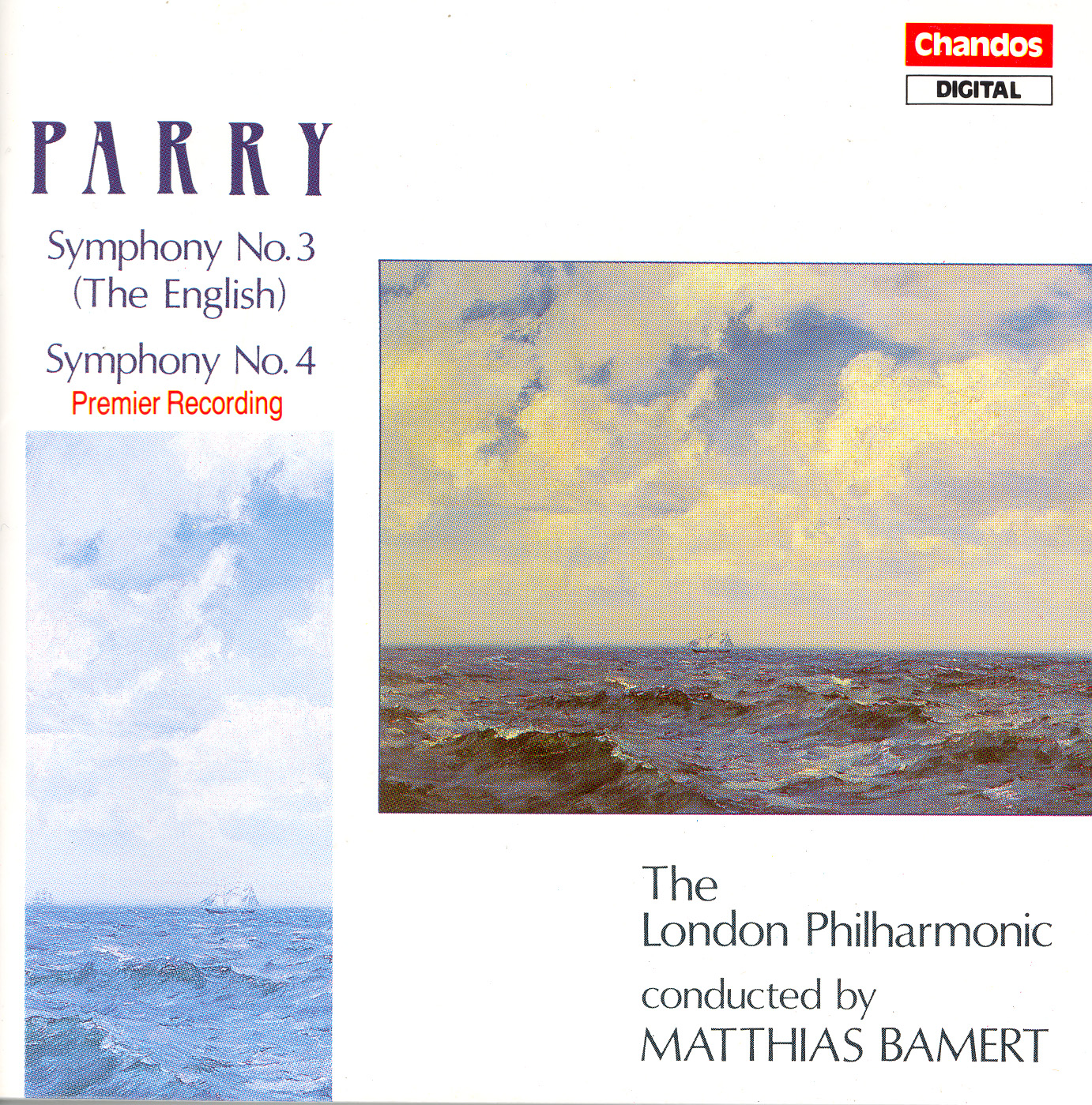
What a change! It is as if Hubert Parry took all of the late-Romantic, Wagnerian chromaticisms from his first two symphonies and tossed them in the rubbish bin in order to make his Symphony no. 3 in C Major. To my ears, the effect of this change sounds almost as an homage to the Classical Era, relying on diatonicism to a fault. Is this the 'British sound' I referred to above?
There is a decided pomp to the first movement, as if appealing less to the senses as it is to propriety. Certainly Parry's music is clearer to the ears, but I am lacking the passion of his earlier symphonic intentions. The composer also tends to repeat musical ideas ad nauseam, far too often in my opinion. It is if Parry has found a new sound, but doesn't want to necessarily develop it rather than playing around with his favorite themes over and over again. I do enjoy some of the harmonic sequences, ones which stray from expectation, and the final musical sentences of the movement are strong ones.
The second-movement Andante sostenuto returns to Teutonic late-Romanticisms, the only glimpse remaining from the previous symphonies. A walking bass line amidst orchestral winds and brass gently rocks at the start, eventually giving way to long undulating string lines, and winsome ones at that. I am not sure this movement fits with the rest of the symphony, but the break in style is notable.
Despite the tempo marking Allegro molto scherzando, this is buttoned-up music, almost as if a Classical Era third-movement Minuet is in play. I think a lighter playing style might be called for as well, more than what the London Philharmonic Orchestra can provide here, as they are a tad heavy-footed. Bamert does give a wonderfully witty stinger at the final moments.
A thick, orchestral chorale opens the fourth movement, which leads to a set of variations. The variations take a while to find their footing, once again reveling in its stately appearance. The C Major key keeps the music very well behaved, although the second-half harmonic shift is a lot of fun. So too, the various spotlights on the various sections of the orchestra are quite enjoyable to hear.
While I mentioned the loose acoustics in the Second Symphony above, it is actually here in the Third Symphony where I think crisper winds and a tauter rhythmic profile alongside a less grandiose string section would add a whole lot of personality to Parry's music. I am actually unfamiliar with any other recordings of the work, so this will have to suffice.
I didn't make mention of either symphony's sobriquets. Symphony no. 2 'Cambridge' is simply named after where the music was premiered, a harmless nickname. When it comes to Symphony no. 3 'English', I am less sure of the history or purpose behind it. If this is the direction Parry will be moving towards in his symphonies, making this one known as 'The English' makes sense, for it is quite different than his previous, and certainly retains a cultural personality. Whether or not this is an improvement upon what came before will be up in the air for this listener. I am not there yet...
Works Series
Vol. 2 from Parry Symphonies on Chandos
Works
Symphony 2 in F Major 'Cambridge' (37.46)
Symphony 3 in C Major 'English' (34.30)
Performers
London Philharmonic Orchestra
Matthias Bamert, conductor
Total Timing: 72.26
Label: Chandos
Year: 1992
Find more Parry recordings HERE!
Comments
Post a Comment