Parry: Symphony 4 & 5
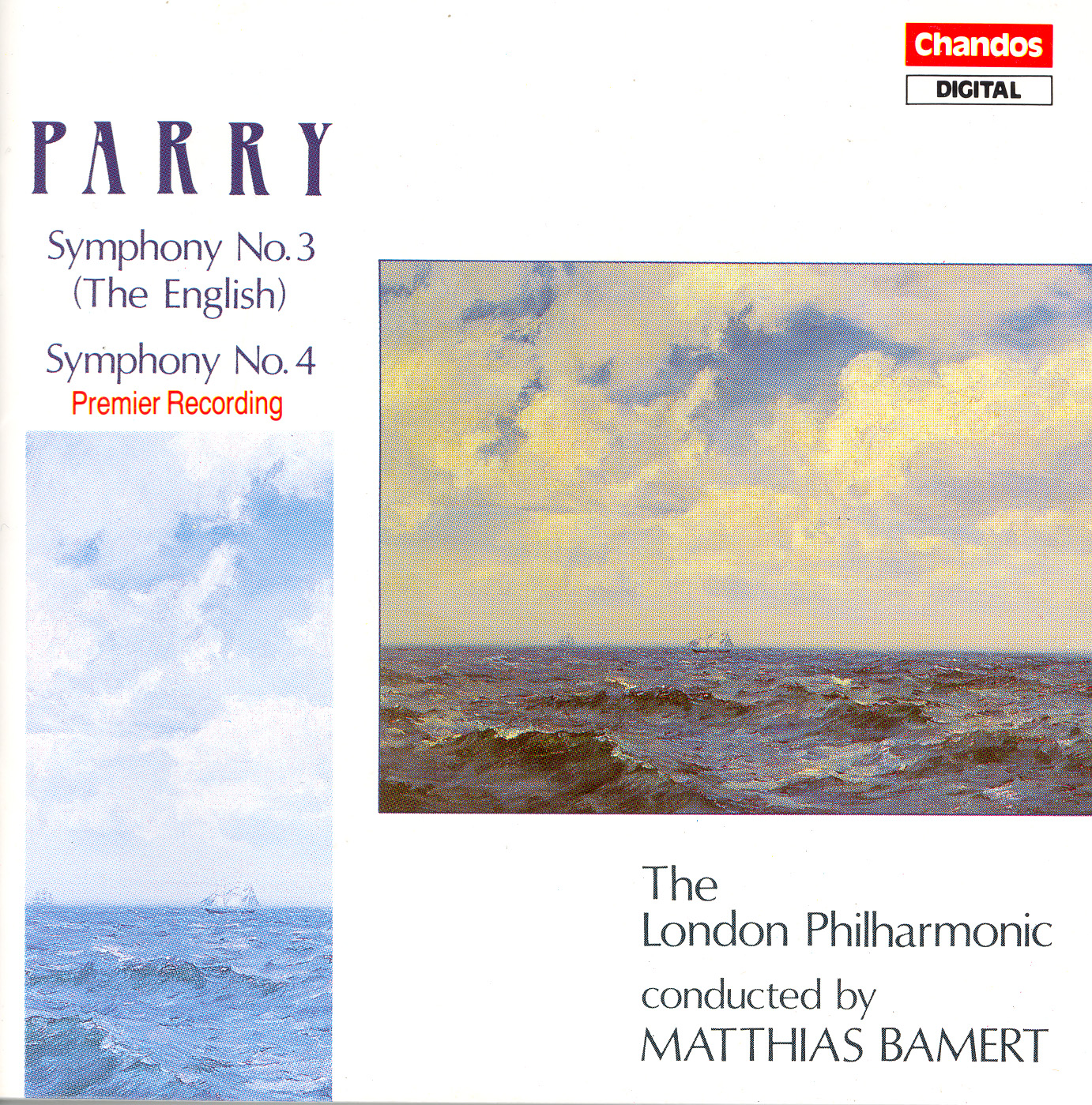
After the very different musical setting by Sir Hubert Parry in his Third Symphony, he comes back to the late-Romantic style in Symphony no. 4 in E minor. This change back into a Germanic mode is not totally unwelcome, as I enjoyed Parry's first two symphonies in the same style, yet I was also hoping for some sort of a progression from the composer. 'Twas not to be.
The first movement sets a very serious mood, a pall which is cast over most of the Fourth Symphony, although I have not known Parry's symphonies to be full of levity or overt congeniality thus far, Symphony no. 3 notwithstanding. High Romance, yes, but Parry's symphonies come off as rather sturdy edifices, and all to their benefit when you get right down to it.
Sir Hubert seems to be in his element when approaching the slow movement of his symphonies. Thick ensemble strings underline the composer's love of Romantic excess, here giving some time over to a lovely violin solo as well. As ever, slow doesn't mean sweet and song-like, for Parry prefers to build-up towards heady drama and tension rather than unalloyed peace or calm. Here, it is a rhythmic crescendo in the last third of the movement, bolstered by timpani, which leads to a lovely musical climax.
A bit of woodwind playfulness arrives in the third movement, a welcome change of pace for the work. Parry does a little of the stop and start in the Scherzo proper, later rustically bringing out the horns in the Trio in true Schwarzwald fashion. As has been the case in his symphonies, Parry brings out more of the British pomp in the final movement, mixed with the same serious attitude from the first movement, albeit with a hefty does of grandiosity and heroism for the conclusion.
Matthias Bamert records Hubert Parry's final revised version of the symphony here, but you can find the original version on Chandos as well, from Rumon Gamba in 2018. That version of Symphony no. 4 comes in five movements with a more autobiographical program to the work, paired with some fun orchestral extras.


Symphony no. 5 in B minor is not only Parry's shortest symphonic creation, but is also set in four connected movements without pause. Furthermore, each of the movements are titles in an Inside Out manner - Stress, Love, Play, Now - perhaps continuing the autobiographical aspects originally tied to the Fourth Symphony.
I don't know that these titles separate the music from his earlier symphonies, for a similar orchestral style is employed here. A serious opening movement, a slow movement of great feeling and emotion, a sturdy, yet upbeat Scherzo, and a glorious conclusion with some British musical elements thrown in. If anything, this work is even a little more self-consciously serious than the previous symphony.
I often enjoy following a composer's works chronologically to hear how they progress across their career, but haven't sensed that compositional growth across Parry's symphonies. I greatly enjoyed his first two symphonies, thus the last two symphonies remain affable to my ears, if not too similar in construction.
If I missed a through line regarding Parry's style in lieu of focusing on the influences of Schumann and Brahms or Mahler and Wagner, it is that of Edward Elgar. While I consider Parry and Stanford the early progenitors of the British symphonic Renaissance, Elgar certainly carried their stylistic banner forward. On the other hand, Elgar was very much Parry's contemporary, only 10 years younger, so perhaps he should be grouped with the duo instead of as a later champion. Time will tell when I spend more time with Sir Edward's music.
Matthias Bamert and the London Philharmonic Orchestra complete their series of Parry's symphonies as they started. The church acoustic provides a grandiose, thick, smooth sound palate for the ensemble, enriching Parry's already excessively late-Romantic orchestral sounds. I could easily imagine someone else swooping in and making a completely different sonic profile of these symphonies rather successfully, one with a drier acoustic with some bite from the winds.
This same orchestra recorded Parry's Symphony no. 5 with Sir Adrian Boult at the helm a decade or so earlier, and with a snappier pace. I would be interested to hear it, for sure. The BBC Magazine also had a recording of the symphony with Vassily Sinaisky leading the BBC Philharmonic Orchestra, making the Fifth Symphony Parry's most recorded symphony, at least as far as I know.
Either way, Hubert Parry's Fifth Symphony is an enjoyable
experience, if not simply more of the same. In some regards it is
disappointing, and in another way the work continues the pleasure principle
similarly evoked in his previous symphonies.
Works Series
Vol. 3 from Parry Symphonies on Chandos
Works
Symphony 4 in E minor (41.40)
Symphony 5 in B minor 'Fantasia' (26.53)
Performers
London Philharmonic Orchestra
Matthias Bamert, conductor
Total Timing: 68.44
Label: Chandos
Year: 1992
Find more Parry recordings HERE!
Comments
Post a Comment