Enescu: Bit 'n Bobs

For this segment of Bit 'n Bobs, I cover a potpourri of works from Romanian composer George Enescu, including two concertante works, an orchestral piece, and chamber music.
Caprice Roumain
When coming across Caprice Roumain, I thought I had forgotten a populous violin concerto from Enescu. Yes, there is solo violin, and yes there is an orchestra, but it was good of Enescu not to name this a concerto.
Essentially, the piece is a very long improvisational doodle for solo violin over modal scales, often in simply two part textures with the ensemble. Sure there are some contrasting rhythmic bits, but even those are simply solo arpeggios over the same exotic modal scales over and over again, akin to a Muezzin in a minaret. And this is carried across four movements (!). To say I was disappointed is an understatement, where the repetitiousness lasts ages to my mind.
This recording is no great shakes either. The recording says it was made in the 1990s, but the sonic quality could have easily have been sourced from 30 - 40 years earlier.
One positive light was learning about Sherban Lupu on this recording. Here is a violinist completely dedicated to the Ensecu cause, digging up lost bits and bobs in dusty library basements to perform. His playing isn't bad here, though. Lupu seems to enjoy employing heterophony with the orchestra, not completely lining up rhythmically at times, and not tuning exactly at the same moments either.
For some, like me, this might drive you nuts, but there is seemingly cause to perform it this way. A year before his death in 2022, Sherban Lupu reprised the work with Ian Hobson leading the Sinfonia da Camera on Toccata Classics. In many ways, he approaches the Caprice Roumain in much the same manner as he did in this older performance, with bounteous orchestral portamentos and loosey-goosey improvisational moments. A third recording, by the amusing Les Dissonances is quite different, but still, the piece doesn't really hang together for me there either.


Piano Concerto in D minor
If I was expecting much more from the Caprice Roumain, my expectations for a fragment taken from an abandoned piano concerto were quite low. I couldn't be happier by how much I was taken by this one-movement Piano Concerto fragment.
Like Enescu's Violin Concerto, the Piano Concerto in D minor is a student work, hardly fitting into the composer's mature musical scene. And yet, I was taken in, just like those other early and/or abandoned works from Enescu's younger years.
While I sense the Russian school behind this music, maybe someone like Rimsky-Korsakov or Mussorgsky, there is also a confrontational Beethoven-ian argument to this music. With that in mind, these might be some of the most declamatory musical statements I have heard from the composer, and I enjoyed every minute of it. The fragment is not long at around 12 minutes, but maybe that was for the best best, as Enescu always had a tough time knowing when to stop.
I heard Luiza Borac in her performance of Enescu's Piano Phantasy on CPO, and she is even more convincing here, obviously yet another advocate of the Romanian composer.
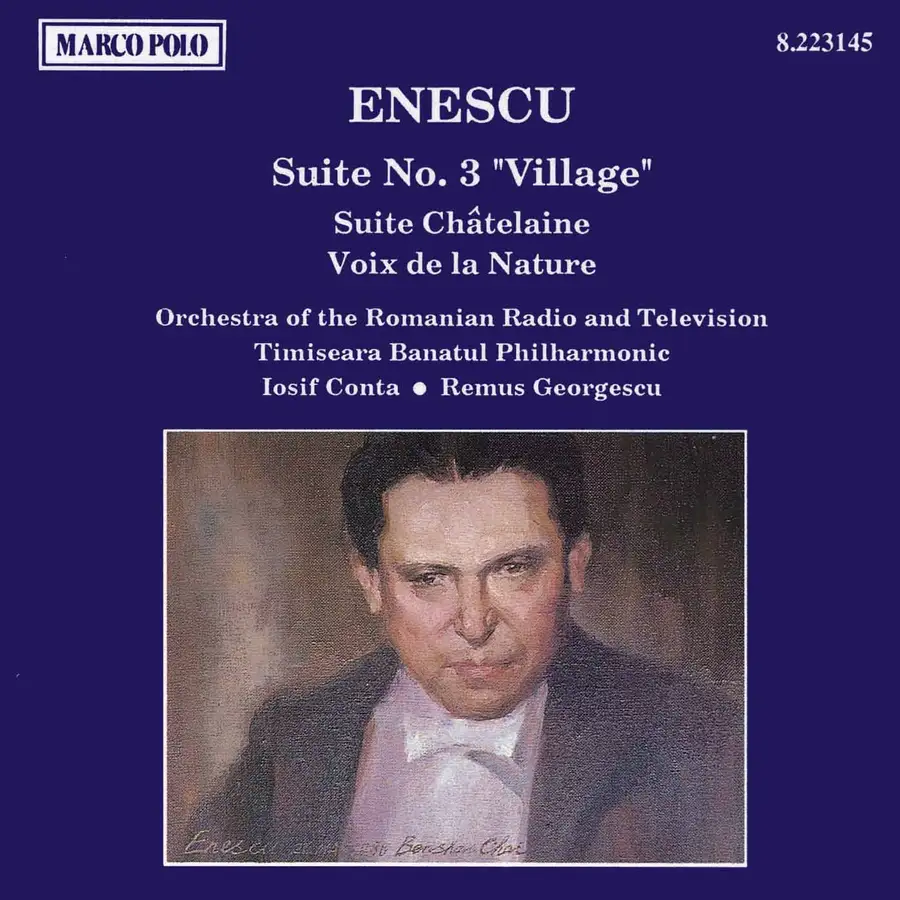
Suite Châtelaine
Suite Châtelaine is pretty affable music from Enescu, considering it is a later work. It too was abandoned by the composer, but there are two movements which remain completed.
The first movement moves in heroic motions, almost fanfare like in some instances, with raucous brass climaxes and dotted march rhythms opposite moments of sweet repose. The second movement is subtitled 'Chasse', although I did not find the music particularly breathless or frenetic. Instead, the listener is treated to hunting horns and a lively, almost humorous setting.
I am not familiar with Timișeara Banatul, but it must be a city or region in Romania with a philharmonic orchestra. They sound plenty put together here. Revisiting these older Marco Polo recording often reveals finer orchestras which weren't as in bad of shape as the memory faultily remembers.

Dixtuor (Decet)
Enescu's Dixtuor is written for two flutes, oboe, English Horn, two clarinets, two bassoons, and two horns, which is sometimes referred to as a Double Wind Quintet.
In many ways, the Decet brings to mind Carl Nielsen's Wind Quintet, if nothing else for than its Classical-Era homages and throwbacks. Enescu's three movements are all pastoral in nature, making the music rather breezy and carefree in tone. Heroism arrives when the horns are in the driver's seat, occasional jaunts into chromaticism provide light complexities, but generally speaking, this is pleasant music making from start to finish.
The Viotta Ensemble features players from the Royal Concertgebouw Orchestra, here performed in alive setting. I hadn't really noticed the live performance aspect until the second movement, where distractions occur every once in a while after that. Unfortunate, as these are fine players.
If you are allergic to such live performance noises, this work can be found elsewhere easily, and I would recommend you do so.
Bits 'n Bobs
Caprice Roumain
Budapest Philharmonic Orchestra
Sherban Lupu, violin
Cristian Mandeal, conductor
Electrecord; 1999
Piano Concerto in D minor (fragment)
Luiza Borac, piano
Bucharest National Radio Orchestra
Nicolae Moldoveanu, conductor
Profil Hänssler; 2022
Suite Châtelaine
Timișeara Banatul Philharmonic Orchestra
Remus Georgescu, conductor
Marco Polo; 1988
Dixtuor, op. 14
Viotta Ensemble
Micha Hamel, conductor
Ottavo; 2001
Find more Enescu recordings HERE!
Comments
Post a Comment