Roussel: Concertos

It has been a good long time since I have been so entertained by a CD booklet, which really takes the theme of French composer Albert Roussel as a Navy midshipman to a new level. First of all, the photographs are simply wonderful, taken by Anita Conti 'The Lady of the Sea' (1899-1997). The images may appear random, but Naïve takes the theme and runs with it. In addition to Conti's photographs of the sea are blueprints and schematics of seafaring implements and conveyances across the pages.
When the listener gets around to the liner notes, more fun is in store. A lengthy essay from Michel Fleury covering Roussel and his music will likely baffle English readers. I know when I got to the words 'halitous', 'oneiric', and 'exordium', my abilities to scan my inner English lexicon and fill in context clues were going to be tasked. The translator of the essay is attributed to MRP, who creates an intelligent, if not occasionally bewildering read. Luckily the content is all excellent.
As to the music, this is my first time coming across Roussel's Piano Concerto and Cello Concertino, so let me start with them. The piano is highly percussive in the first movement of the Piano Concerto, where I am immediately reminded of Béla Bartók. The orchestra compounds the matter with great chordal hits and strikes to meet the soloist, here performed by French pianist Alexandre Tharaud.
The second movement of the Piano Concerto is twice the length of either the first or third movements, making it the centerpiece of the short work. I detect a bluesy swing here at times, among Neo-Classical dissonance and strangely lyrical consonance. The final movement returns to the irascible nature of the first, perhaps not quite as towering as the work began.
I am much more immediately taken with Roussel's Cello Concertino, which is warmer and friendlier than the Piano Concerto. At Opus 57, we are at the final works written by the composer, and this one is a fine sendoff for someone who didn't write too many in this genre. Gentle in nature, but continuing to imbue light Neo-Classical angularities, the three short movements fly by in no time at all, with a certain breeziness running through them all. If I am reminded of Shostakovich here, it must be Roussel's use of trumpet as a wind texture, which announces its presence throughout in a plucky manner.
The Petite Suite and the Concerto for Small Orchestra are also brief Neo-Classical pieces of brief lengths, a through-line across all of the works on this recording. While the liner notes intimate William Walton as a comparison to Roussel, I am actually reminded of Malcolm Arnold's concertos, which were full of generous wit as well as curious harmonies and lightly passing dissonances. Certainly the orchestral colors are to the fore in these pieces, distracting the listener from their perfunctory timings and economic structures. If I have a preference, it is probably for the breezier Concerto for Orchestra, although the Petite Suite has its own charms all the same. Both contain oodles of instrumental solos to relish from this group.
Having listened to these last two orchestral pieces from the Royal Scottish National Orchestra on Naxos, I appreciate the difference in quality the Ensemble Orchestral de Paris provides. The winds are tart, not homogeneous nor symphonic, bringing a fruity, jovial sec texture to the ensemble. The strings too sound more of a chamber group, but with a fine, silky depth to them.
Even if I am not familiar with him on record, US conductor David Stern is an international performer, doing quite a bit of work in France. He hasn't been an official music director of this Paris ensemble, so I am wondering what their ties together are. Either way, the pairing works really well for this music, making the music come alive in their own French soundworld. Stern is also the son of the famous violinist Isaac Stern, something I am sure the son is tired of being associated with in every article.
Albert Roussel's Neo-Classical style isn't always to my liking harmonically, where his musical angularity is often surprising, but the composer incorporates enough springy rhythms and instrumental colors to carry the day. Certainly, I am especially swayed by these particular players in fine sound from the enterprising Valois / Naïve music labels.
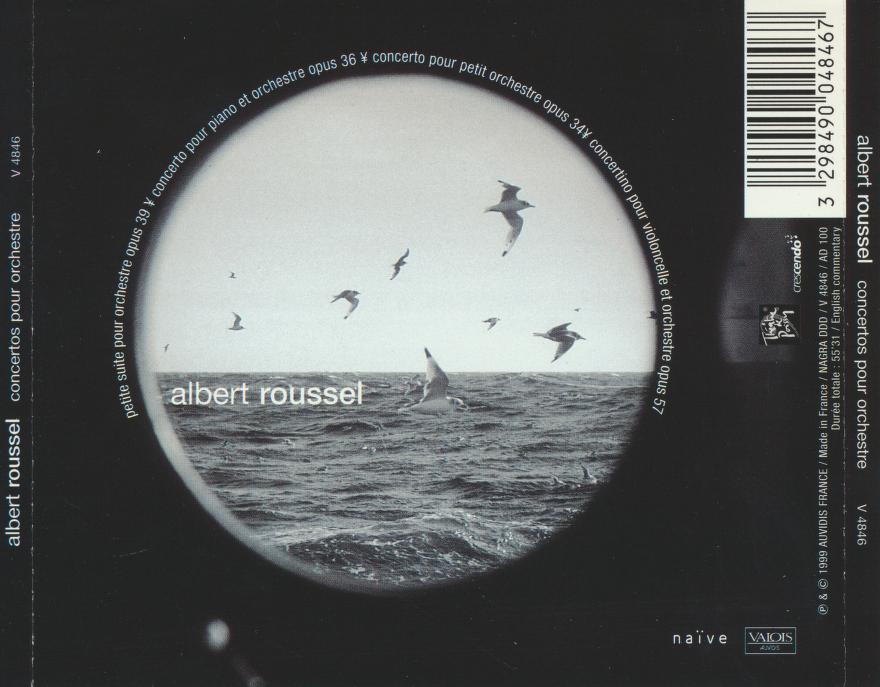
Works
Piano Concerto, op. 36 (17.20)
Cello Concertino, op. 57 (12.29)
Concerto for Small Orchestra, op. 34 (12.35)
Petite Suite, op. 39 (12.42)
Soloists
Alexandre Tharaud, piano
Jean-Guihen Queyras, cello
Ensembles
Ensemble Orchestral de Paris
David Stern, conductor
Label: Naïve
Year: 1999
Total Timing: 55.06
This highly entertaining recording, both aurally and physically, features Roussel in full Neo-Classical mode.
Such things don't always please me 100% of the time, yet I am never put off at any time either.
These French players make the music come alive in wonderfully pert sonics.

Find more Roussel recordings HERE!
Comments
Post a Comment