Walton: Viola Concerto

Having listened to Sir William Walton's Violin Concerto recently, I hear parallels between it and the composer's Viola Concerto, even though a decade, plus many revisions, separate the two works.
First is their structure. Both concertos eschew a dedicated slow movement for three relatively uptempo movement settings. It is the first movement in the Viola Concerto which is more moderate, providing some lyricism to the composition, although all of the movements have their moments of tempo changes. If I hear a moody, murder-mystery wandering at the ope of both pieces, I am sure it is just my musical imagination running away from me. In conjunction, Walton also places a Scherzo of sorts in the central movement, separating the longer outer movements in both concertos. The last movement is showier than the rest, although Walton maintains a melancholic seriousness across both works.
Perhaps it is in the performances I heard this time around, but both Violin and Viola Concertos strike me as rather Romantic sounding, or maybe better described as Neo-Romantic in their emotional effusion and musical output. Walton is bursting with a wealth of ideas, both melodic and harmonic, not to mention a masterly attention to orchestral color cushioning the soloist. Yet no one would mistake these works as anything but purely 20th Century.
Here, famed Canadian violinist tackles Walton's Viola Concerto, stepping away from his main instrument. I have read a few interviews where Ehnes describes his late affinity for the viola, and this is not the first time I have heard him take up the viola on record either. As a solo instrument, the viola has had so few concertos composed for it, I could easily imagine concert violists sitting at home and griping about the bounty of violin concertos clogging up the catalog, and along comes a star violinist taking over one of the few opportunities to record solo viola repertoire.
Ehnes isn't the first violinist to do so either, with both Nigel Kennedy and Maxim Vengerov taking up Walton's Viola Concerto in past years. The good news is that Ehnes takes a different approach than most others, offering a whirlwind, virtuosic attempt at the concerto. His performance here times closer to the classic William Primrose account, much speedier than most. Of course, Primrose didn't play the 1961 revision, but still it has been said Sir William preferred faster performances of the work, and this one certainly moves in those motions. Plus, who can argue with the pure musicianship Ehnes is in command of?
On the other hand, Ehnes sounds like he is playing a violin. Where are the husky, earthy timbres capable of from the viola, an instrument lifelong violists can make purr and growl in its own special way? I am sure there are many capable violists ripe for their time in the spotlight.
Few have recorded the Sonata for Strings, a reconstruction of Walton's String Quartet no. 2 by his close friend Sir Malcolm Arnold in conjunction with Walton himself. While I have no doubt of my preference for the original string quartet, there are enough differences in the actual music which make the Sonata its own work, aided, with no hesitancy on my part, by Edward Gardner's performance. The slow third movement might be too chromatic and wandering, yet I find the more I listen to this work, the more impact it has upon my ears.
When Martyn Brabbins' recording of Walton's Partita for Orchestra on Hyperion was released in 2017, unfavorable comparisons to George Szell's pioneering recording with Cleveland were in abundance. Yet, I haven't found the same reactions regarding this one with Edward Gardner leading the BBC Symphony Orchestra on Chandos, although this team comes in two minutes quicker than Brabbins. The work itself is easy to love, for the Partita moves in such fun directions, most of them totally unexpected.
If I have come away with anything at only two recordings into my current William Walton recording survey, the composer is the real deal. His music is complex musically, yet approachable and enjoyable for the masses, methinks. That is a fine line to be able to tread, but what really sets apart the composer for me is in his handling of orchestral sections, a confident accounting of rhythm, and an excellent journey leading the listener from beginning to end.
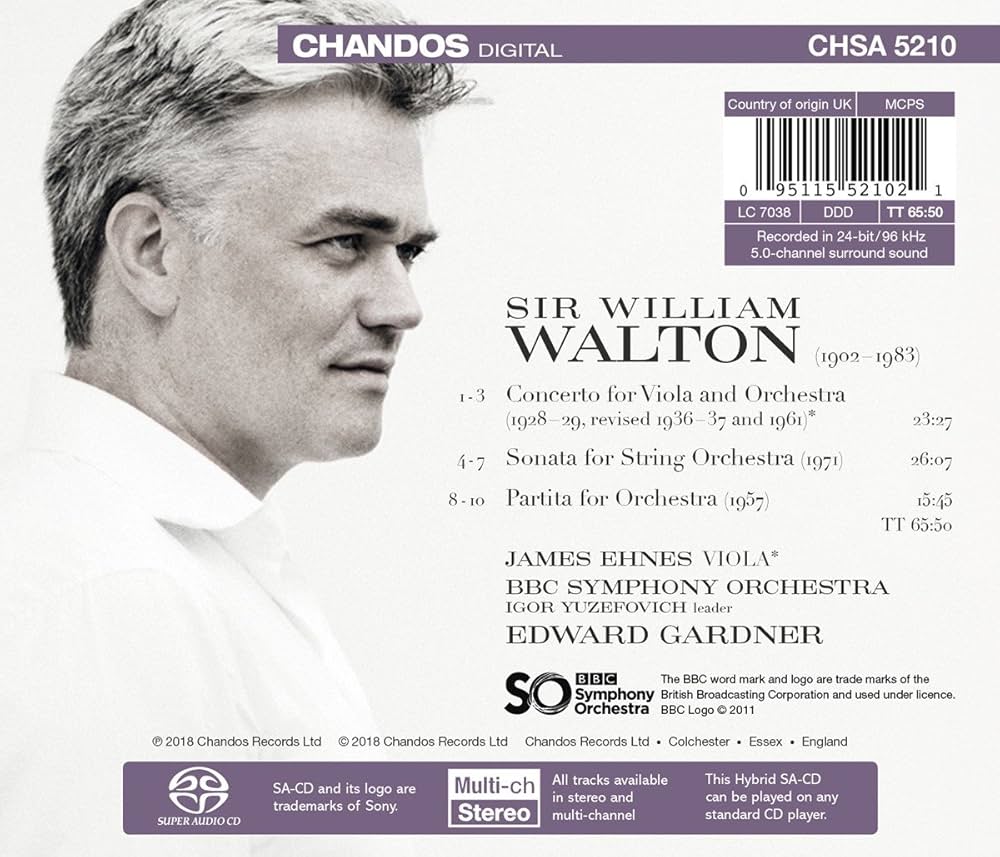
Works
Viola Concerto (23.27)
Sonata for Strings (26.07)
Partita for Orchestra (15.45)
Soloist
James Ehnes, viola
Ensemble
BBC Symphony Orchestra
Edward Gardner, conductor
Label: Chandos
Year: 2018
Total Timing: 65.50
Maybe I am being harsh, but step aside Ehnes; allow a lifelong violist to have a chance at this music. They get little enough time in the spotlight, not to mention a violinist taking over this repertoire.
That said, I like how Gardner and Ehnes run rampant with Walton's Viola Concerto, as few have done since William Primrose.
The Partita and Sonata make for a fine coupling, ably handled by the BBC Symphony Orchestra.

Find more Walton recordings HERE!
Comments
Post a Comment