Rautavaara: Symphony 5 & 6
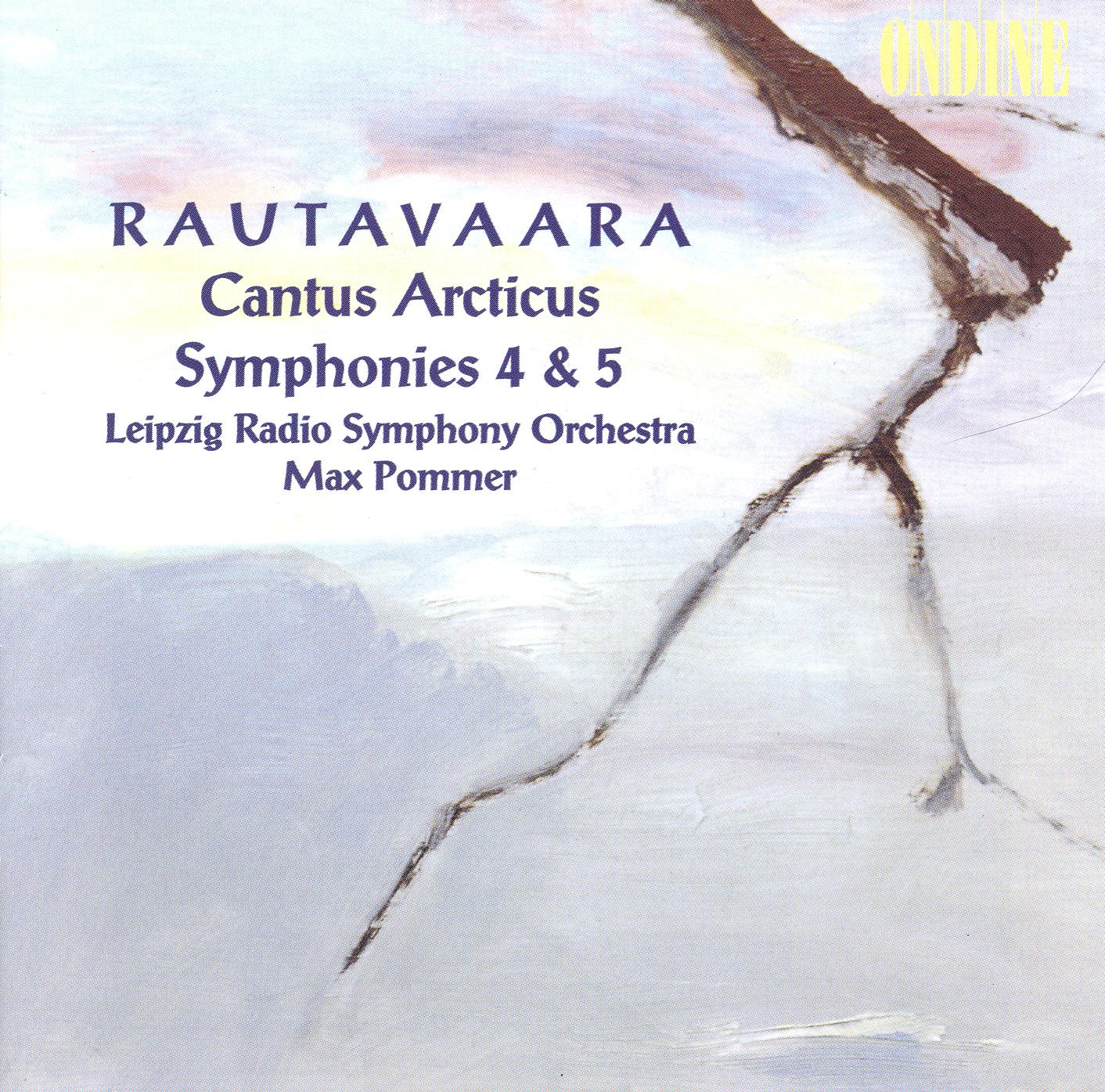
So, where to go after two pairs of symphonies in completely differing styles in the 1950s and 1960s? Well, Finnish composer Einojuhani Rautavaara must have struggled with that same question, for the 1970s were devoid of any contributions to the symphony genre. It took until 1985 for another symphony to germinate within the composer's pen.
The running title for Symphony no. 5 was 'Monologue with Angels', although that idea was shelved for one reason or another, thus I will leave its intent alone for the time being. Structurally, Rautavaara moved away from a traditional movement format for a one-movement, 30-minute work with many changes within the symphony.
If Rautavaara moved away from the atonality and serialism of the 60s, this certainly doesn't mean the composer stayed away from experimental, progressive musical ideas. The opening moments demonstrate this clearly, with Rautavaara adopting aleatoric elements, using time passing (groupings of seconds to be exact) to dictate ensemble section entrances and changes in playing for the instrumentalists. Not only this, but he also requires players to blow through their instruments without tone, or to play with mouthpieces only, across and into extreme ranges, as well as many other avant-garde musical techniques.
The sounds created are not necessarily difficult, however, it makes for very atmospheric listening, without much in the way of melody or traditional harmonic movement. This is not atonal, but to call the music traditional would be wrong as well. Certainly modern would be apt, but also the previously mentioned avant-garde, a catch-all for unusual and forward-looking techniques in art.
The biggest moments happen at the very beginning, where waves of crescendos and decrescendos rise and fall, with the tam-tam striking at the highest point. The large middle section of various tempos employs meter, with melancholic utterances underlining the whole piece. Only at the end is the listener reminded of what occurred in the opening moments, although this is done so rather differently to conclude the work.
A large percussion section contributes to the unique soundworld Rautavaara creates. Toms and timpani pound out at the most rhythmic and loudest portions, while the pitched, bell-like instruments add to the atmosphere and color of the ensemble.
The biggest problem for me is the non-stop 30-minute runtime. There are no particular goalposts for the listener outside of the opening and closing moments, even though orchestral textures and tempos change to form larger sections within the work. On the other hand, I have no problem with these performances, especially since I can't really make any comparisons; Max Pommer's is the only one out there as far as I know.
Truthfully, Symphony no. 5 is much easier compared to Symphony no. 4. Yet, Rautavaara is not afraid of dissonance here either, often creating alien musical landscapes. The pulsing and throbbing which ends the symphony is perhaps the best way to conclude what was an unusual symphonic experience. It will be interesting to hear where Rautavaara goes from here.

As I understand it, Rautavaara composed an opera entitled Vincent, a stage production based on the life and times of Vincent van Gogh. In that three-Act opera, an instrumental prelude introduced each Act, which is the genesis of Symphony no. 6 'Vincentiana'. I can't speak to whether or not the music comes directly from those preludes, scuttled from points of the opera, or were composed merely in the same style, for I have not seen or heard that production.
What I can say is that many of my descriptions of Symphony no. 5 could be applied just as confidently in Symphony no. 6. Rautavaara's music begins set in aleatory, but eventually moves on to tradition meter. Extended techniques are required of the players and an expanded percussion section contributes to the color world of the symphony (plus harp!). In addition, a synthesizer with preset sound qualities intrudes throughout the work, really compounding the otherworldly quality of the music.
And yet, despite these similarities, Symphony no. 6 simply works better for me. There could be a couple of reasons for this to happen. First, the 40-minute work is divided into four movements, allowing the listener to reset from that music which came before. Second, each movement receives a title, giving the listener a visual, historical, or psychological program to grasp on to. Vincent van Gogh as a visual artist left many images for us to imagine music and painting co-mingling in Rautavaara's symphonic world.
While the addition of synthesizer is indeed strange, I daresay Rautavaara moves further towards engagement as the work goes on. By the time the fourth movement 'Apotheosis' arrives, Rautavaara is nearly song like, reminding this listener of the middle movement from Symphony no. 1. So too, the movement sound different enough to make a satisfying whole, where the third movement 'Saint-Rémy' is cheerfully upbeat and blithe, bursting out into a wild waltz for the ages.
If we are reminded of Symphony no. 5 in the opening moments of the first movement, with another long crescendo leading into a timpani and tam-tam din, it works all the better with van Gogh's 'Starry Night' planted firmly in the psyche. One can hear the rise and fall of 'The Crows' over the wheat fields in the second movement, without having to resort to explaining the music to oneself in absolute musical terms. That said, this is where the listener really comes into contact with the synthesizer, as it pairs up with an array of percussion.
Rautavaara also provides the listener snatches of melodic material, even aside from what I mentioned of the final movement. The harmonies progress more affably when the orchestra is in the throes of whatever atmosphere Rautavaara is conjuring musically. I daresay, cinematic could be applied to some moments, although the composer never quite moves expectedly in his slow shifts of harmony.
And so, I am left on a high note by the conclusion of Symphony no. 6. With only two symphonies to go, these last three were all written in the 1990s, if this is where Rautavaara will be hanging his musical coat as a composer, I think I am on board for what comes next. I say 'I think', for the the composer has given me wildly swaying swings in style before. These two symphonies seem to say the composer has finally found his voice.
Vol. 3 from Rautavaara Symphonies on Ondine
Works
Symphony 5 (32.22)
Symphony 6 'Vincentiana' (16.35)
Ensembles
Leipzig Radio Symphony Orchestra (5)
Helsinki Philharmonic Orchestra (6)
Label: Ondine
Year: 1990 (5), 1994 (6); 2009 (set)
Total Timing: 73.43
Comments
Post a Comment