Mozart: Symphony 38 & 39

In order to listen chronologically to Mozart's symphonies, I will break my normal pattern and take one symphony from both Vol. 10 and Vol. 11. This means I will most likely post the following symphonies at the same time.
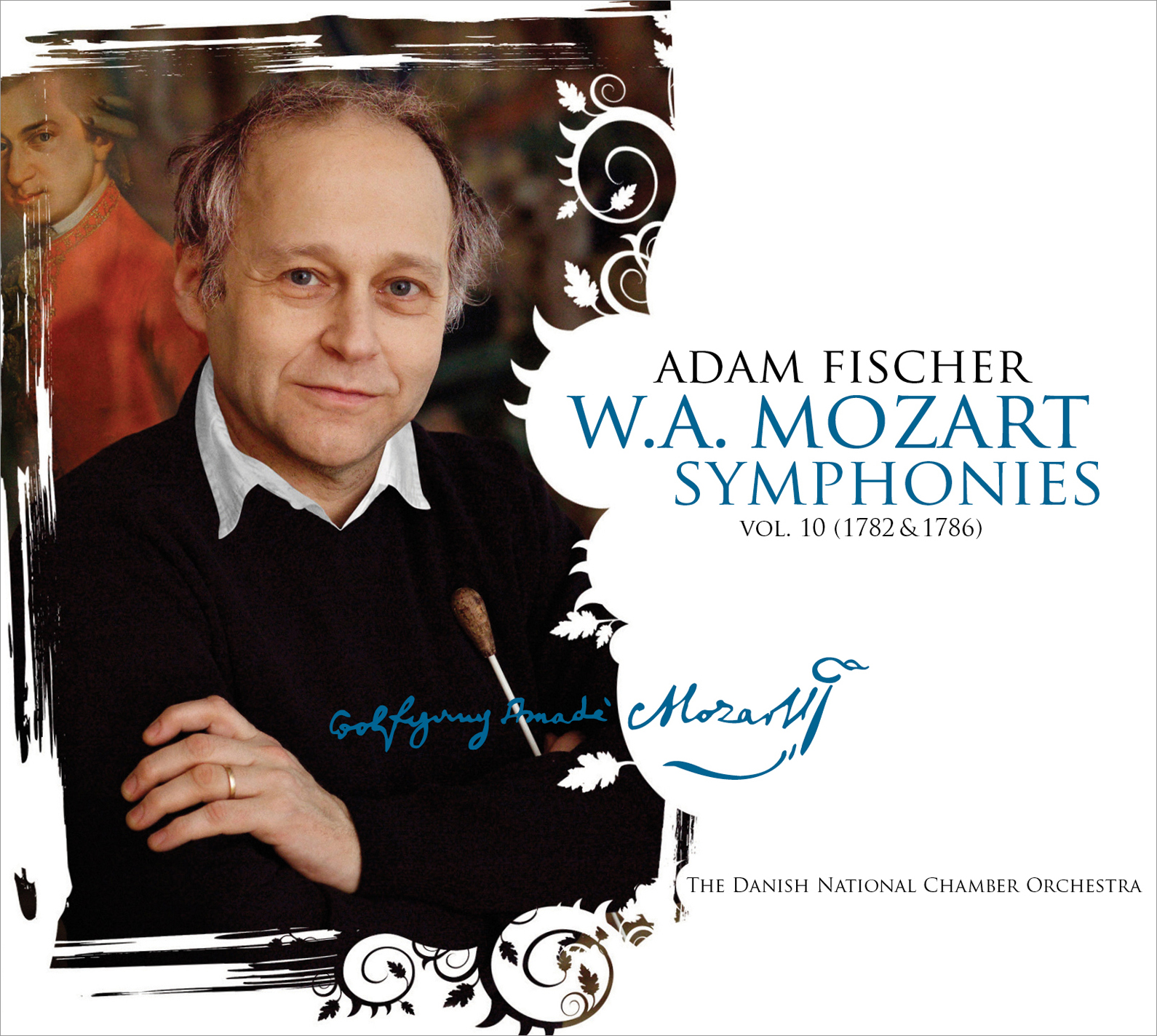
The cover image above actually contains Symphony no. 39, while Volume 10 programs Symphony no. 38. Why the two volumes split up the chronological order is beyond me.
For those looking for my generalized thoughts, skip to the bottom. Otherwise, I will do a movement-by-movement breakdown of each symphony for those who wish to listen along. I will provide a video of these same performers I am listening to in order to make it easier to follow along with my thoughts.
Movement 1
Key: D Major
Meter: Common time
Tempo: Adagio & Allegro; Fischer:
 = 56 & 148
Winds: flute, oboe, bassoon, horn, trumpet, timpani

How neat the composer overlaps themes in the opening Allegro. A syncopated violin accompaniment moves into an upward moving motive filled with many repeated notes. Underneath, the lower string work on a their own idea, which leans on beat two as a rhythmic motive. The composer wonderfully uses these ideas imitatively and through sequencing, one which never grows old with this listener.
There are more melodic ideas, a string fanfare figure which turns minor with added bassoons, another superb idea presented and integrated by Mozart. All of this, and we have still to reach the development, an area which ups the expectation of the listener when it arrives. Fischer takes all of the repeats as well.
I cannot overstate enough the delicious abundance of melodies and the captivating symphonic argument Mozart creates across this movement. Perhaps a favorite of mine.
Movement 2
Key: G Major
Meter: 6/8
Tempo: Andante; Fischer:
. = 40Winds: flute, oboe, bassoon, horn
Unlike K. 425, Mozart wisely abandons the trumpet and timpani to showcase his way with intimacy and grace. Here again, we have a lovely lilting 6/8, this time not interrupted in the way of undue aggression, although there are plenty of minor-keyed divergences and unexpected sforzandos in which Mozart moves the music.
If I sound like a broken record, I don't believe Fischer and the Danes suspend time with this music, as I always hope they will. I will keep holding on for such things from this team.
Movement 3
Key: D Major
Meter: 2/4
Tempo: Presto; Fischer:
= 210Winds: flute, oboe, bassoon, horn, trumpet, timpani
This is really the only time I have thought Fischer simply takes the music too fast. It is fleet and engaging, and of course, the players can handle such things. Yet, there were moments were I felt the rhythmic demon at Fischer's back driving this affair with a three-pronged whip.
The strong presence of trumpet and timpani make their presence known too, not letting me forget their upfront presence in Symphony 35 & 36. I suppose this shows the Danish National Chamber Orchestra can play at these tempos with light-footed fleetness as well as driving hardness.
Like the previous symphony, I detect more at work in this final movement than showcasing speed and virtuosity on the part of Mozart. Musical development is a hallmark here, I think, and I appreciate the composer attention to musical depth as well as entertainment.
Despite being a three-movement symphony, this is a mightily substantive work, one which grows on me the more I listen to it. This simply quality easily makes the Prague Symphony a favorite of mine.

Symphony 39 in E-flat Major, K. 543
Movement 1
Key: E-flat Major
Meter: Cut time & 3/4
Tempo: Adagio & Allegro; Fischer:
= 50 & 156Winds: flute, clarinet, bassoon, horn, trumpet, timpani
Oboes are not in play across this symphony. Rather clarinets completely replace the oboes, another bold choice from Mozart, especially since his symphonies are rarely found without the double reed instrument. On the other hand, all of the other winds are fully on board.
Fischer takes a rather unhurried and untroubled approach to this first movement, aided by Mozart's clear orchestrations when the ensemble is away from tutti statement. These elements really sets this work apart from the previous three symphonies, which forced bounding kettledrums down my throat. A fulsome sounding E-flat Major rounds out these musical feelings on my part, with a variety of wind interpolations and occasional plucked bass lines.
A beautifully bucolic first movement.
Movement 2
Key: A-flat Major
Meter: 2/4
Tempo: Andante con moto; Fischer:
= 56Winds: flute, clarinet, bassoon, horn
Bucolic is probably an excellent word for the opening motive in the second movement as well, with its gently skipping melody. Again, Mozart removes all the troubles of the world for the listener in this movement. This is one of my favorite heart-melting moments from the composer, where all of the musical elements come together to form a perfect whole.
Any minor keyed jaunts are kept to a minimum, with their gray skies quelled before any storms even hint at brewing into something major.
Movement 3
Key: E-flat Major & E-flat Major (Trio)
Meter: 3/4
Tempo: Menuetto; Fischer:
= 158Winds: flute, clarinet, bassoon, horn, trumpet, timpani
Once again, Mozart joins the Minuet and Trio through a common key, instead of his normal key change. I must say, though, the Minuet makes very little impression on me. It is rather unmelodic from my point of view, instead full of musical motions.
Quite the opposite occurs in the Trio, where it is the clarinets who are featured, with one clarinet hanging out in its lower range on accompaniment figures while the first clarinet tootles out the melody. This feature certainly keeps in line with the agrarian nature of this symphony thus far, for this one reeks of the Austrian landscape and Oktoberfest.
Movement 4
Key: E-flat Major
Meter: 2/4
Tempo: Allegro; Fischer:
= 146Winds: flute, clarinet, bassoon, horn, trumpet, timpani
What a lightly skittering, cheeky final movement this is! As is often the case with this listener, I love how Mozart has the strings and winds using each other for musical ends, rather than keeping them as separate entities. Plus, the horns get to punch out a little here and there as well.
Well, if you are wanting to find Mozart in a rather woodsy mode, this is the symphony for you. the work flowers beautifully throughout, rarely wanting to strangle the listener with over-the-top musical gestures and punctuations. Instead he delights through a rather genial mood and perky musical antics.
Final Thoughts
I must say, I was worried with most of the symphonies in Volumes 10 & 11, for the hard hit timpani made the music somewhat cold for me. Symphony no. 39 shows Fischer does not approach every work quite the same, and I suppose the same would hold true for Mozart as well.
It is nice to be able to dwell in the fine playing of the Danish National Chamber Orchestra as well, where plenty of attention is given over to thoughtful phrasings as well as an overall purpose.
Well... only one more volume to go, and perhaps Mozart's most famous works in the symphonic genre appear next.
Work Series
Vol. 10 & 11 from Mozart Symphonies on Da Capo
Works
Symphony 38 in D Major 'Prague', K. 504 (34.52)
Symphony 39 in E-flat Major, K. 543 (28.55)
Performers
Danish National Chamber Orchestra
Ádám Fischer, conductor
Label: Da Capo
Year: 2013
Comments
Post a Comment