Rautavaara: Symphony 7 & 8
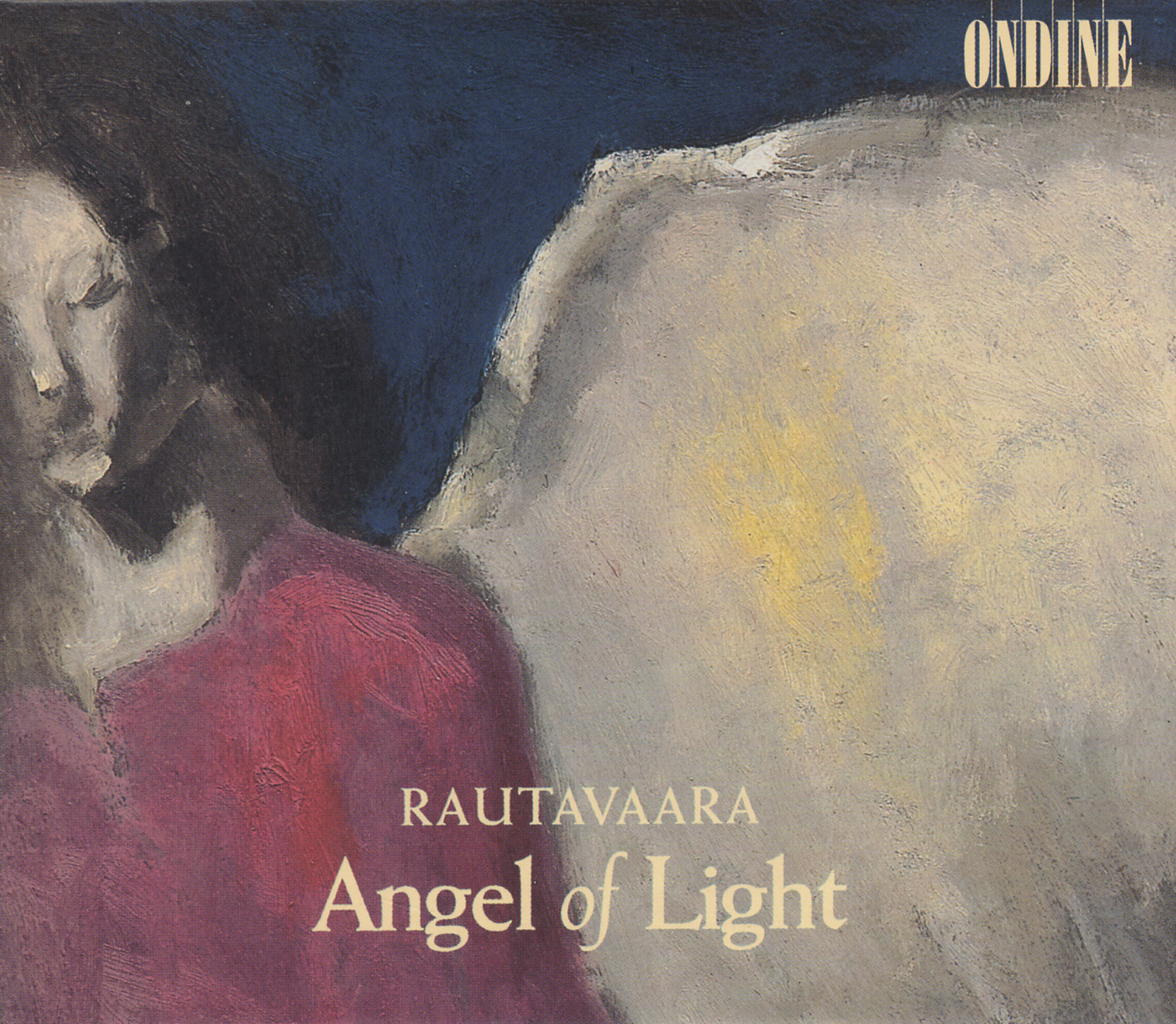
In these last two symphonies I am covering by Finnish composer Einojuhani Rautavaara, the performances come from the leadership of Leif Segerstam, joined in by the Helsinki Philharmonic Orchestra. I like the idea of having Segerstam at the helm, for the Finnish conductor is a steady hand, an important attribute in Rautavaara's music.
As I was listening to today's music, I find myself at a loss as to who I could compare the music of Rautavaara with. He is modern, but not of the uncompromising sort, even though he does employ dissonance aside great consonance and tonality. He is not new age or minimalist composer, yet I could see some listener's minds going that direction. The closest parallels I could come up with are perhaps Messiaen and Hovhaness, but those two composers seem wrong as well. Oh well...
The composer subtitles Symphony no. 7 as 'Angel of Light'. I don't know if there is any programmatic content associated with that sobriquet, however I am aware this work exists with other works he wrote around the same time regarding angels. Aside from some furious rushing of strings, I am not particularly reminded of Angels, but I suppose what matters is the music.
Rautavaara abandons the aleatoric elements from the previous two symphonies and returns to the more 'traditional' approach of the symphony we found in his first and third efforts in the genre. The composer is also sticking to the four-movement format, a solid choice, I think, after hearing the one-movement Fifth Symphony.
The first movement moves at a rather slow pace, with otherworldly vibraphone and bells at the very opening. An insistent, throbbing, but satisfying bass keeps the listener grounded in this music's harmonies. On the other hand, the harmonic movement also moves quite slow, where Rautavaara moves the music rather vertically, one lengthy chord at a time, only to change every handful of measures. All the while, other orchestral voices move across those chords horizontally, creating a feeling of forward motion instead of a static quality. Again, the word atmospheric continues in my mind when listening to these symphonies.
The second movement provides the rare bit of upbeat tempo existing in Symphony no. 7. To create a somewhat rascally personality to this Scherzo, the percussive sound of xylophone is added to the mix. As to dissonance, Rautavaara sets the trumpets harshly in intervals of seconds towards the end of the second movement, a bit of unusually astringent texture coming from the composer. The interval of seconds is something he will carry across these last two symphonies, often some of the only emphatic dissonance the composer chooses to employ.
The second and third movements of both Symphony no. 7 and 8 are played without stop, marked attacca at the end of the second movement. Another movement of slowly shifting, shimmery chords follows, bringing us back to Rautavaara's beloved soundworld. Here there is less moving atop of the chords instrumentally, with thinner ensemble textures, so one feels the portents of these harmonies even stronger. A beautiful solo horn, oboe, bassoon, and violin are some of the only 'melodic' moments afforded the music, with my preference leaning towards the sound of the French Horn here. It is during the violin solo one can hear little bird twitterings from the winds. Certainly, the ending of strings and horn dying away into eternity could have confidently finished off this work.
But Rautavaara has other things in mind. A grandiose brass statement opens the movement, continued by thick, divided strings, almost sounding out cinematically. The burblings of winds remind us as to whose symphony is being played, with a nice addition of harp here. Perhaps some of these burblings, and later on in ever-moving strings, are the titular 'Angels' of the piece, buoyed by epic brass chords waxing and waning across most of this movement's runtime? As an aside, I caught just the tiniest hint of the previously mentioned intervals of seconds, I think in horn and harp later on; otherwise, this movement moves most deliciously.
One can understand the sudden popularity following the release of this symphony. The hook of Angels mingled with Rautavaara's symphonic sound needed just the right timing with the public, and this was it.
Rautavaara doesn't stray too far from the Seventh Symphony in Symphony no. 8 either, almost sounding out even more cinematically then before. An equally enigmatic subtitle of 'The Journey' accompanies the work, allowing the listener to let their imaginations run wild through the composer's slow-moving musical world.
Follow the bold bass line in this symphony, and you can follow the slow harmonic motion I talk about in Rautavaara's music. In the first movement, the bass is bolstered by timpani and more pitched percussion and harp. I haven't mentioned it as of yet, buy Rautavaara contributes wonderfully to his music through his use of contrabassoon, a low double-reed instrument which hardly receives it due. Listen to the many prevailing intervals of seconds; I think I caught the clarinets doing this as I am typing away, but there are more to come. I must say the composer's use of this particular brand of dissonance is evermore subtle than the trumpets in the previous symphony, so no need to fear. Did you catch the bird calls; here they are passed from clarinet, to oboe, to flute just as the movement concludes.
A Scherzo once again inhabits the second movement. More strikingly, one can hear the interval of seconds right at the outset, both in the winds and brass, but the violins get the treatment too! At times this element is disconcerting considering the lush undercurrent provided in the lower instruments. Although they also appeared in the first movement, the toms add quite a bit of drama here, where Rautavaara is nearly violent in this music.
However, just as he builds to a musical climax in the second movement, the orchestra quickly dies away making way for a direct segue into the third movement. Here, a lovely horn solo opens, with string chords shifting cinematically, later buoyed by harp and bassoons. If nothing else, one could confidently call Rautavaara an expert colorist, for he is very particular with orchestral-instrument combinations, all to the listener's favor. Once again, the horn dying away into nothingness could easily conclude this symphony.
Horns and chime notably open the last movement, one which moves in rather dramatic directions. While the trumpets and trombones pair up separately, it is the strings which are put into intervals of seconds again, fighting against the filmic, consonant qualities, although not for long. I wish the flutes and clarinets were a little more present as they quickly meander in the background, pulling the background workload for the ensemble, but I guess I can't have everything.
One wonders what kind of 'Journey' Rautavaara imagines in this music? I suppose spelling everything out for the listener lessens the fun, and certainly I always encourage imagination over definition; it just seems more fun that way. Really, Symphony no. 8 finishes off his set on a high point; he really seemed to be on to something in these last two symphonies. The composer lived another 16 years after this composition; were there plans for another? Had Rautavaara said everything he had to say in the symphony genre? I am sure trawling the internet might reveal some answers, but I think I can live happy with what is here.
Work Series
Vol. 3 from Rautavaara Symphonies on Ondine
Works
Symphony 7 'Angel of Light' (37.53)
Symphony 8 'The Journey' (29.07)
Ensembles
Helsinki Philharmonic Orchestra
Vol. 3 from Rautavaara Symphonies on Ondine
Works
Symphony 7 'Angel of Light' (37.53)
Symphony 8 'The Journey' (29.07)
Ensembles
Helsinki Philharmonic Orchestra
Leif Segerstam, conductor
Label: Ondine
Year: 1995 (7), 2001 (8); 2009 (set)
Total Timing: 67.10
Label: Ondine
Year: 1995 (7), 2001 (8); 2009 (set)
Total Timing: 67.10
Find more Rautavaara recordings HERE!
Comments
Post a Comment