Walton: Concertante and Orchestrated Bits 'n Bobs

Since I recently listened to Sir William Walton's three major string concertos, I thought it necessary to also hear his 'lesser' concertante works.
In addition, a few pieces which were orchestrated from Walton's original musical states are also given a spin. Here, I have chosen to listen to the series on Chandos, simply because I own much of the series already.

Sinfonia Concertante
It may be an early work, but Sir William Walton's Sinfonia Concertante for solo piano is great. I say early, yet it exists just a few years before his Viola Concerto, a beloved work. Akin to his other concertos, this outer movements are the most gregarious, with the first being the most serious minded and the last a virtuosic jazzy gas. The middle movement is quite different from the others, as it is quite lyrical, brooding, and song-like, where the composer would come to prefer a Scherzo in the central movement.
There also is the issue of what version of the Sinfonia Concertante to perform or hear. Walton himself preferred the later revised version, but most modern recordings have used his original. What is the difference. As I understand it, Walton pared down the orchestration and simplified some orchestral textures and the solo piano part. Beyond these generalizations, I can't comment on specifics.
In any case, only the more recent Clare Hammond recording on BIS (2024) has chosen to use Walton's later revised edition, aside from those performances of Walton leading the music himself, although I have not heard Hammond's performance. Here pianist Kathryn Stott chooses the original, where she and Vernon Handley, with the Royal Philharmonic Orchestra, are muscular and splashy in Walton's music.
I really enjoyed myself very much here. There is just so much energy and pizzazz throughout from these performers, captured by the now defunct Conifer Classics. I am certainly glad I made to time to hear this music.

The Two Pieces for Violin were originally meant for piano accompaniment, but was later orchestrated by Christopher Palmer for orchestra. This diptych should not be confused with the Two Pieces from Henry V for string orchestra, a completely different composition.
As the title suggests, the work is split into two movements, a Canzonetta and a Scherzetto. The first is rather pastoral, nearly bardic in its music making, aided by the presence of harp. The rambunctious joy is still rather intimate in the upbeat second portion, giving the quality of a chamber ensemble at times. Eventually, the orchestration opens up and gives us the full symphonic colors Walton loves.
Lydia Mordkovitch not only loved the literature of her homeland, but ably took up the literature of Britain. The Two Pieces for Violin are a short example of her important contributions, but what a lovely addition nonetheless.
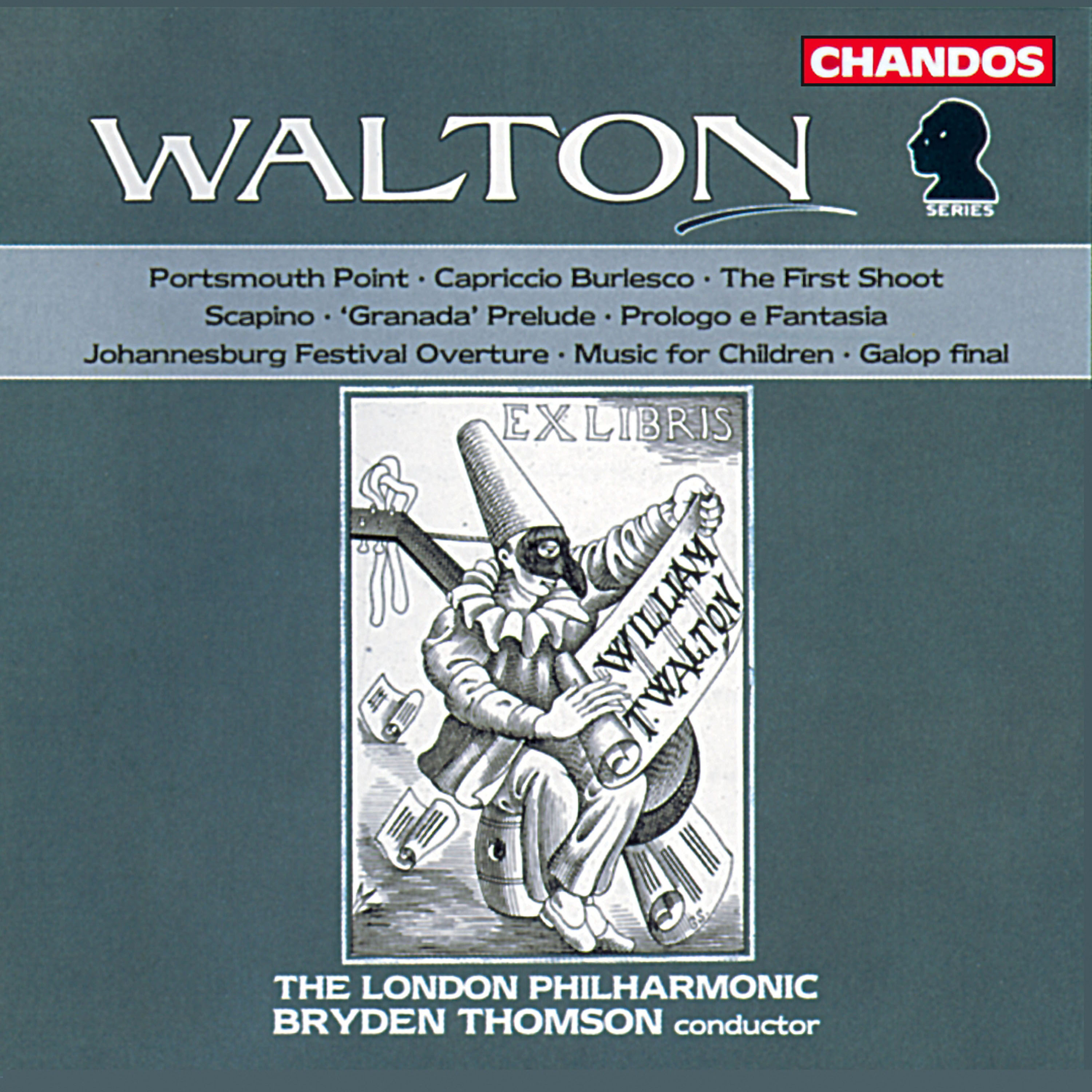
Music for Children
Like the Two Violin Pieces, Music for Children is taken from a set of four-hand piano duets directed at the ability and learning of children. One can hear the simplicity of these origins in most of the eleven movements from this orchestral suite, for never are the textures or voices given undue complexity.
Such a comment is not a problem, but nothing here rises to something like Debussy's Children's Corner, for example. Instead, ten very short movements bandy back and forth between the perky and lyrical, all of them charming in their own way. Only the final madcap Galop is something a bit more than the rest, fitting for the conclusion, I think.
I think Bryden Thomson performs the movements out of order, although perhaps that stems from the result of the original having been re-orchestrated, again done here by Christopher Palmer.

Varii Capricci
Yet again, William Walton goes back to the well to come up with the orchestral Varii Capricci. In this case, Five Bagatelles for guitar is the source material, thus there must be quite a bit of interpolation on the part of the composer to come up with this later work.
There is certainly a dance aspect to much of the music, not a surprise coming from a guitar. The use of harp also provides a nod to that stringed instrument, keeping the progenitor in focus. And yet, Walton uses the resources from the full palate of an orchestra, even if he can be varied in what colors he uses at any given time.
While I am glad I gave time to hear this last five-movement work, I don't know if it really sticks in my mind. Had I heard the solo guitar, I am certain my memory would conjure its music more strongly, and yet, there are pungent musical flavors here regardless, easily enjoyable for all ears.
Bits 'n Bobs
Sinfonia Concertante
Kathryn Stott, piano
Royal Philharmonic Orchestra
Vernon Handley, conductor
Conifer; 1989
Two Pieces for Violin
Lydia Mordkovitch, violin
London Philharmonic Orchestra
Jan Latham-Koenig, conductor
Chandos; 1992
Music for Children
London Philharmonic Orchestra
Bryden Thomson, conductor
Chandos; 1991
Varii Capricci
London Philharmonic Orchestra
Bryden Thomson, conductor
Chandos; 1991
Find more Walton recordings HERE!
Comments
Post a Comment