Enescu: Vox Maris & Poème Roumain

George Enescu didn't care for his early Nationalist style later in life, despite that style containing his most appealing music, at least for his audiences. On this recording, it is the Poème Roumain which is akin to the composer's more famous Romanian Rhapsodies, albeit in longer form here. There is a mix of Smetana, Dvořák, and Grieg, which I suppose is the reason the composer moved away from that style, for it wasn't truly his own musical voice.
Regardless, I enjoy the modal harmonic motion, the winsome melodies, and the constant changing of meters and tempos in the Romanian Poem. It is also most apparent the 'George Enescu' Bucharest Philharmonic Orchestra is eating this music up with a spoon.
Conversely, the same orchestra, named after this Romanian composer, sounds rough in Vox Maris. As opposed to Poème Roumain, this music is highly chromatic and in a solidly late-Romantic vein. The inner workings of Enescu's instrumentation is a feat unto itself, for the composer always has five or more different strands of musical motion going on at once, many of which are rather difficult to even discern as a listener.
I get the 'Voice of the Sea' setting, however when the distant tenor and chorus are not participating, nor the wind machine, the work gets lost in its own waves of sound, and is not particularly fetching for this listener. On the other hand, I detect a similar vibe to Alexander Scriabin, maybe due to the inclusion of a chorus, so perhaps that is Enescu's audience. I just don't find this as elevated or singular as I do Scriabin.
Voix de la Nature, or under its other title Nuages d'Automne sur les Forêts, is similarly a late work from Enescu, but the music making is much more succinct, and the journey towards and away from the main climax are much more satisfying, at least to these ears. When the horns ring out by the last third of the piece, Enescu has taken me hook, line, and sinker.
Sure I think the NDR Philharmonic Orchestra plays better on CPO, but one can't fault Mandeal or the Bucharest orchestra for committing to their fellow countryman. As I mentioned earlier, the ensemble is much better here in the outer works, whereas the thick, active motion of Vox Maris is a challenge for the group. Otherwise, the Arte Nova sonics are fine, if not outstanding in any way.
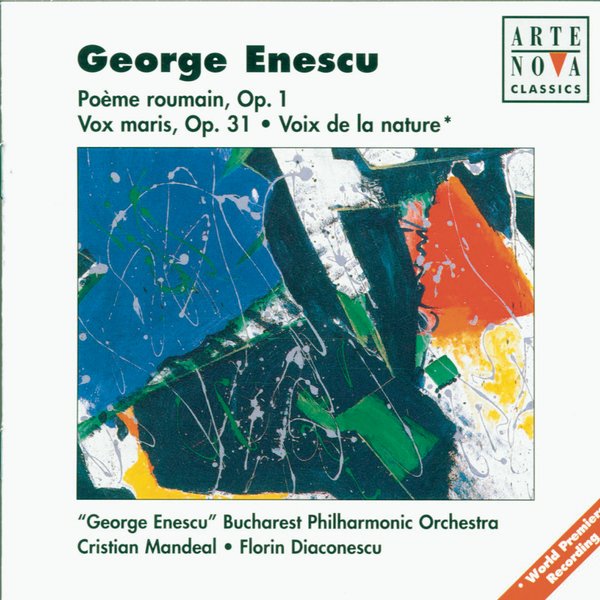
I own the 2006 reissue of this recording, found in a striking Chartreuse, but I will also provide the original 1997 cover art at the bottom of this post for those interested.

Works
Poème Roumain, op. 1 (27.10)
Vox Maris, op. 31 (26.24)
Voix de la Nature, op. posth. (8.38)
Soloists
Florin Diaconescu, tenor
Performers
'George Enescu' Philharmonic Choir
'George Enescu' Philharmonic Orchestra
Cristian Mandeal, conductor
Label: Arte Nova
Year: 1997; 2006
Total Timing: 62.21
I really enjoyed Enescu's Romanian Poem, and continue to like Poems of the Forest, but I still am having trouble coming to terms with the composer's later style.
If you have a liking of Scriabin, perhaps you will enjoy Vox Maris more than I did, although I do appreciate that the vocal contributions are an unusual orchestral texture.


Find more Enescu recordings HERE!
Comments
Post a Comment