A Hymn for The Trinity
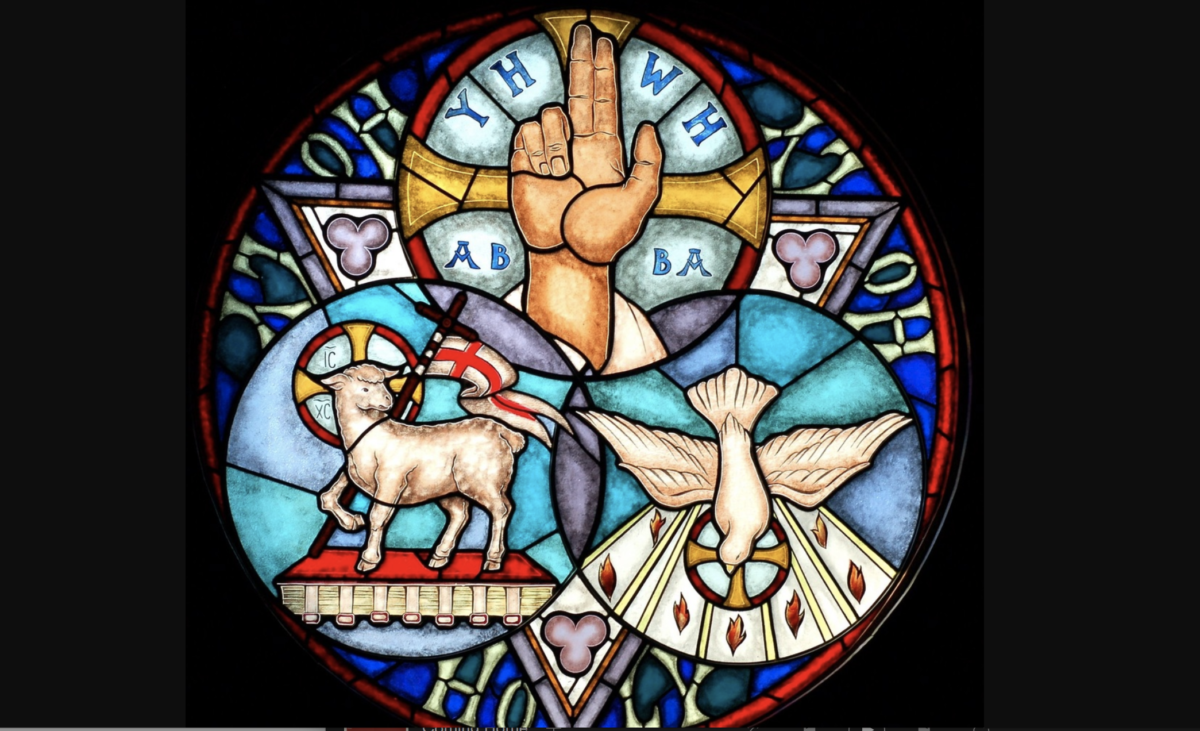
I was hitherto unaware of a piece of Roman history known as The Heresies of Arian, but there are online sources if you wish to read further on the matter. As far as I can make out, this was a religious notion believing Jesus was subordinate to God the Father as the primary Divine, since The Son of Man was created later. The idea of The Trinity puts The Father, The Son, and The Holy Spirit as God on an equal plane, where the idea of a Holy Triune is most prevalent amongst major denominations.
But don't take my word as gospel. There are far more learnèd scholars out there who know more on the subject than I do, and I am sure beliefs range far and wide between different sects of religion. My purpose as a music lover is to present a hymn honoring Trinity Sunday. It should come as no surprise that I have chosen Holy, Holy, Holy for this week's hymn series.
This is one of those golden oldies of a hymn which I can remember since time immemorial. The words were written by Reginald Heber in the 1820s (or more likely published), a time when Heber served as vicar in Britain and later as Bishop of Calcutta.
Each verse begins with three utterances of the word Holy, one of the reasons the hymn works so well for Trinity Sunday. This word repetition is nothing new however, as choral Masses from ages past were often composed for the word Sanctus in groups of three (a Latin word translating into English as Holy), before moving on to the rest of the Latin text. How convenient the Latin word Sanctus and the English word Holy are both two syllables!The hymn's four verses move typically from early morning in the first verse, to the Passion and the Sin of Man in the third verse, to general praises and venerations elsewhere. The fourth verse adds an extra set of Holy, Holy, Holys in the middle of the last verse, and concludes with the phrase 'God in three Persons, blessed Trinity', a perfect summing up of Trinity Sunday.
I should also mention that each strophe of text ends on the sound 'Eee', occurring in every line of the hymn. This makes the rhyme scheme very easy to follow, although the hymn comes along with a great prevalence of the word Thee as a result. The metrical index lists the hymn as 11.12.12.10, an irregular meter, yet the stanzas come with plenty of hymn tunes available to be able to swap the music out with another in these same words.
There are some wonderful images in this text as well. Any singing of the words 'Cherubim and Seraphim' are always a pleasure for this singer, but also in that same verse, 'casting down their golden crown into the glassy sea' seems nearly patriotic. The whole third verse changes the mood of the hymn completely with 'though the darkness hide Thee, though the eye of sinful man Thy glory may not see' is a powerful statement. This should allow the organist to offer a more intimate registration before the exalted finale.
The common tune set to Holy, Holy, Holy was composed by John Dykes, often with the date 1861 attached to it. As I understand it, Dykes wrote the music specifically for Heber's words, and while there are occasionally other tunes set to these words, this tune seems to fit the best, or least is far more popular.Circling around to the story regarding The Heresies of Arian mentioned above, the tune attached to this hymn is named NICAEA. Named so after the meeting of the First Council of Nicaea in the time of Roman Emperor Constantine I in order to ban the idea of a ranked importance among God and Jesus, and to establish the Doctrine of the Trinity.
Nicaea is composed in the grand tradition of a Lutheran chorale, even if historically we are referring to two Anglican or Catholic people associated with the creating of this hymn.
The first main musical phrase is arched in shape, rising at the start and falling at the end. The same phrase returns again, but in the third line of the hymn, repeating the music note for note. The second phrase is more wave-like, rising and falling, only to end on a dominant chord, the only phrase in the hymn to do so. This second line melody also pops up into the hymn's highest range. The fourth and last phrase of the hymn begins on that same high note the second phrase jumped up to, and generally moves in a descending line from its high range to low, completing the entire tune.
The rising first six notes sound out a major triad on 1 - 1 / 3 - 3 / 5 - 5 and it makes for a splendidly simple, yet memorable melody. The repetition in the third phrase helps to cement the musical idea, where also the contrasting phrases are similar enough in their rhythmic motion to always keep the main melodic idea in the forefront of the singer.
The part writing is fairly conjunct, with the occasional leap, making Holy, Holy, Holy pretty easy for congregations. If you are an alto or tenor part singer, you will have the most fun, for the parts are always in constant motion, even when the main melody is being sustained. A few octave leaps in the bass should be no problem for old hands in this hymn.
The tune Nicaea is usually found in D Major, although apparently Dykes originally composed the music in E Major, a key I don't think I have ever seen before in this hymn. This hymn is an instance where I almost prefer the key of E-flat Major, one that shows up in hymnals every once in a while. I recently saw one version printed in the key of D-flat Major, and I would be interested to see how that works for congregations. As a lover of flat key signatures on pipe organ, I tend to lean towards those key settings as opposed to sharps, although D Major will be preferred by most.For churches with more musical resources, there is enough of a triumphant nature to the hymn to effectively add handbells, brass, or even orchestra as is available. The tune is ubiquitous to be enjoyed in many variations, although I am always taken with plain-old pipe organ and congregation. I would be most surprised if Christian rock bands and gospel groups haven't taken up the hymn as well.
How do you prefer Holy, Holy, Holy to sound out?
Find more Hymns HERE!
Comments
Post a Comment