Saint-Saëns: String Quartets
I originally found the first movement of Camille Saint-Saëns' String Quartet no. 1 in E minor simply too convoluted. Over time, I have come to enjoy the various sections of this first movement, yet I will admit there is a lot going on, and is the longest of any of the movements on this entire recording.
The following three movements are much easier to love, especially the second movement's syncopated uptempo, although I will admit to enjoying the songfulness of the third movement as well. The final movement is not fiery nor folksy, hardly causing the heart to race, but the composer does his own thing, which is admirable as well.
I am more immediately taken with String Quartet no. 2 in G major from Saint-Saëns. The work is more efficient in scope and the motivic qualities are much tighter. The little fanfare ideas which litter the first movement are excellent devices, where the composer is using rhythmic devices as much as melodic ones.
The second movement is quite different, not as sweet as in the previous quartet, and if I detect a modal harmonic landscape, I don't find it particularly exotic sounding, at least musically speaking. Again, the third, and last, movement doesn't race to the finish, preferring winsome music making to anything athletic. I should mention Camille Saint-Saëns' love of the fugal form finds its way into both of these two quartets, confirming the composer as an unashamédly conservative composer of the 20th Century.
At the time of this recording in 1997, the String Quartet in E minor by Gabriel Fauré wasn't found on record in great number. Today, an explosion of sorts has found the work well loved by many, often paired with fellow French composers such as Debussy, Ravel, and Franck, although the most recent, as of my typing, pairs Fauré's lone quartet with Elgar's.
To say Fauré's quartet is in a completely different musical world than Saint-Saëns' would be an understatement, even if Fauré still holds links to the Romantic Era. His writing for a string quartet spaces the instruments apart from each other in a rather spare sounding way, where the harmonic language is much more chromatic. I daresay the composer is more interested in harmonic motion than he is in anything melodic, for nothing catches me the same way as the previous two from Saint-Saëns. But then again, Fauré was more musically fashionable and moved with modern trends more than Saint-Saëns ever did.
The final movement from Fauré has a rather characterful dancing quality I enjoy, where the music's texture is aided by plenty of pizzicatos. And yet, the composer doesn't lower the bar from what came before, making his String Quartet fit all of a piece quite nicely.
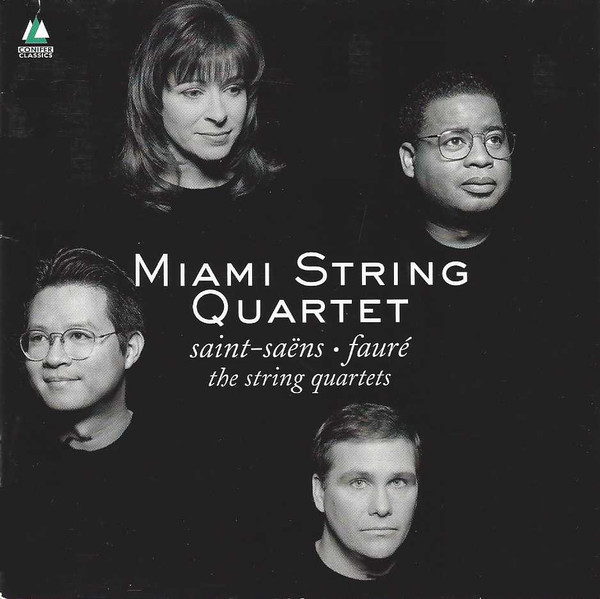
The Miami Quartet's recording on the Conifer label is notable for how fleet they play this music, most strongly heard in the Second String Quartet from Saint-Saëns, where in some cases, other recordings come in two minutes slower per movement (!). Indeed, I never sense Miami ever really wants to unnecessarily dwell in this music, where I could imagine some loving rubato adding to the music.
The Conifer engineering is a bit bright, which I initially took as a rather metallic sound from the quartet. Odd since the players are captured in a performing space, not a recording studio. Yet, never am I unhappy with these performances from the Miami Quartet, who tackle this music with great energy. While many recordings host the two quartets from Saint-Saëns all by themselves, the addition of the Fauré String Quartet is a big draw here.

Works
Camille Saint-Saëns
String Quartet 1 in E Minor, op. 112 (29.32)
String Quartet 2 in G Major, op. 153 (23.16)
Gabriel Fauré
String Quartet in E minor, op. 121 (21.57)
Performers
Miami Quartet
Ivan Chang, violin
Cathy Meng Robinson, violin
Chauncey Patterson, viola
Keith Robinson, cello
Label: Conifer
Year: 1997
Total Timing: 75.18
Really, the only thing holding this recording back from hitting the highest of marks is its brightly engineered sound.
Some may also take issue with Miami's bushy-tailed tempos, where a lusher Romantic sound could easily be imagined, especially in the music of Saint-Saëns.

Find more Saint-Saëns recordings HERE!

Comments
Post a Comment