Saint-Saëns: Choral Music

In any case, I had attempted to purchase this 2000s CD a number of times off of Amazon, not from a marketplace seller either. The first time I ordered, I received the completely wrong recording, which I promptly returned. When I reordered, I received the exact same wrong CD, although for the life of me, I don't remember what that incorrect recording was. It definitely wasn't Saint-Saëns, certainly not choral music, and I am not even sure if it was even in the correct genre. In any case, I held on to that wrong recording when ordering again, but I still received that same incorrect album. Suffice to say, I gave up and returned them all.
Fast forward to today. I knew I would be going through much of the Camille Saint-Saëns' catalogue soon, so I thought I would attempt again, although it had been some 20 years. Eureka! Success had found its way to my doorstep. Why did I try so hard to acquire this recording? First, there are a scant few albums completely dedicated to the a cappella choral music of Saint-Saëns. One might be able to find the odd single piece from the composer performed by the likes of The King's Singers or Amarcord, but I like to listen to a larger conspectus from a single composer as opposed to having Saint-Saëns mixed in with a multitude of other French composers.
This recording on ATMA Classique presents not just nine a cappella choral works from Saint-Saëns, but ones specifically written for male choir. Luckily, only one piece is shared with the performance from Diego Fasolis on Chandos, which primarily featured mixed-choir selections.
Nine choir pieces might seem a slim program for a CD, but each of these choral numbers time between five to nine minutes each, a substantial timing for a single a cappella choral work. Indeed, Saint-Saëns changes up the key signatures, time signatures, and modes within each of these pieces, making each one rather varied, and I am sure, harrowing for groups of singers.
The music generally sounds burly, no surprise as they are all set for male singers. Yet, Saint-Saëns varies each number with wit, texture, and mood pretty well. The Song of Autumn is probably the most heartfelt of the program, although Saint-Saëns never holds one mood for long. I enjoy the dance nature of the Sérénade, Saltarelle, and The Soldiers of Gédéon, with many la's and other non-lexical syllables to vary the accompaniment figures amongst the voices. Others mix homophony with highly polyphonic sections, such as portions of the opening Aviateurs.
Truthfully, in these choral pieces, the music sounds strongly French, not a quality I often ally to Saint-Saëns, who was more stodgily Romantic than Gallically Nationalistic. I hear a foretaste of Ravel's Chansons, and in the last two pieces, such as Le Matin, some surprise harmonies bringing to mind Poulenc to some degree. The tradition of partsong writing exists across Gallic and Teutonic composers alike, thus there are similarities to Schumann and Brahms as well as French sources. It is also nice to have intelligently programmed pieces alluding to both the seasons of the year, in this case Autumn, Winter, and Spring, and modes of employment, here Aviators, Miners (Minors?), Soldiers, and Sailors, whether planned or not.
I am unfamiliar with the Québec-based chorus Les Chantres Musiciens and their director Dr. Gilbert Patenaude, but I enjoy their sound very much. They are not quite as solidly hearty as the Helsinki University Choir I heard in Sibelius recently. Instead, the tenors here are flutier sounding, mixing their tone in their highest registers, a unique, lovely vocalization which sounds determinedly French, or perhaps French-Canadian. Frédéric Antoun, the tenor soloist in two pieces, adds to the hautbois timbre of the tenors, beautifully portrayed here.
The ATMA sonics captures the chorus closely, not giving into the acoustic of the St. Augustine of Miramar location beyond a mild ambiance. The physical media lists all of the singers by name, 27 performing here if the personnel roster is correct, with 12 tenors and 15 basses. One of the songs requires a double chorus as well, handled adeptly here by this group and its director.
If anyone has an interest in the music of Saint-Saëns or has a love of choral music, this is an outstanding recording. While the song texts are provided in the booklet, English translations are not given, for those interested in such things.
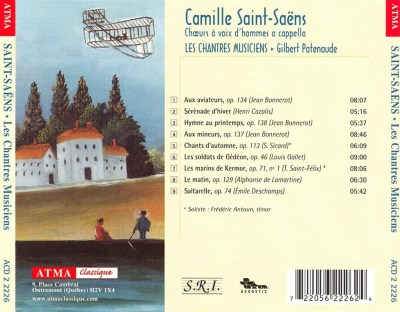
Works
Aux Aviateurs, op. 134 (8.07)
Serenade d'Hiver, op. 25 (5.16)
Hymne au Printemps, op. 138 (5.37)
Aux Mineurs, op. 137 (8.46)
Chants d'Automne, op. 113 (6.09)
Les Soldats de Gédéon, op. 46 (9.00)
Les Marins de Kermor, op. 71 no. 1 (8.06)
Le Matins, op. 129 (6.30)
Saltarelle, op. 74 (5.42)
Soloists
Frédéric Antoun, tenor
Ensembles
Les Chantres Musiciens
Gilbert Patenaude, conductor
Label: ATMA Classique
Year: 2000
Total Timing: 63.13
This recording was just what the doctor ordered. Excellent a cappella singing in literature off-the-beaten path on record, all from a major French composer.

Find more Saint-Saëns recordings HERE!
Comments
Post a Comment