Beethoven: Symphony 7 & 8

Preface
Despite the presence of the famous Allegretto from Symphony no. 7, the two symphonies on this volume are unabashedly joyful affairs. Hardly anything could keep these two works from buoying the spirits of even the hardest of souls.
As I don't visit these symphonies all that often, I look forward to breaking them down further.
Those looking for my generalized thoughts alone should skip to the bottom to read my final thoughts. Otherwise, I will do a movement-by-movement breakdown of each symphony for those who wish to listen along. I will provide a video of these same performers I am listening to in order to make it easier to follow along with my thoughts. That YouTube playlist can be found at the very bottom of this blog post.
Movement 1
Key: A Major
Meter: Cut time & 6/8
Tempo: Poco sostenuto & Vivace
BPM Chailly:
 = 72 & . = 106
The music is rather genial in this 'sustained' introduction, with scales being passed around for a good chunk of time. The bass line moves chromatically, ensuring the listener gets to hear far-flung keys too.
There are hints of a melody in this introduction as well, barely audible in the violins, but more formally presented by the flute (at about 2:15-2:30). Whether such a melodic idea is a red herring from Beethoven or will be revisited should become apparent later.
I would have to go back and look at my entries of Beethoven's previous symphonies, but it seems unusual for a compound meter to open the first movement proper, here marked Vivace. This choice allows for a rollicking good time, yet it seems a time signature more apt for a final movement.
The first melodic area in the Vivace proper is a superb motive. It is tuneful, yet adventurous in the best way. The first statement is made rather gently with flutes in the driver's seat, and even here the listener can tell that this melody will develop into a swashbuckler of a motivic idea. For me, it is the second half of the melody I enjoy the most, the one where it simply rises and falls. Well, it only takes Beethoven until the immediately following restatement to fully realize this melody for full orchestra, and it is a mighty galop of a musical idea, secured by a solid pedal note.
Am I crazy, or is this a mono-thematic exposition? To my ears, and in no way am I an expert music theorist, nor am I checking periodicals, reference books, or websites for a musical analysis, but what follows pretty much holds onto the dotted galloping rhythms and takes it this way and that until the exposition repeat and development. Sure, there are contrasting sections, but anything which could be considered a second motivic area doesn't sound strong enough on its own, instead continuing based on what came before. The development may have some clues...
Well, the development certainly latches onto the galloping dotted rhythms even stronger. Perhaps a monothematic first movement allows Beethoven to further blur the line between development, recapitulation, and coda. The recapitulation is certainly anything but a mere restatement, preferring to array his melody in yet more guises, elongations, and variations. It is clear when Beethoven is ramping up to secure A Major for the conclusion of the movement, yet the move to A-flat Major is perhaps the most curious thing I have encountered from him thus far.
A great opening movement!
Movement 2
Key: A minor & A Major
Meter: 2/4
Tempo: Allegretto
BPM Chailly:
= 76Of lesser known Beethoven symphonies, this Allegretto movement is probably the most famous. There was a YouTube video a while back which put together clips of movies which have used the music from the first part of this movement, and indeed it can have a cinematic quality.
Beethoven almost treats this first section as a variation of sorts, moving the melody around the orchestra, changing the colors with each iterations. From my perspective though, this is Beethoven's slinkiest musical idea, especially as it slithers around chromatically. And it is not just the melody either. There is an equally important countermelody, plus the obsessive quality of the repeated accompanying parts, both rhythmically and pitch-wise.
Of course, those who hear this opening melody in pop culture never get to hear what follows. A lovely, woodsy section follows in the parallel Major, a portion led by woodwinds. When the minor returns, it never quite comes back the same way as it did in the opening, an aspect to this movement which lends my mind towards variation attributes.
Beethoven does allow for a small string-laden fugal portion, an unexpected texture for sure. While the major-keyed segment comes back again, Beethoven seems more interested in keeping scraps of the main tune in the mind of the listener clear through to the end.
Movement 3
Key: F Major & D Major
Meter: 3/4
Tempo: Presto & Assai meno presto
BPM Chailly: 𝅗𝅥. = 134 & 𝅗𝅥. = 82
In another shocking move, the third movement does not appear in the key of the symphony, as is usually the case. Instead, a chromatic mediant of F Major is used. Odd too, since somehow, Beethoven ends the very first section of the Scherzo in A Major. I suppose this choice is due to the prevalence of A as the key center of the last two movements.
I love the overly-rambunctious, heavy handed opening, followed by the lightest skitterings of winds and strings. This is a quality of third movements I have come to greatly enjoy from the composer in general. The 'B' section of the Scherzo is really long, but features the wonderful interplay of strings and winds we have come to expect, including a lovely piping from the oboe.
The Trio is begun in a sleepy, woodsy vein, with the violins providing an ever-present halo above the winds. Surprisingly, Beethoven has the whole ensemble join in triumphantly before moving on again, another memorable musical moment. That sleepy horn transition back to the Scherzo, while another appearance of the Trio follows once more, making for a Double Trio situation.
Of course, the main Scherzo ends the whole shebang, yet in a moment of levity, Beethoven briefly brings back the Trio theme, only to make an upbeat punctuation mark immediately after the short reference. What cunning!
Movement 4
Key: A Major & C Major
Meter: 2/4
Tempo: Allegro con brio
BPM Chailly:
= 150No matter who the conductor is, I have had issue with this final movement. It is just too daggum repetitive for my tastes. Over and over, and over again, the rare moment in Beethoven where my attention tends to wander.
The galloping dotted rhythms come back from the first movement, although used in a different way of course. Beethoven tends to emphasize the offbeats with his main reel, an aspect I enjoy.
Really, there are little touches throughout which I do like very much, however, they tend to be too short to take notice. Take the horns which are allowed to punch out in a short portion, although I think the Gewandhaus could have been even more rustic in this respect.
Truthfully, it is only this final movement which holds Symphony no. 7 back from being an unadulterated masterpiece for me. I truly delight in the joyful spirit of the music throughout the work, and the mark of a great composer is slathered all over the symphony.
I remained woefully silent regarding Riccardo Chailly and the Gewandhaus Orchestra in this breakdown. Suffice to say, Chailly is on his best behavior here, providing a reading which is pretty much on the straight and narrow. Perhaps the Allegretto is a little too impulsive in tempo, but not by an egregious amount. The Gewandhaus sound beautiful throughout, a touchstone of this series, I think.

Symphony 8 in F Major, op. 93
Movement 1
Key: F Major
Meter: 3/4
Tempo: Allegro vivace e con brio
BPM Chailly:
 = 178Symphony no. 8 is generally regarded as a throwback work to Classical Era norms, although there are plenty of Beethoven-ian hallmarks to savor. Plus, this work is a simply jolly good time.
The structure here is more easily identifiable too. While the main theme is concise and well balanced, I actually enjoy the rather heroic transitional material. This latter part starts with an intervallic leap up of a third, followed by a second statement at a fourth, and a final one of a sixth. This leaping around eventually reminds me of a donkey sound Mendelssohn will cleave to in his Midsummer Night's Dream Overture.
The second motivic area is also rather enjoyable, with a rising scale of four notes, where each repetition restarts back on the beginning note, only to take a larger intervallic leap for the following short scalular idea. The best part, though, is the tail of this motivic idea, which is rather chromatic and falling in contrast.
Towards the end of the exposition, some chugging octaves are continued into the development, another musical attribute I enjoy in this movement. These leaping intervals scare up quite a bit of interest throughout, sort of driving some of this music along outside of what I described above.
Again, the point of development to recapitulation is blurred. While I knew I was in the recapitulation area, the music was startlingly developmental. When we arrived at the second motivic reprise, my ears found more steady ground. Beethoven injects a fair bit more ritardandos, fermatas, and silences into a lengthy Coda, and the sforzandos and hemiolas I expected from Beethoven in the exposition found more life in the recapitulation and coda.
Movement 2
Key: B-flat Major
Meter: 2/4
Tempo: Allegretto scherzando
BPM Chailly:
= 92What a curious change. While Beethoven chose a quicker tempo in Symphony no. 7 for his second movement, it at least had a significant change of mood, more towards the morose, serious, and pastoral. Here, a lighter, witty quality besets the second movement, one usually reserved by the composer for the third movement, even using the term scherzando.
Upon hearing this movement, one could almost imagine a comic opera from the likes of Rossini here. Beethoven uses staccatos and the shortest of note lengths to portray a frothy atmosphere, often bouncing back and forth between strings and winds at great length.
The only bit of contrasts are some speedy, Vivaldi-like tremolos put on a single note. But these stormy pop-ups do not disrupt anything as far as mood is concerned, for the composer is in the bounciest of spirits. Short too, for the movement is over in hardly anytime at all, a rarity from the usually long-winded Beethoven.
Movement 3
Key: F Major
Meter: 3/4 & Trio
Tempo: Tempo di Minuetto
BPM Chailly:
= 130 & = 116Well, well, well... an honest-to-goodness Minuet. I suppose it makes sense that Beethoven would not put a Scherzo here, as the previous movement was so lighthearted.
And Chailly does not unduly rush this Minuet either, making the music a little heavier going in contrast to the music which came immediately before. Beethoven inserts little offbeat sforzandos, but shifts them to on-beat accents, so there is still the composer's musical personality here; just slightly muted. The 'B' section of the Minuet affords some love to the bassoon as well.
The Trio shifts the spotlight to the horns and clarinet, and later on the bassoon joins in on the woodsy fun. This movement is akin to having Robin Williams in a serious dramatic role. You know the actor is a master of high-energy comedy, yet playing it straight or down-right creepy works just as well. So too here with Beethoven, who doesn't always need to plunge his listeners into a dark psychological miasma.
Movement 4
Key: F Major & F-sharp minor
Meter: Cut time
Tempo: Allegro vivace
BPM Chailly: 𝅗𝅥 =
Chailly drives this Classical Era jaunt forward, which the Gewandhaus handles in stride. This is certainly a heroic first theme at this driving pace, where the bounding pedal notes from the bassoons and basses draw some concern from the listener.
Beethoven maintains another light, buoyant freshness not typical of the composer, yet careens through A-flat Major, D-flat Major, and F-sharp minor as if it were the most natural thing to do. It is the more lyrical second theme which receives these harmonic twists, where only the latter minor key back to F Major sounds nearly a leap too far.
Now at Symphony no. 8, it would be interesting to do a comparison with the early major-keyed symphonies, especially as Beethoven is honoring Haydn and Mozart in this work. Would op. 93 sound progressive or conservative compared to Symphony no. 1, 2, or 4? A step forward or a step back as a composition? Just a curiosity from my mind.
Overtures
The Overture from Egmont is a fun ride at any listening session, but hearing the Gewandhaus Orchestra dig into those opening chords is a distinct pleasure for this listener. I am less familiar with the Ruins of Athens Overture, but it is given plenty of delights here.
Final Thoughts
Perhaps unfairly, Beethoven is associated with music which eternally dwells in turmoil. Symphony no. 7 & 8 certainly show what a versatile composer he truly was, penning some of his most joyful music within a rather late period of composition.
I could certainly understand if someone considered Symphony no. 8 to be too lightweight, for the music doesn't move where the listener expects. Perhaps that is the genius here.
As mentioned here and there, Chailly is at his best behavior in this music, giving fairly 'standard' readings of these two symphonies, although the later work can be much more impulsive in approach from this crew. Does this mean the Italian conductor has less to say in this music? I am not walking away from these recorded performances disappointed, so I don't think such a statement would be the correct correlation (or is it causation?). In fact, these might be the finest of the set thus far.
Work Series
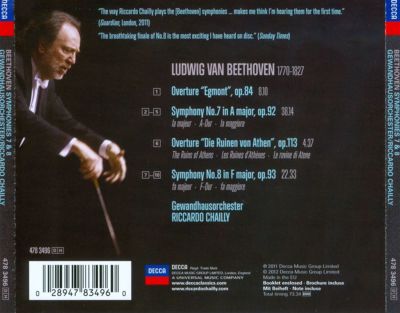
Vol. 4 from Beethoven Symphonies on Decca
Works
Symphony 7 in A Major, op. 92 (38.13)
Symphony 8 in F Major, op. 93 (22.25)
Egmont, op. 84: Overture (8.10)
Ruins of Athens, op. 113: Overture (4.37)
Performers
Gewandhaus Orchestra
Riccardo Chailly, conductor
Label: Decca
Year: 2011
Total Timing: 73.31
Comments
Post a Comment