Saint-Saëns: Orchestral Suites

There are many aspects I enjoyed from this recording of Saint-Saëns' orchestral suites, but a warning; I feel like I am going to be unduly harsh with this recording.
I really enjoy the fact Jun Märkl has programmed three concert suites together. The Suite Algérienne will probably be the most familiar, particularly the final Marche Militaire Française, a lollipop curtain closer if ever there was one.
In this suite, Saint-Saëns pays tribute to his favorite vacation spot, Algiers, also the location of the composer's final breaths. There are quite a few musical exoticisms across the four movements, including a fair bit more percussion than the French composer usually utilized. I feel Märkl is at his most springy here too, although at times, the last movement seems nearly too fast for this ensemble.
There are precious few recordings of the Suite in D Major, and if you can find it, the work usually comes in tow with starrier concertante pieces. The composition is an honest-to-goodness dance suite in the most classical sense of the term, although perhaps Baroque would be the more apt label.
Märkl and the Basque National Orchestra play this with the lightest of touches. This works for the throwback dances, especially the Prelude and Sarabande, which sound as if they are intrinsically influenced from the past. But once we get into the heavier Gavotte, and even moreso the Romance, I wish the players would slather some Romanticism on the music. After all, this Suite is a meeting of musical eras in the 19th Century.
This aspect unfortunately continues into the Suite in D minor for cello and orchestra. Not even in the exquisite Romance does Spanish cellist Guillermo Pastrana dare throw himself into the score, rather preferring to skate across the music. With the Basque ensemble in the accompaniment role, this means the gentleness I detected earlier is par for the course here.
Some will really like this approach to Saint-Saëns' suites, but it just rubbed me the wrong way for some reason. I wanted more variety and I desired to hear the Romantic side add some emotional touch to the proceedings as well. Having recently heard British cellist Steven Isserlis in this same Cello Suite, who comes in some five minutes quicker than Märkl and Pastrana, I am more firmly provided what I think my ears want out of this music on their recording.
On the other hand, I was delightfully surprised by the playing of the Basque National Orchestra, an ensemble I don't believe I have heard before. While they aren't the tightest group, and their hall was recorded a little dryly by Naxos but boasting a remarkably solid bass line, I was never distracted by any particular aspect from their performance.
Plus, this music deserves hearing. Listening to the Prelude of the Suite in D Major, try not to be moved by its music. The musical devices the composer employs are rather simple, yet Saint-Saëns makes pure musical magic out of them. Who isn't enraptured by the winds duetting with the cello in the Serenade movement? Similar descriptions could be given to so many portions of these suites.
EDIT: I completely forgot the final Serenade in E-flat Major at the end of the program. This is a rather lovely work I was heretofore unfamiliar with. Like some other short, single-movement pieces from Saint-Saëns, the Serenade makes for wonderful listening, mixing his talent for spinning a melody amidst endlessly colorful orchestrations.
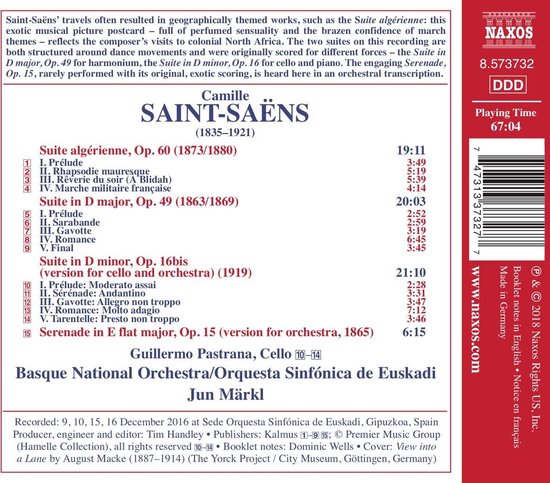
Works
Suite Algérienne, op. 60 (19.11)
Suite in D Major, op. 49 (20.03)
Suite in D minor, op. 16bis (21.10)
Serenade in E-flat Major, op. 15 (6.15)
Soloist
Guillermo Pastrana, cello (op. 16)
Ensembles
Basque National Orchestra
Jun Märkl, conductor
Label: Naxos
Year: 2018
Total Timing: 67.04

I think I have come around on this recording a little bit, if nothing else than from talking it through and many relistens.
The D-keyed suites are made of lighter stuff than the more exotic Suite Algérienne, a work I am more familiar with. I do wish some effort was given towards Saint-Saëns' Romanticisms, but this isn't my show after all.
Either way, the Basque players do their country proud.
Find more Saint-Saëns recordings HERE!
Comments
Post a Comment