Malcom Arnold: A Box-Set Comparison

In 2006, the year British composer Sir Malcolm Arnold died, Decca released three separate, four-CD slim box sets featuring recordings of the composer's music as previously released on Conifer, Koch, and Decca-sphere labels such as Argo.
A decade later in 2016, Sony released The Complete Conifer Recordings of Malcolm Arnold. This Sony set came with 11CDs which widely copies many of the tracks from the Decca set with a few small differences. One of the biggest being, the Sony set came in just one box.
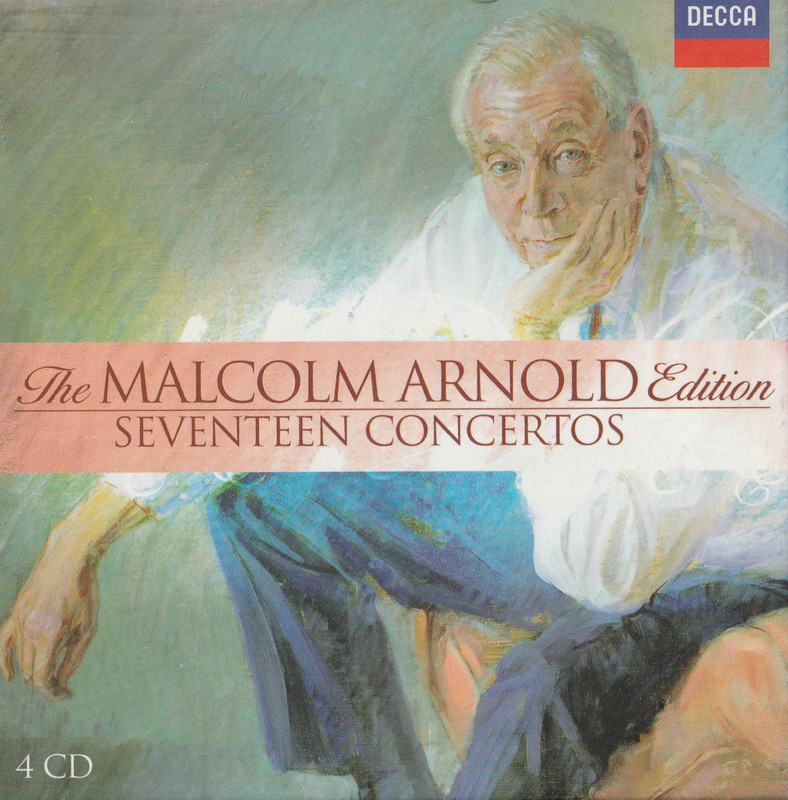
I just reviewed the Decca Malcolm Arnold Edition sets, which you can find on the Arnold page (BLOG) which comes in three volumes - Vol. 1 covers Eleven Symphonies, including the Symphony for Strings and Symphony for Brass; Vol. 2 provides Seventeen Concertos, while Vol. 3 contains 2CDs of miscellany orchestral works, arrangements for brass band, and solo piano music.
I hold on to the older Decca sets mainly because it has more music. Brass Quintet no. 1 and the Symphony for Brass from the Philip Jones Brass Ensemble in the 70s on Argo are out on the Sony set. The Harmonica Concerto, Guitar Concerto, and Recorder Concerto are also not in the Sony set, since that is what Decca covered. That also means the historical recording of Sir Adrian Boult leading Arnold's English Dances in 1954 and Eduard Beinum leading Beckus the Dandipratt in 1947, both with the London Philharmonic Orchestra in older stereo, are not included as well. Plus, the entire CD with the composer's solo piano music from Koch International is not represented either.
While I can take or leave the piano music, although I am better for having heard it, I would sorely miss the piquant concerto settings fro harmonica, guitar, and recorder. Actually, the two brass works are well worth hearing too, played excellently by the Philip Jones Brass Ensemble.
Yet, if you want the main symphonies, and the most 'serious' of concertos from Malcolm Arnold, the Sony set should suffice. While Decca presents the symphonies in number order, and the concertos are grouped on CD by instrument type, Sony retains the original CD pairings, mixing symphonies with overtures and concertos as they were originally released. I could see positives for both presentations.
The Decca liner notes are good, but nothing to blow anyone away. With all of the works, barely a breath is spent on each one. I would hardly say I really got to know any background of any one piece through reading. There is a nice essay on Arnold and these recordings. I am unsure what comes with the Sony box, but knowing other series from Sony, it won't be blowing anyone's minds either.
In the marketplace, the Decca sets are both really hard to find or are listed for exorbitant prices. I am not sure what the Sony set is going for nowadays, but once upon a time you could find it for a cool $20, although as sets tend to go, prices eventually become the product of ridiculous gouging.
So, what am I trying to say? I still love the original Decca sets. Quite frankly, you could probably go out and find the original Conifer recordings on the used Amazon or E-bay market; certainly those originals are bound to have better liner notes. This approach might even be cheaper in the long run depending how much these sets are going for now. But, Sir Malcolm Arnold's music is worth it I think, and the string of performances featured on the sets are very good still today.

Comments
Post a Comment